



The SQE2 oral skills stations carry a pass rate of approximately 80% as of January 2026, yet many candidates still struggle because they misunderstand what assessors are actually looking for. Unlike written exams where answers are either right or wrong, advocacy and client interviewing are marked against competency frameworks that reward technique, structure, and professional conduct as much as legal knowledge.
Understanding how these sqe2 oral skills are assessed can transform your preparation from guesswork into targeted practice. This guide breaks down the marking criteria, reveals what separates competent from outstanding performances, and provides practical next steps to help you qualify with confidence.
Key Takeaways
- SQE2 oral assessments use standardised competency frameworks, not subjective impressions, to ensure fair and consistent marking across all candidates
- Advocacy and client interviewing are marked separately against distinct criteria, with communication skills and professional conduct weighted heavily in both
- Assessors score performance on a scale where “competent” is the pass threshold, not “perfect”, you don’t need flawless delivery to succeed
- Common mistakes like talking over clients, ignoring instructions, or failing to structure submissions cost more marks than minor legal errors
- Targeted practice with realistic scenarios and feedback is the most effective way to meet the assessment standards and pass first time
What Makes SQE2 Oral Skills Different From Written Assessments
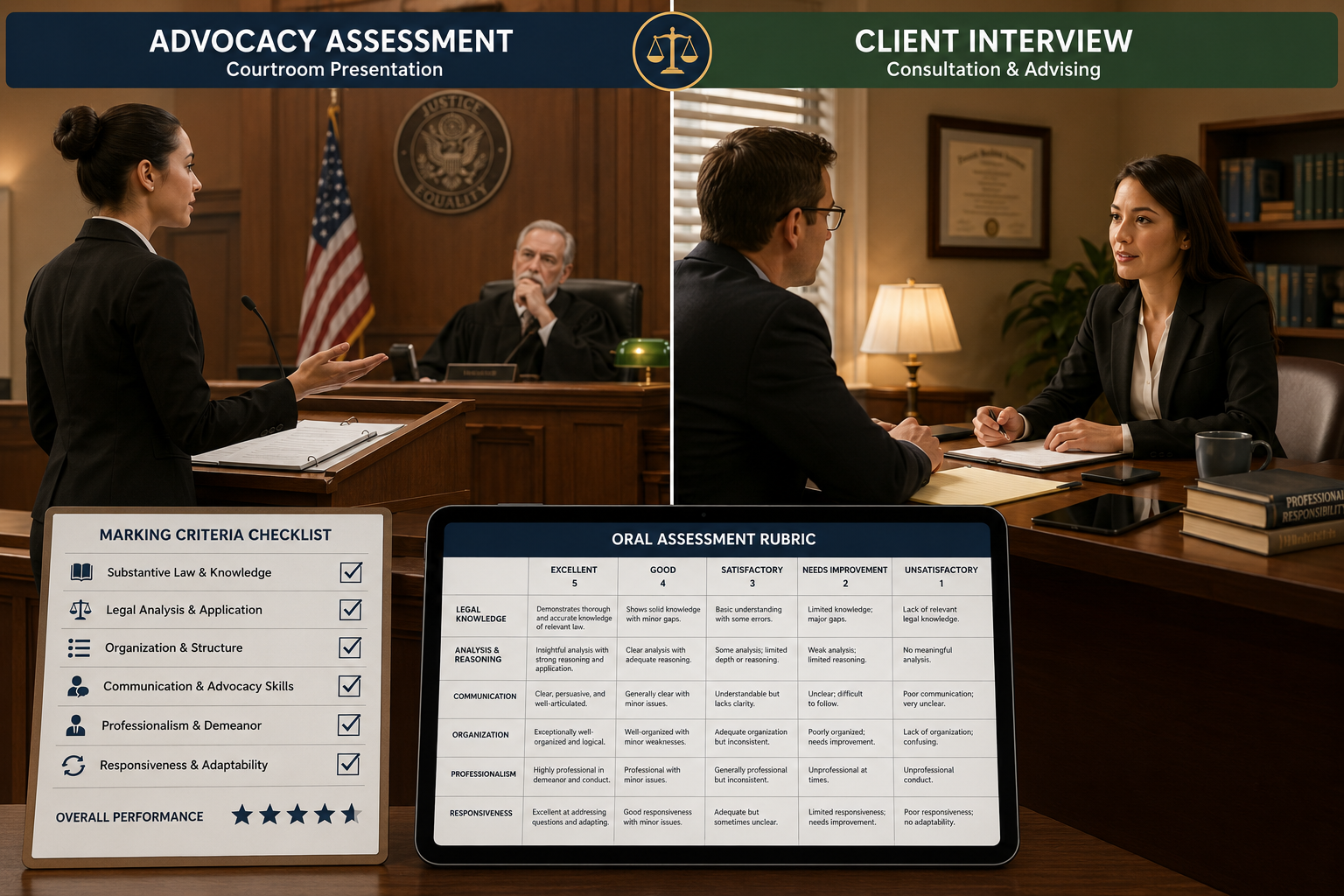
The SQE2 assessment tests practical legal skills through simulated real-world scenarios. Unlike SQE1’s multiple-choice format, SQE2 oral stations require you to interact with actors playing clients, witnesses, or judges. These interactions are observed and marked by trained assessors who evaluate your performance against published competency statements.
The oral skills component includes two distinct assessment types: advocacy and client interviewing. Each uses different scenarios, different marking criteria, and different performance expectations. You might excel at one and struggle with the other, which is why understanding the specific requirements of each station matters.
The Two Core SQE2 Oral Skills Stations
Advocacy assesses your ability to present legal arguments persuasively and professionally. You’ll typically receive case papers, prepare submissions, and deliver them to an actor playing a judge or tribunal member. The scenario might involve a bail application, a case management hearing, or a simple application in civil or criminal proceedings.
Client interviewing evaluates how you gather information, build rapport, and provide preliminary advice. You’ll meet with an actor playing a client who has a legal problem. Your task is to conduct a structured interview, identify relevant facts, and offer initial guidance while demonstrating empathy and professionalism.
Both stations test overlapping skills like communication and professional conduct, but they emphasise different competencies. Advocacy rewards structure, persuasion, and legal analysis. Client interviewing prioritises active listening, relationship-building, and practical problem-solving.
How Assessors Are Trained to Mark Consistently
The Solicitors Regulation Authority (SRA) trains all SQE2 assessors using standardised materials and calibration exercises. Before each assessment window, assessors review the competency statements, watch sample performances, and practice applying the marking criteria to ensure consistency.
This training means your performance is judged against objective standards, not personal preferences. An assessor in London will apply the same criteria as one in Manchester. The framework removes subjectivity by defining what “competent” looks like for each skill area.
Assessors don’t compare you to other candidates or expect perfection. They’re checking whether you meet the threshold standard required of a newly qualified solicitor. This is reassuring: you don’t need to be the best in the room, just competent enough to practice safely and effectively.
The Actual Marking Criteria for Advocacy Stations
Advocacy stations are marked against five core competency areas, each contributing to your overall score. Understanding these criteria helps you focus your preparation on what assessors actually value rather than what you assume matters.
Legal Knowledge and Application
Assessors check whether you understand the relevant law and apply it correctly to the facts. This doesn’t mean memorising statutes word-for-word. It means demonstrating that you know which legal principles apply, how they interact with the scenario, and what outcome you’re seeking.
For example, in a bail application, you should reference the Bail Act 1976, identify relevant exceptions to the right to bail, and explain why your client’s circumstances satisfy (or don’t satisfy) those exceptions. You don’t need to cite section numbers perfectly, but you must show you understand the legal framework.
Common mistakes include:
- Misidentifying the applicable law or procedure
- Failing to connect legal principles to the specific facts
- Ignoring contrary arguments or weaknesses in your position
- Overstating the strength of your case without acknowledging limitations
Structure and Organisation
Your advocacy must follow a logical structure that helps the judge understand your argument. Assessors reward clear signposting, coherent sequencing, and effective time management.
A strong advocacy submission typically includes:
- A brief introduction stating what you’re asking for and why
- A summary of relevant facts
- The legal basis for your application
- Application of law to facts
- A clear conclusion restating your request
Candidates who jump between points, repeat themselves, or run out of time before finishing their submissions lose marks. Practice structuring your arguments within the time limit, usually 10-15 minutes depending on the scenario.
Communication and Persuasion
How you deliver your argument matters as much as what you say. Assessors evaluate your tone, pace, clarity, and ability to engage the judge. Effective advocates speak confidently but respectfully, maintain appropriate eye contact, and adjust their delivery based on the judge’s reactions.
Avoid reading from notes verbatim. While you can refer to your preparation materials, your advocacy should feel like a conversation with the judge, not a scripted performance. Use plain English, avoid unnecessary jargon, and explain complex points clearly.
Persuasion isn’t about being aggressive or theatrical. It’s about presenting your case logically, highlighting strengths, addressing weaknesses honestly, and helping the judge reach the decision you’re seeking.
Professional Conduct and Ethics
Every advocacy station tests your understanding of professional obligations. Assessors watch for:
- Honesty and integrity (not misleading the court)
- Respect for the judge and opposing parties
- Appropriate dress and demeanour
- Compliance with court etiquette
If the scenario includes facts that undermine your case, you must acknowledge them. Trying to hide unfavourable information or misrepresenting the law will result in a fail, regardless of how well you perform in other areas.
Responsiveness and Adaptability
Judges may interrupt with questions or challenge your arguments. How you respond reveals your ability to think on your feet and engage in genuine advocacy rather than delivering a rehearsed speech.
Strong candidates welcome questions, answer them directly, and use them as opportunities to reinforce their position. Weak candidates become flustered, defensive, or ignore the question and continue with their prepared script.
Practice handling interruptions during your preparation. Ask study partners or tutors to play devil’s advocate and challenge your arguments. This builds the adaptability assessors are looking for.
How Client Interview Stations Are Marked
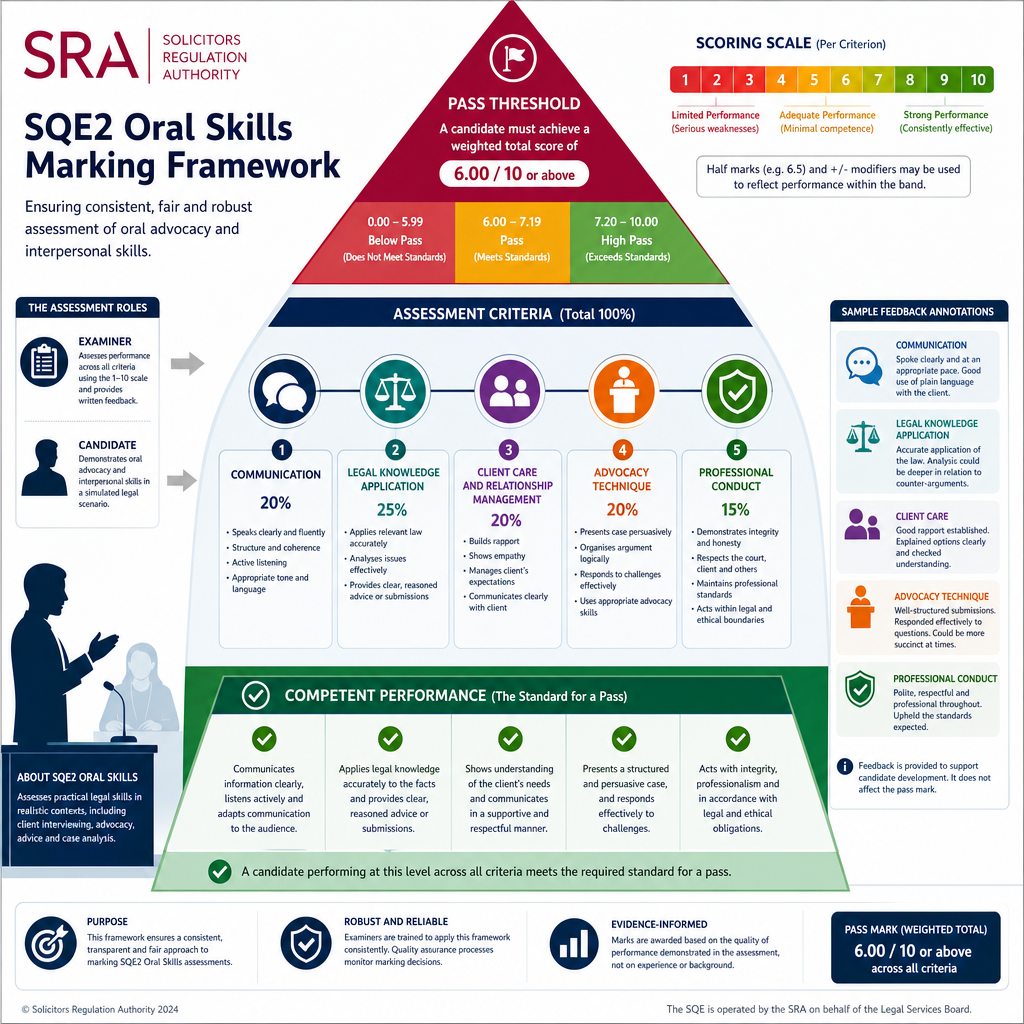
Client interviewing uses a different competency framework because the skills required differ from advocacy. While both test communication and professionalism, interviewing emphasises empathy, information-gathering, and client care.
Building Rapport and Demonstrating Empathy
The first few minutes of your interview set the tone. Assessors evaluate whether you create a comfortable environment, introduce yourself clearly, explain confidentiality, and show genuine interest in the client’s concerns.
Empathy doesn’t mean agreeing with everything the client says or becoming emotionally involved. It means acknowledging their feelings, validating their concerns, and demonstrating that you understand their perspective. Simple phrases like “I can see this has been stressful for you” or “That must have been difficult” go a long way.
Candidates who rush straight into questions without building rapport, interrupt the client repeatedly, or show impatience when the client is upset will lose marks. Take time to establish trust before diving into the legal details.
Effective Questioning Techniques
Your ability to gather relevant information through structured questioning is central to this assessment. Assessors look for a balance between open and closed questions, appropriate follow-up, and the ability to probe without leading the client.
Start with open questions to let the client tell their story: “Can you tell me what happened?” or “What brings you here today?” Then use closed questions to clarify specific details: “What date did this occur?” or “Did you sign the contract?”
Avoid leading questions that suggest the answer you want: “You didn’t agree to that, did you?” Instead, ask neutral questions: “What was your response when they made that request?”
Active listening is crucial. Show you’re paying attention through verbal acknowledgments (“I see,” “Go on”) and non-verbal cues (nodding, maintaining eye contact). Take notes, but don’t let note-taking prevent you from engaging with the client.
Identifying Legal Issues and Providing Preliminary Advice
Once you’ve gathered the facts, you must identify the relevant legal issues and provide appropriate preliminary advice. This doesn’t mean conducting a full legal analysis or giving definitive answers, you’re meeting the client for the first time, and you’ll need to research and consider their matter further.
Assessors want to see that you can:
- Spot the key legal issues arising from the facts
- Explain those issues to the client in plain English
- Outline possible next steps or options
- Manage the client’s expectations realistically
- Identify what additional information or documents you need
For example, if a client describes a potential breach of contract, you might say: “Based on what you’ve told me, it sounds like there may be a breach of contract here. I’ll need to review the contract itself and any correspondence to advise you properly, but generally, you may have options including negotiation, mediation, or potentially legal action. Let’s talk about what you’d like to achieve.”
Avoid giving overly optimistic advice or making promises you can’t keep. If you’re unsure about something, it’s better to say “I’ll need to research that and get back to you” than to guess.
Professional Conduct in Client Interactions
Just as with advocacy, professional conduct is assessed throughout the interview. Key areas include:
- Maintaining appropriate boundaries
- Respecting client confidentiality
- Identifying and managing conflicts of interest
- Recognising when to escalate or refer matters
- Demonstrating cultural sensitivity and inclusivity
If the scenario includes a potential conflict of interest or an ethical issue, you must identify it and explain how you would handle it. For example, if the client asks you to do something improper, you should politely explain why you cannot do so and what the professional rules require.
Time Management and Structure
Client interviews typically last 15-20 minutes. You need to gather sufficient information, identify issues, and provide advice within that timeframe. Assessors mark your ability to manage the interview efficiently without rushing the client or wasting time on irrelevant details.
A well-structured interview might follow this pattern:
- Introduction and rapport-building (2-3 minutes)
- Open questioning to understand the client’s story (5-7 minutes)
- Focused questioning to clarify details (3-5 minutes)
- Preliminary advice and next steps (3-5 minutes)
- Closing and confirming arrangements (1-2 minutes)
Practice timing your interviews so you develop an instinct for pacing. If you’re running short on time, prioritise the most important issues rather than trying to cover everything superficially.
Common Mistakes That Cost Marks in SQE2 Oral Skills
Understanding what not to do is as important as knowing what assessors want to see. These mistakes appear repeatedly in candidate feedback and can turn a passing performance into a fail.
Ignoring or Misreading Instructions
Every oral skills station comes with written instructions explaining the scenario, your role, and what you’re expected to do. Candidates who skim these instructions or misunderstand their task often fail despite demonstrating good skills.
For example, if the advocacy instructions say “make submissions on liability only, not quantum,” but you spend half your time discussing damages, you’ve failed to follow instructions. Similarly, if the client interview brief says “the client is anxious and needs reassurance,” but you adopt a brusque, business-like approach, you’ve missed a key aspect of the scenario.
Read instructions carefully, highlight key requirements, and check them again before you start. If something is unclear, you can usually ask the assessor for clarification before the station begins.
Talking Over the Client or Judge
Interrupting the client during an interview or speaking over the judge during advocacy demonstrates poor communication skills and lack of respect. Assessors mark this harshly because it suggests you won’t listen to clients or respond appropriately to judicial guidance in practice.
If the client is speaking, let them finish before you respond. If the judge asks a question, stop your submission immediately and answer. Don’t try to finish your point first or ignore the interruption.
This requires practice because it feels unnatural to stop mid-sentence. Role-play scenarios where your practice partner deliberately interrupts you, so you learn to pause, listen, and respond appropriately.
Failing to Demonstrate Professional Conduct
Professional conduct isn’t a separate station, it’s assessed throughout every oral skills exercise. Candidates sometimes focus so heavily on legal knowledge or communication that they forget to demonstrate integrity, respect, and ethical awareness.
Examples of conduct failures include:
- Misleading the court about facts or law
- Being rude or dismissive to the client
- Failing to identify obvious conflicts of interest
- Ignoring confidentiality requirements
- Showing bias or making inappropriate assumptions
Even if you perform well in other areas, a serious conduct breach can result in a fail. Always prioritise honesty, respect, and ethical behaviour.
Providing Advice Beyond Your Competence
In client interviews, some candidates feel pressured to answer every question definitively, even when they’re unsure. This leads to incorrect or overly confident advice that assessors mark down.
It’s perfectly acceptable, and often preferable, to say “I’ll need to research that and get back to you” or “That’s outside my area of expertise, so I’d recommend we consult a specialist.” This demonstrates professional awareness of your limitations, which is a competency in itself.
Don’t guess or make up legal principles. If you can’t remember the relevant law, acknowledge it and explain how you would find the answer.
Poor Time Management
Running out of time before completing your advocacy submission or failing to provide any advice during a client interview will cost marks. Assessors can only mark what they observe, so if you don’t finish, you can’t demonstrate all the required competencies.
Practice with a timer until you develop an instinct for pacing. If you’re running short on time, prioritise your strongest points and conclude clearly rather than rushing through everything at double speed.
How to Prepare Effectively for SQE2 Oral Skills
Passing the sqe2 oral skills stations requires targeted practice, not just reading about technique. Here’s how to prepare effectively.
Use Realistic Practice Scenarios
The best preparation involves working through scenarios that mirror the actual assessment format. Many SQE2 preparation providers offer practice materials, but quality varies significantly.
Look for resources that include:
- Detailed scenario papers matching the SQE2 format
- Clear instructions and time limits
- Suggested marking criteria or model answers
- Opportunities for feedback on your performance
Understanding how case management tools help with client files training can also support your practical skills development, as many scenarios involve reviewing documents and organising information.
Record and Review Your Practice Sessions
Video or audio recording your practice advocacy and client interviews allows you to review your performance objectively. You’ll notice verbal tics, unclear explanations, or moments where you lost structure that you wouldn’t catch in the moment.
Watch your recordings and ask:
- Did I follow a clear structure?
- Was my communication clear and professional?
- Did I listen actively and respond appropriately?
- How was my body language and eye contact?
- Did I manage time effectively?
This self-assessment builds awareness and helps you improve faster than practice alone.
Get Feedback From Qualified Practitioners
While peer practice is valuable, feedback from qualified solicitors or experienced tutors provides insights you can’t get elsewhere. They understand what “competent” looks like in practice and can identify subtle issues that affect your performance.
If you’re self-studying, consider booking occasional one-to-one sessions with an SQE2 tutor for feedback on your oral skills. Even a single session can highlight blind spots and accelerate your improvement.
Focus on Competencies, Not Perfection
Remember that assessors are checking whether you meet the competent standard, not whether you’re the best advocate or interviewer they’ve ever seen. This means you can pass despite making minor mistakes, as long as you demonstrate the core competencies consistently.
Don’t aim for a flawless performance. Aim for a competent one that shows you can:
- Apply legal knowledge appropriately
- Communicate clearly and professionally
- Listen and respond to others
- Manage time and structure effectively
- Maintain ethical standards
This mindset reduces anxiety and helps you focus on what matters.
Understand the Pass Mark and Scoring System
The SQE2 pass mark is set using a standard-setting methodology that ensures consistency across assessment windows. Unlike percentage-based exams, the pass mark reflects the minimum competency level required, not a fixed score.
This means the difficulty of scenarios is calibrated, and assessors are trained to apply consistent standards. Your focus should be on demonstrating competency, not achieving a particular numerical score.
For context, approximately 80% of candidates pass SQE2 overall, though pass rates vary by station. Oral skills stations typically have higher pass rates than written stations, suggesting that with proper preparation, most candidates can meet the required standard.
Frequently Asked Questions
How long do I have to prepare for each oral skills station?
You typically receive preparation materials 15-20 minutes before each station begins. This includes the scenario, instructions, and any documents you need to review. Use this time to read carefully, identify key issues, plan your structure, and make notes. The actual station then lasts 10-20 minutes depending on the task.
Can I bring notes into the advocacy or client interview station?
Yes, you can refer to notes you’ve made during preparation time. However, you shouldn’t read from them verbatim. Assessors want to see you engage naturally with the judge or client, not deliver a scripted performance. Use notes as prompts and reminders, not a script.
What happens if I make a legal mistake during the station?
Minor legal errors won’t automatically cause you to fail if you demonstrate the other competencies well. Assessors understand that newly qualified solicitors don’t know everything and that you’d research issues in practice. However, fundamental misunderstandings of basic legal principles or procedures will affect your score. Focus on applying the law you do know correctly rather than trying to cover everything.
Are the actors playing clients or judges trying to trick me?
No. The actors follow standardised scripts designed to test specific competencies. They’re not trying to catch you out or make the task harder than necessary. If a client seems difficult or a judge asks challenging questions, it’s part of the scenario design to test how you handle realistic situations. Stay professional, listen carefully, and respond appropriately.
How many oral skills stations are there in SQE2?
SQE2 includes multiple stations covering different skills. The exact number and combination of oral skills stations (advocacy and client interviewing) can vary between assessment windows, but you’ll typically face at least one of each type. Check the current SQE2 structure for the most up-to-date information.
Can I fail SQE2 even if I pass the oral skills stations?
Yes. SQE2 assesses multiple skills including written tasks like legal research, writing, and drafting. You must demonstrate competence across all assessed skills to pass overall. However, strong performance in oral skills can help balance weaker performance elsewhere, as the assessment is holistic.
Conclusion
The SQE2 oral skills assessment measures your ability to communicate, advocate, and interact with clients at the standard expected of a newly qualified solicitor. Understanding how advocacy and client interviewing are actually marked, through standardised competency frameworks, trained assessors, and objective criteria, transforms your preparation from guesswork into focused practice.
Success doesn’t require perfection. It requires demonstrating competence consistently across the key areas: legal knowledge application, communication, structure, professional conduct, and responsiveness. By avoiding common mistakes, practising with realistic scenarios, and seeking feedback, you can develop the skills assessors are looking for.
Your practical next steps are clear. Review the published competency statements for each oral skills station. Practice with timed scenarios that mirror the assessment format. Record your practice sessions and analyse your performance honestly. Seek feedback from qualified practitioners who understand the standards. And remember: you’re preparing to meet a competent threshold, not to be perfect.
The SQE route to qualification offers a clear pathway for aspiring solicitors who prepare strategically. With targeted practice and a solid understanding of how oral skills are marked, you can approach these stations with confidence and qualify with the skills you need to succeed in practice.