

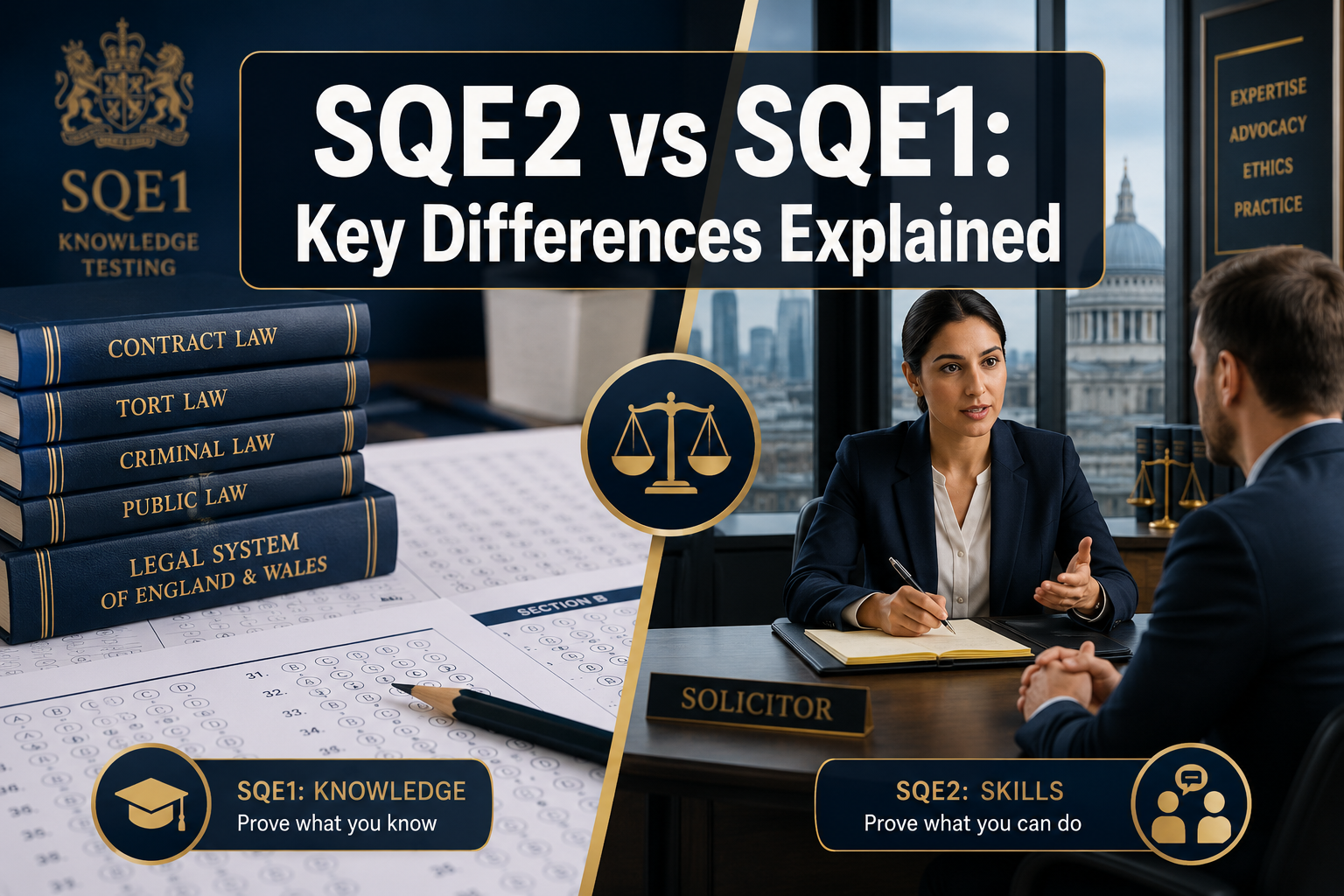

Only around half of all candidates pass SQE1 on their first attempt — yet many of those who do progress to SQE2 feel underprepared for how dramatically the experience changes. The format shifts, the skills tested shift, and the entire preparation mindset needs to shift too. Understanding the SQE2 vs SQE1 key differences before you reach that stage is one of the most practical things you can do for your legal career journey.
Whether you have just passed SQE1, are still studying for it, or are mapping out your full qualification route, this guide gives you straightforward advice on what to expect — and how to prepare with confidence.
Key Takeaways
- 🎯 SQE1 tests legal knowledge through multiple-choice questions; SQE2 tests practical skills through written and oral tasks
- 📋 SQE1 must be passed before SQE2 — the two stages are sequential, not interchangeable
- 💷 SQE2 costs more than SQE1 in SRA assessment fees alone, and preparation costs are typically higher too
- 📊 SQE2 pass rates are generally higher, but the cohort is more self-selecting — candidates have already cleared SQE1
- 🔄 Your entire study approach must change when moving from SQE1 to SQE2 — recognition and recall give way to performance and application
What Are SQE1 and SQE2?
The Solicitors Qualifying Examination (SQE) is the centralised assessment route to qualifying as a solicitor in England and Wales. It replaced the Legal Practice Course (LPC) route for most new entrants and is regulated by the Solicitors Regulation Authority (SRA).
The SQE has two stages:
- SQE1 — a knowledge-based assessment covering the functioning legal knowledge (FLK) that every solicitor needs
- SQE2 — a skills-based assessment testing how candidates apply legal knowledge in realistic practice contexts
Both stages must be passed. Qualifying Work Experience (QWE) of at least two years must also be completed, though it does not have to happen in a fixed order relative to the assessments. For a broader view of the pathway, see our guide on pathways to becoming a solicitor in the UK.
SQE2 vs SQE1 Key Differences: Format and Structure
This is where the contrast is most striking.
SQE1 Format
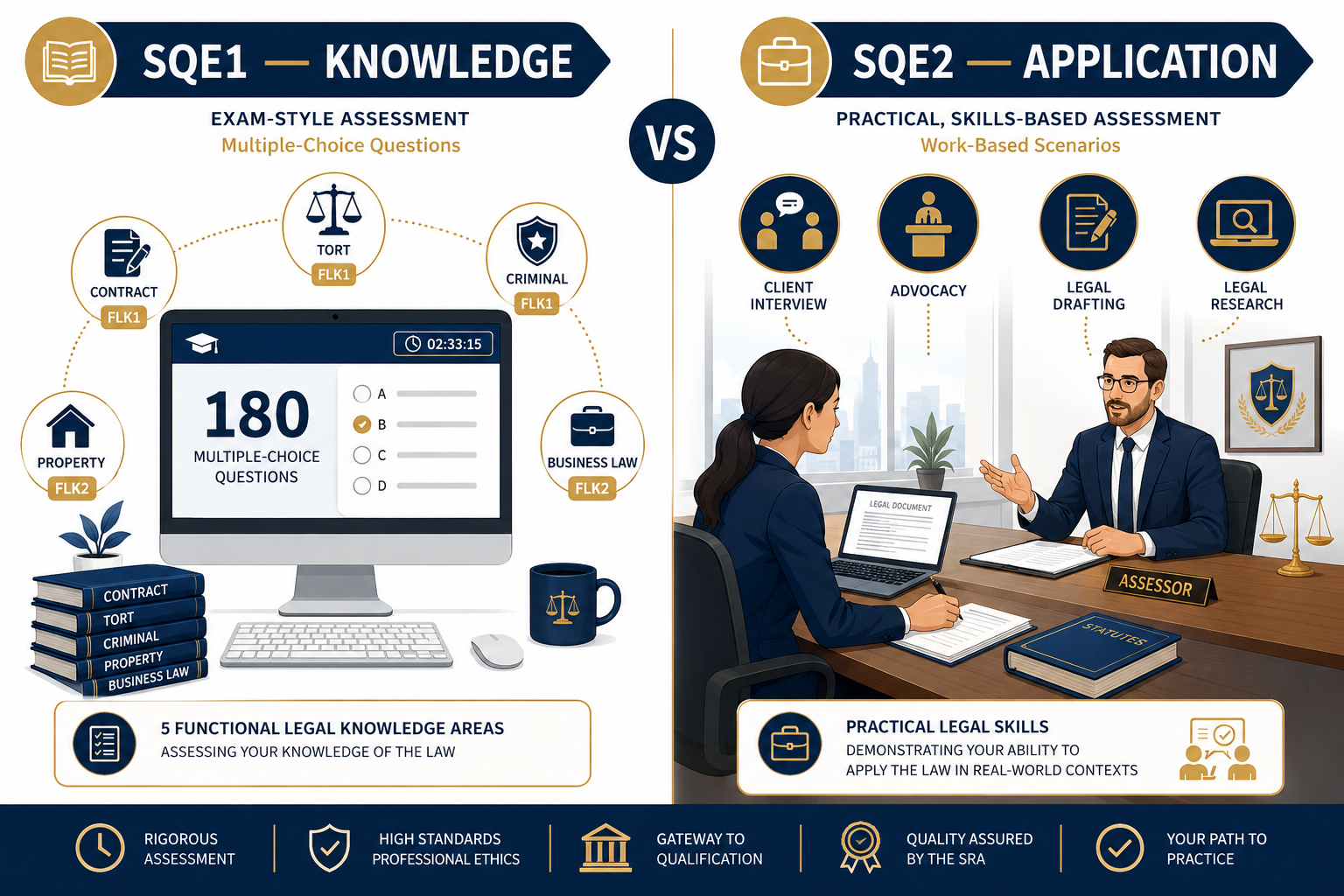
SQE1 consists of two separate papers, each sat on a different day:
- FLK1 — covers Business Law and Practice, Dispute Resolution, Contract, Tort, Legal System of England and Wales, Constitutional and Administrative Law, EU Law (retained), and Legal Services
- FLK2 — covers Property Practice, Wills and Intestacy, Tax, Trusts, Criminal Law and Practice
Each paper contains 180 single best answer multiple-choice questions (MCQs). That is 360 MCQs in total. Questions are computer-based and sat at approved test centres.
If you want to sharpen your MCQ technique, our article on SQE1 MCQ speed techniques for last-minute crammers is a practical starting point.
SQE2 Format
SQE2 is entirely different in structure. It assesses five core legal skills across a range of practice areas:
- Client interviewing and attendance note/legal analysis
- Advocacy and oral presentation
- Case and matter analysis
- Legal research and written advice
- Legal drafting
These are assessed through a combination of written tasks and oral assessments, delivered over multiple days. The practice areas covered include Criminal, Dispute Resolution, Property, Wills and Intestacy/Estate Administration, and Business.
💡 Key point: There are no MCQs in SQE2. Every task requires you to produce or perform something — a draft document, a spoken argument, a written advice note.
What Each Assessment Actually Tests
Understanding the distinction between knowledge and application is central to grasping the SQE2 vs SQE1 key differences.
SQE1: Testing Legal Knowledge
SQE1 is designed to confirm that a candidate has a solid foundation of legal knowledge across the core areas of English and Welsh law. The MCQ format tests whether you can identify the correct legal rule, principle, or outcome in a given scenario.
This requires strong recognition skills — seeing a fact pattern and matching it to the right legal answer. Common traps include near-identical answer options and scenarios that test the boundaries of rules. For example, SQE1 FLK1 topics that trip up 80% of first-timers often involve areas where candidates confuse similar but distinct legal principles.
SQE2: Testing Legal Skills in Practice
SQE2 assumes the legal knowledge is already there. The question it asks is: can you use that knowledge in a real professional context?
A candidate sitting SQE2 might be asked to:
- Interview a client and produce a structured attendance note
- Draft a commercial lease clause or a will
- Prepare written submissions for a hearing
- Research a legal issue and advise a client in writing
The assessors are looking for professional competence — not just correct answers, but appropriate communication, sound judgement, and practical skill. For a closer look at how SQE2 difficulty compares to expectations, see our detailed breakdown of how many people fail SQE2.
Timing, Sequencing, and Exam Windows
The Mandatory Order
SQE1 must be passed before a candidate can sit SQE2. This is a firm SRA requirement, not a recommendation. There is no way to sit SQE2 first or simultaneously.
Exam Windows in 2026
In 2026, SQE1 is offered twice per year — typically in January and in April/May, with results released several weeks after each sitting. SQE2 is also offered twice per year, but the windows are staggered so that candidates who pass SQE1 in one sitting can, in theory, progress to SQE2 in the following window.
This means the fastest possible route through both assessments is roughly six to twelve months if preparation is already well advanced. Most candidates take longer, particularly when balancing study with Qualifying Work Experience.
For guidance on realistic preparation timelines, see how long it takes to prepare for the SQE exam.
Attempts and Limits
Candidates have a maximum of three attempts at each stage. Failing all three attempts at either stage means the SQE route is no longer available. For more on what this means in practice, see our guide on what happens if you fail the SQE three times.
SQE2 vs SQE1 Key Differences: Cost Comparison
Cost is one of the most significant practical differences between the two stages.
SRA Assessment Fees (2026)
| Assessment | SRA Fee per Sitting |
|---|---|
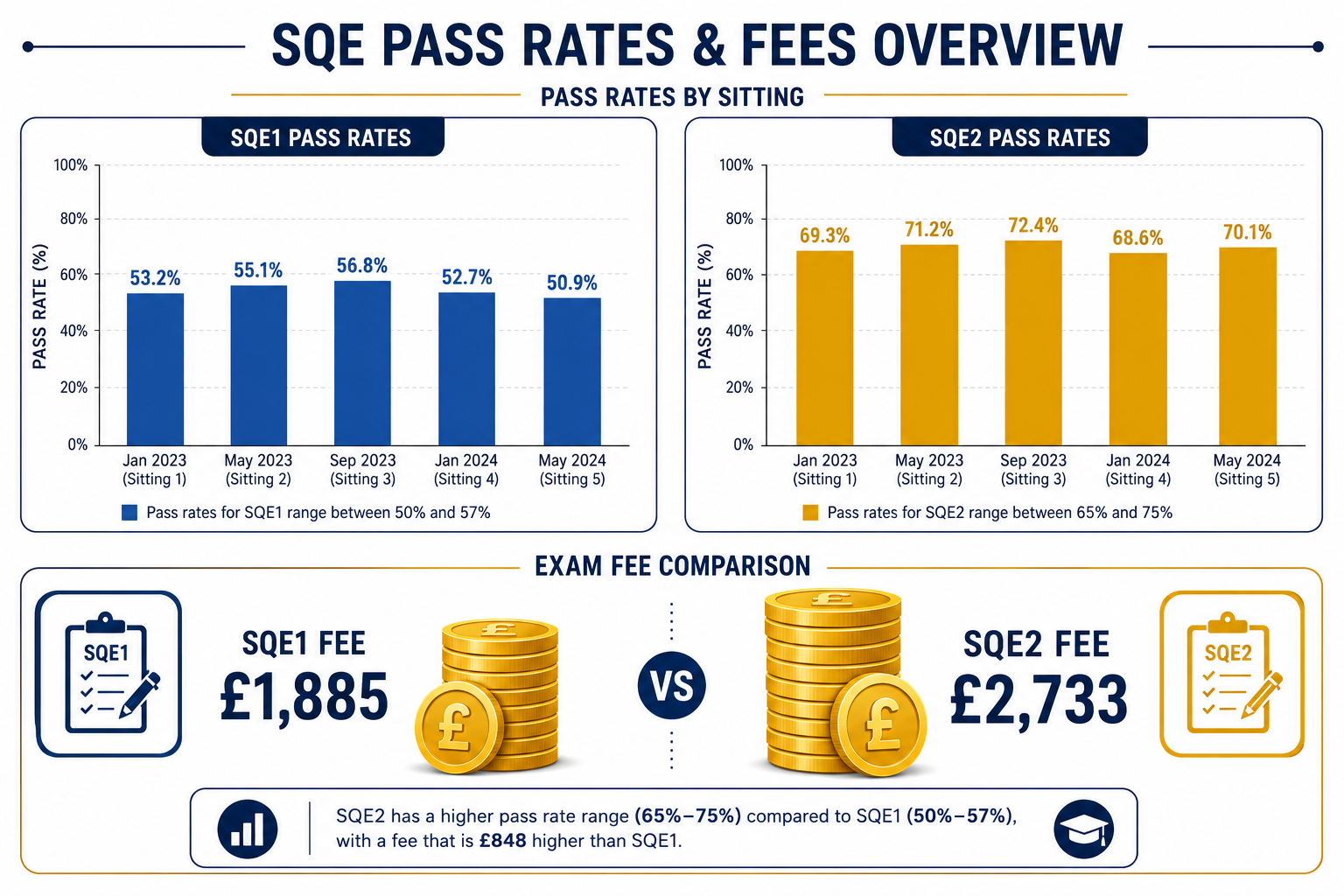
| SQE1 (both FLK papers) | £1,885 |
| SQE2 (full assessment) | £2,733 |
These are the fees charged directly by the SRA to sit each assessment. They do not include preparation course costs, which can add thousands of pounds on top.
Preparation Course Costs
- SQE1 preparation courses typically range from £1,500 to £4,000 depending on the provider and level of support
- SQE2 preparation courses tend to cost £3,000 to £8,000 or more, reflecting the intensive, skills-based nature of the training required
For a full breakdown of total costs involved, see how much does a SQE cost and explore the SQE cost and funding options category for funding routes.
💡 Good to know: Some law firms sponsor candidates through both stages. If you are working towards a training contract or have a firm’s support, check whether they cover SQE2 fees — see do law firms pay for SQE.
Pass Rates: How Difficult Is Each Stage?
Pass rates for both stages are published by the SRA following each assessment window. The picture is nuanced.
SQE1 Pass Rates
SQE1 pass rates have consistently sat in the 50–60% range across sittings since the assessment launched. This means a significant proportion of candidates do not pass on their first attempt. The MCQ format can be deceptively difficult — the questions are carefully constructed to test precision, not just general knowledge.
SQE2 Pass Rates
SQE2 pass rates are generally higher, often in the 65–75% range. However, this figure requires context: by the time candidates sit SQE2, they have already passed SQE1. This creates a more self-selecting cohort — those who struggled significantly with SQE1 may not have reached SQE2 yet.
The overall picture of SQE pass rates, including first-time pass data, is covered in detail at how many people pass SQE first time and what is the fail rate for the SQE exam.
How Your Preparation Approach Must Change
This is perhaps the most underestimated aspect of the transition. Candidates who do well in SQE1 through disciplined MCQ practice sometimes struggle with SQE2 because they continue using the same study methods.
SQE1 Preparation: Recognition and Recall
For SQE1, effective preparation focuses on:
- ✅ Building a broad knowledge base across all FLK domains
- ✅ Practising large volumes of MCQs under timed conditions
- ✅ Identifying weak areas and targeting revision accordingly
- ✅ Learning to eliminate wrong answers quickly and confidently
The goal is to be able to recognise the right answer from a set of options. Depth in one area matters less than breadth across all areas.
SQE2 Preparation: Performance and Application
For SQE2, the preparation model changes entirely:
- ✅ Practising skills tasks in realistic, timed conditions
- ✅ Recording and reviewing mock client interviews
- ✅ Drafting documents and receiving structured feedback
- ✅ Learning the professional standards expected in each practice area
- ✅ Understanding how to communicate legal advice clearly to a non-specialist client
The goal is to perform competently under assessment conditions. You are not choosing between options — you are producing original work that will be assessed against professional benchmarks.
Summary Comparison Table
| Feature | SQE1 | SQE2 |
|---|---|---|
| Format | 360 MCQs across two papers | Written and oral skills tasks |
| What it tests | Legal knowledge (FLK) | Practical skills in legal contexts |
| Number of sittings/year | 2 | 2 |
| SRA fee (2026) | £1,885 | £2,733 |
| Typical prep course cost | £1,500–£4,000 | £3,000–£8,000 |
| Typical pass rate | 50–60% | 65–75% |
| Must pass first? | Yes — prerequisite for SQE2 | No — but SQE1 must be passed first |
| Prep focus | Recognition, recall, MCQ technique | Performance, drafting, oral skills |
| Attempts allowed | 3 | 3 |
| Open book? | No | No |
Interactive Tool: SQE Stage Readiness Checker
Use the tool below to assess whether you are ready to progress from SQE1 to SQE2 preparation.
Are You Ready to Move from SQE1 to SQE2?
Answer 5 quick questions to find out where you stand and what to focus on next.
FAQ
Q: Can I sit SQE2 without passing SQE1? No. The SRA requires SQE1 to be passed before a candidate can register for SQE2. There is no exception to this rule.
Q: Is SQE2 harder than SQE1? They are difficult in different ways. SQE1 is hard because of the breadth of knowledge required and the precision demanded by MCQs. SQE2 is hard because it requires professional-level performance under timed conditions. Pass rates for SQE2 are generally higher, but the cohort is more self-selecting. See is the SQE the hardest exam for a broader perspective.
Q: How long should I allow between passing SQE1 and sitting SQE2? Most candidates allow three to six months of dedicated SQE2 preparation. Some take longer, particularly if they are simultaneously completing QWE. Rushing into SQE2 without sufficient skills practice is a common mistake.
Q: Do I need to complete my QWE before sitting SQE2? No. QWE does not have to be completed before sitting either assessment. However, all requirements — SQE1, SQE2, and two years of QWE — must be met before the SRA will admit you as a solicitor.
Q: Are the SQE2 practice areas the same as SQE1 subject areas? There is overlap, but they are not identical. SQE2 focuses on practice contexts (how law is applied in a professional setting) rather than the abstract FLK domains tested in SQE1. Candidates often find that their SQE1 knowledge needs to be translated into practical application rather than simply recalled.
Q: Can I self-study for SQE2? It is possible, but significantly more challenging than self-studying for SQE1. SQE2 requires skills feedback that is hard to generate alone. See our guide on whether you can study for the SQE by yourself for an honest assessment.
Conclusion
The SQE2 vs SQE1 key differences go far deeper than simply “one comes after the other.” They represent two genuinely distinct challenges — one testing what you know, the other testing what you can do with that knowledge.
SQE1 demands breadth, precision, and strong MCQ technique. SQE2 demands professional performance, clear communication, and the ability to apply legal knowledge in realistic practice scenarios. The preparation approach, the costs, the format, and the mindset all need to change when you make the transition.
Practical Next Steps ✅
- Confirm your SQE1 status — if you have passed, register your result with the SRA and check the next SQE2 window
- Audit your skills — identify which of the five SQE2 skills areas needs the most development
- Plan your budget — factor in the £2,733 SRA fee plus preparation course costs
- Review your QWE — ensure you are on track for the required two years
- Choose a preparation route — structured course, self-study with feedback, or a combination
- Start early — the candidates who perform best in SQE2 are those who begin skills practice well in advance, not the week before
The legal career journey is a clear pathway when you understand each stage. Approach SQE2 with the same structured commitment that got you through SQE1 — and qualify with confidence.