

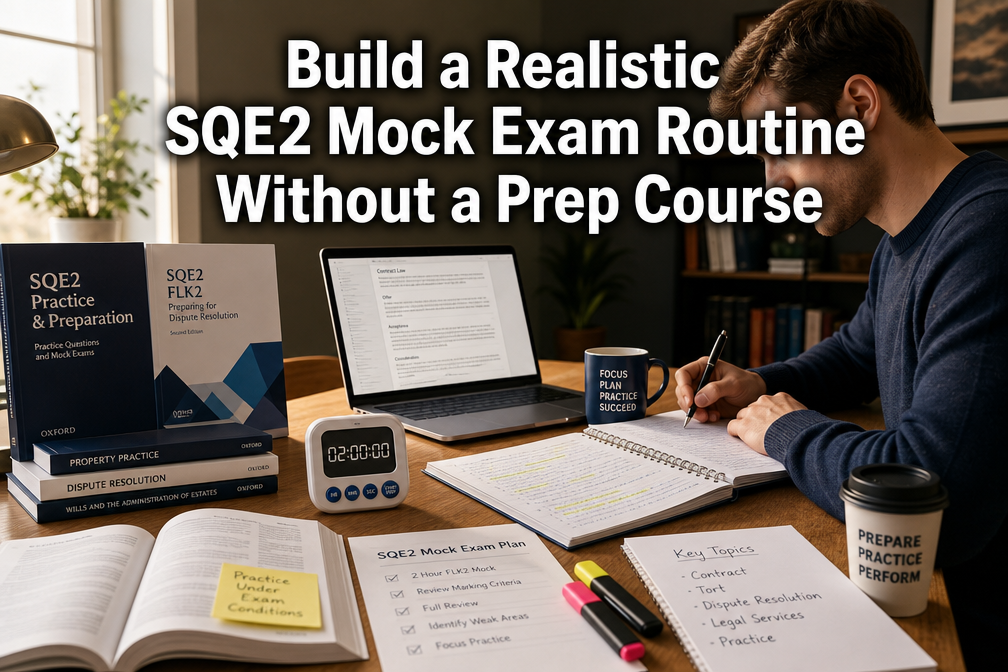

The SRA reports that approximately 80% of candidates pass SQE2 on their first attempt, but that figure masks a crucial truth: those who fail often cite inadequate practice with realistic scenarios as their primary weakness. If you’re preparing for SQE2 without enrolling in a formal prep course, you’re not alone, and you’re not at a disadvantage, provided you build a structured mock exam routine using sra sqe2 sample questions and authentic practice materials.
This guide shows you exactly how to create a realistic, effective SQE2 preparation routine that mirrors the actual assessment format, develops the practical legal skills the SRA tests, and builds exam-day confidence, all without the expense of a traditional prep course.
Key Takeaways
- SQE2 tests five practical skills across 16 legal practice areas through timed, scenario-based assessments that require structured practice
- A realistic mock exam routine should include weekly timed practice sessions, self-assessment using SRA criteria, and progressive skill development
- Official SRA sqe2 sample questions and assessment specifications provide the foundation for authentic independent preparation
- Effective self-study combines regular mock assessments, peer feedback, targeted skill refinement, and consistent review of performance gaps
- Independent candidates can achieve pass rates comparable to course-takers by following a disciplined, evidence-based practice schedule
Understanding What SQE2 Actually Tests
Before building your mock exam routine, you need clarity on what the SRA assesses. SQE2 differs fundamentally from SQE1, it’s not about legal knowledge recall but practical application.
The assessment evaluates five core skills:
- Client interviewing and attendance note writing
- Advocacy (oral)
- Case and matter analysis
- Legal research
- Legal writing
These skills are tested across 16 practice areas including criminal litigation, dispute resolution, property practice, wills and intestacy, and business organisations. Each assessment station presents a realistic legal scenario requiring you to demonstrate competence at the threshold standard expected of a newly qualified solicitor.
The SRA publishes detailed assessment criteria for each skill area. These criteria specify exactly what assessors look for: how you structure client interviews, the clarity of your legal analysis, your ability to identify relevant issues, and how effectively you communicate legal advice.
Understanding these criteria is non-negotiable. Your mock exam routine must train you to meet these specific standards, not generic legal skills.
Why Traditional Study Methods Fail for SQE2
Many candidates approach SQE2 preparation the same way they tackled SQE1, reading textbooks, making notes, watching lectures. This approach fundamentally misunderstands what SQE2 demands.
SQE2 is a performance assessment. You cannot pass by knowing the law; you must demonstrate you can apply it under timed conditions in realistic scenarios. Reading about client interviewing techniques doesn’t prepare you to conduct an actual interview with a nervous client who provides information in a disorganized manner.
The skills tested, advocacy, legal drafting, case analysis, require muscle memory developed through repeated practice. You need to internalize the structure of a good attendance note, the rhythm of an effective client interview, and the analytical framework for case analysis.
This is why sra sqe2 sample questions and timed mock assessments form the core of effective preparation. They force you to perform, not just understand.
Building Your Foundation: Essential Resources
Your mock exam routine requires specific materials. Here’s what you need:
Official SRA Resources:
- SRA Assessment Specification for SQE2 (details all assessment criteria)
- SRA sample materials and specimen assessments
- SRA Functioning Legal Knowledge documents
- SRA Statement of Solicitor Competence
Practice Materials:
- Printed or digital sra sqe2 sample questions covering all skill areas
- Timer or stopwatch for timed practice
- Recording device for advocacy practice
- Legal research databases (free options include BAILII)
Reference Materials:
- Core legal practice textbooks for quick reference
- Template documents (attendance notes, legal letters, case analyses)
- SRA Code of Conduct and professional standards
Feedback Mechanisms:
- Study partner or peer review group
- Self-assessment checklists based on SRA criteria
- Progress tracking spreadsheet
You don’t need expensive courses. The SRA provides the assessment framework; your job is to practice systematically against those standards.
Structuring Your Weekly Mock Exam Routine
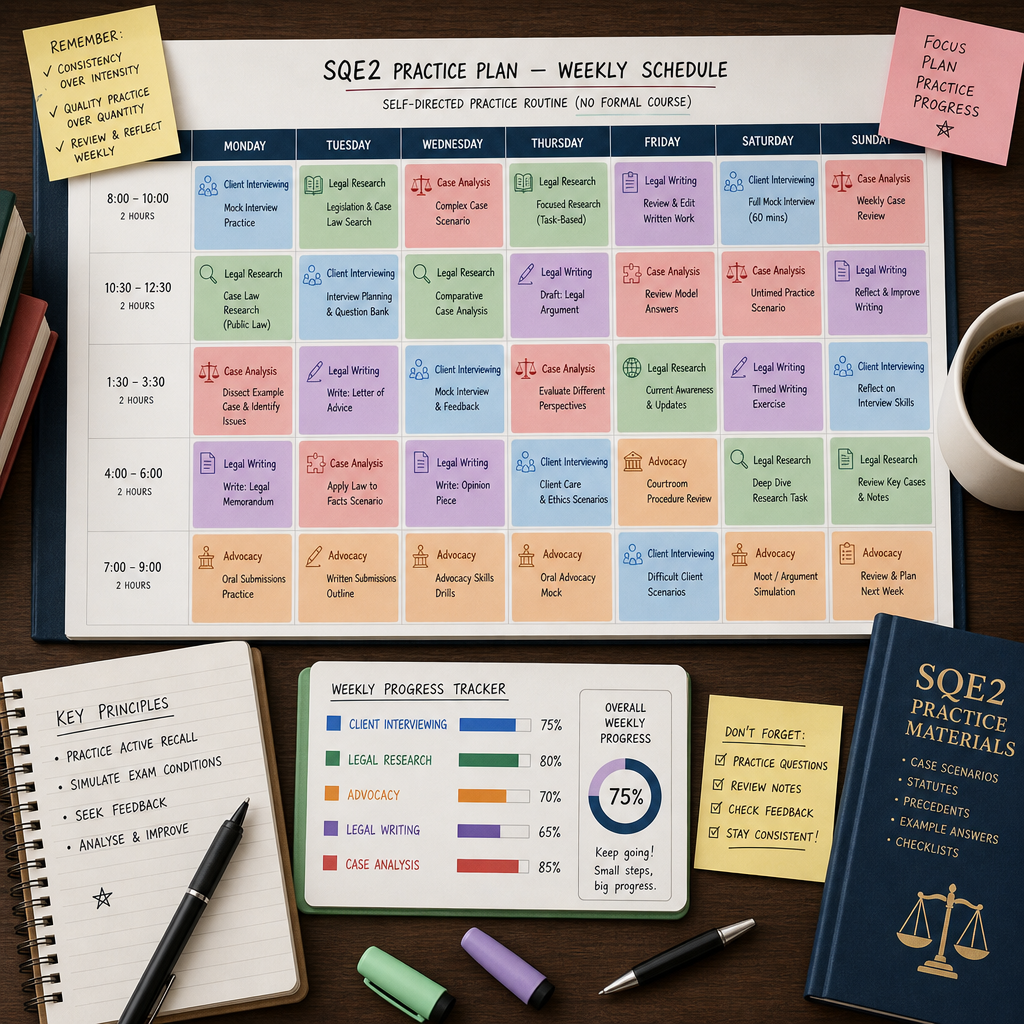
A realistic routine balances skill development, timed practice, and performance review. Here’s a proven weekly structure:
Monday: Client Interviewing Practice
Time commitment: 2-3 hours
Start your week with client interviewing, it’s often the most challenging skill for candidates to master independently.
- Review one SRA sample client interviewing scenario (30 minutes)
- Conduct a timed mock interview using the scenario (20 minutes)
- Draft an attendance note from your interview (30 minutes)
- Self-assess against SRA criteria (20 minutes)
- Identify two specific improvement areas (10 minutes)
Record your mock interviews if possible. Watching yourself reveals habits you don’t notice in the moment, talking over the client, missing non-verbal cues, or failing to clarify ambiguous information.
Tuesday: Legal Research and Writing
Time commitment: 2-3 hours
- Complete one timed legal research task (45 minutes)
- Draft a legal advice letter based on your research (45 minutes)
- Compare your work to model answers (30 minutes)
- Revise one section based on gaps identified (20 minutes)
Focus on efficiency. SQE2 research tasks don’t require exhaustive analysis, they test whether you can identify relevant law, apply it accurately, and communicate advice clearly within tight time constraints.
Wednesday: Advocacy Practice
Time commitment: 2 hours
- Review one advocacy scenario (20 minutes)
- Prepare your submissions (30 minutes)
- Deliver your advocacy (record it) (15 minutes)
- Review recording against SRA criteria (30 minutes)
- Repeat with improved approach (25 minutes)
Advocacy improves dramatically with repetition. Don’t just practice once, deliver the same submission multiple times, refining your structure, tone, and responsiveness each time.
Thursday: Case and Matter Analysis
Time commitment: 2-3 hours
- Complete one timed case analysis task (60 minutes)
- Self-mark using SRA criteria (20 minutes)
- Review model answer (20 minutes)
- Identify knowledge gaps (15 minutes)
- Create targeted revision notes (25 minutes)
Case analysis tests your ability to spot issues, apply law accurately, and provide practical advice. Pay attention to how model answers structure their analysis, this reveals the analytical framework assessors expect.
Friday: Mixed Skills Practice
Time commitment: 2 hours
Rotate through different skills each week:
- Week 1: Additional client interviewing
- Week 2: Additional legal writing
- Week 3: Additional advocacy
- Week 4: Additional case analysis
This prevents skill atrophy and ensures balanced development.
Saturday: Full Mock Assessment
Time commitment: 4-5 hours
Once every two weeks, complete a full mock SQE2 assessment under exam conditions:
- Set up exam environment (quiet space, timer, all materials ready)
- Complete 4-5 assessment stations back-to-back with proper timing
- Take scheduled breaks as in the real exam
- Self-assess all stations using SRA criteria
- Calculate estimated scores and identify patterns
Full mocks build stamina and reveal how your performance changes under sustained pressure. Many candidates perform well on individual tasks but struggle when completing multiple assessments consecutively.
Sunday: Review and Planning
Time commitment: 1-2 hours
- Review the week’s practice (30 minutes)
- Update progress tracker (15 minutes)
- Identify persistent weaknesses (20 minutes)
- Plan next week’s focus areas (15 minutes)
- Prepare materials for Monday (20 minutes)
This reflection time is crucial. Without it, you repeat the same mistakes rather than progressively improving.
Using SRA SQE2 Sample Questions Effectively
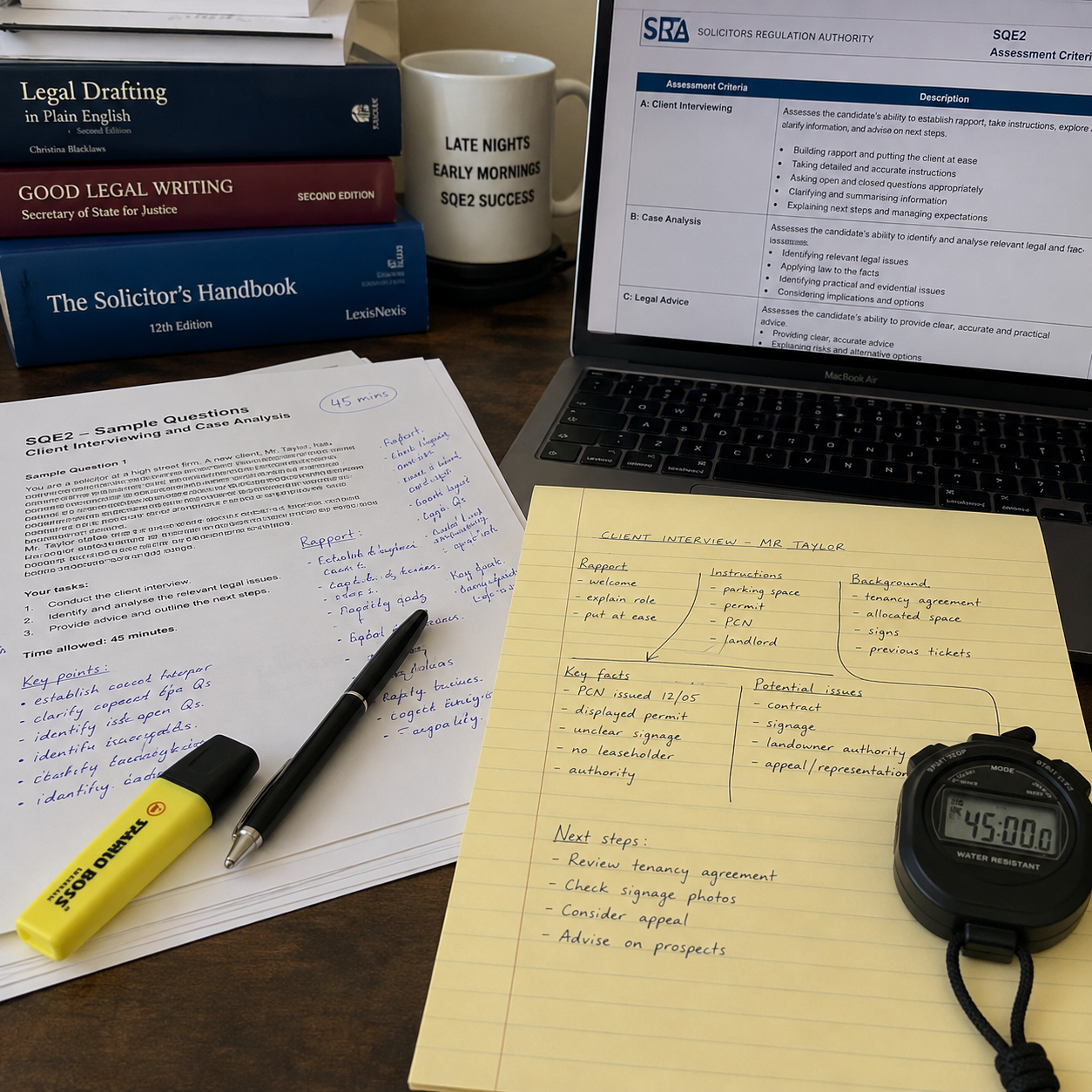
The SRA publishes specimen assessments and sample materials, these are gold dust for independent candidates. Here’s how to maximize their value:
First Pass: Familiarization
Work through each sample question untimed initially. Your goal is understanding the scenario, identifying what the question asks, and recognizing the legal issues involved. Take notes on:
- The scenario structure
- Information provided and information missing
- What the task requires you to produce
- Which legal areas are being tested
Second Pass: Timed Practice
Attempt the same question again under strict exam timing. This reveals whether you can perform under pressure. Most candidates find their performance drops significantly when timed, this is normal and why timed practice is essential.
Third Pass: Comparative Analysis
Compare your answer to any model answers or guidance the SRA provides. Focus on:
- Structure and organization
- Completeness (did you miss key issues?)
- Legal accuracy
- Professional communication style
- Practical advice quality
Fourth Pass: Skill Transfer
Create your own variations of the scenario. Change the facts slightly and rework the question. This tests whether you’ve internalized the analytical approach or just memorized one specific answer.
For comprehensive guidance on self-study approaches, review our detailed guide to preparing for the Solicitors Qualifying Examination without a traditional course.
Developing Self-Assessment Skills
Without a tutor, you must become your own assessor. This requires discipline and honesty.
Create Assessment Checklists
For each skill area, convert the SRA criteria into a checklist. For client interviewing, your checklist might include:
- Established rapport and put client at ease
- Asked open questions to gather information
- Listened actively without interrupting
- Clarified ambiguous or incomplete information
- Identified client’s objectives
- Explained next steps clearly
- Maintained professional boundaries
- Recorded accurate attendance note
- Captured all relevant facts
- Identified legal issues arising
After each practice session, score yourself honestly on each criterion (1-5 scale). Track scores over time to measure improvement.
Record and Review
For advocacy and client interviewing, recording yourself is invaluable. Watch recordings with your checklist and note specific timestamps where you met or missed criteria.
This feels uncomfortable initially, most people dislike watching themselves perform. Push through this discomfort. The insights gained are worth it.
Peer Review
If possible, establish a peer review arrangement with another SQE2 candidate. Exchange practice work and provide structured feedback using SRA criteria.
Peer review offers two benefits: you receive feedback on your work, and assessing others’ work sharpens your understanding of what good performance looks like.
Common Pitfalls in Independent SQE2 Preparation
Pitfall 1: Insufficient Timed Practice
Many candidates practice skills but rarely under exam timing. This creates false confidence. Always include timed practice in your routine.
Pitfall 2: Neglecting Weaker Skills
It’s tempting to focus on skills you already do well. Resist this. Your pass depends on meeting the threshold standard across all skills. Allocate more time to your weakest areas.
Pitfall 3: Passive Learning
Reading about how to conduct client interviews isn’t practice. SQE2 demands active performance. If you’re not producing work product (attendance notes, legal letters, advocacy submissions), you’re not preparing effectively.
Pitfall 4: Ignoring Professional Conduct
Every SQE2 assessment includes professional conduct elements. Candidates often overlook these, focusing only on technical legal skills. Review the SRA Code of Conduct regularly and consider ethical dimensions in every practice scenario.
Pitfall 5: Inadequate Exam Stamina
SQE2 assessments run across multiple days with several stations each day. If you’ve never completed multiple assessments consecutively, you’ll struggle with fatigue. Build stamina through regular full mock assessments.
Tracking Progress and Adjusting Your Routine
Effective preparation requires measurement. Create a simple tracking system:
Skills Progress Tracker
| Skill Area | Week 1 Score | Week 4 Score | Week 8 Score | Week 12 Score | Target |
|---|---|---|---|---|---|
| Client Interviewing | 3.2/5 | 3.6/5 | 4.1/5 | 4.4/5 | 4.0+ |
| Advocacy | 2.8/5 | 3.2/5 | 3.7/5 | 4.0/5 | 4.0+ |
| Legal Research | 3.8/5 | 4.0/5 | 4.2/5 | 4.3/5 | 4.0+ |
| Legal Writing | 3.5/5 | 3.8/5 | 4.0/5 | 4.2/5 | 4.0+ |
| Case Analysis | 3.0/5 | 3.4/5 | 3.9/5 | 4.1/5 | 4.0+ |
Review your tracker monthly. If a skill isn’t improving, adjust your approach:
- Increase practice frequency
- Seek additional resources or guidance
- Break the skill into smaller components
- Review SRA criteria more carefully
For insights on identifying and addressing weak areas, see our guide on fixing SQE1 weak areas before exam day, many principles apply equally to SQE2.
Realistic Timeline: How Long Does This Take?
Most candidates need 3-4 months of structured practice following the routine outlined above. This assumes:
- 12-15 hours per week dedicated to practice
- Solid foundation in relevant legal knowledge
- Consistent adherence to the schedule
If you’re working full-time, extend this to 4-6 months with 8-10 hours weekly practice.
Don’t rush. SQE2 assessments cost approximately £1,980 (current guidance; verify with SRA). Failing because you under-prepared is expensive. Better to delay your assessment date and arrive fully ready.
For detailed guidance on realistic study timelines, review our article on how long to prepare for the SQE exam.
Supplementing Your Routine: Additional Resources
While your core routine uses sra sqe2 sample questions and official materials, these supplementary resources add value:
Free Resources:
- SRA YouTube channel (assessment guidance videos)
- BAILII (free legal research practice)
- Law Society practice notes (context for practice areas)
- Legal blogs covering recent developments
Low-Cost Resources:
- SQE2 skills textbooks (£30-50 each)
- Practice question banks (£50-150)
- Online legal research training modules
Community Resources:
- SQE candidate forums and study groups
- LinkedIn SQE preparation groups
- Local law society events
Avoid expensive courses, but don’t be penny-wise and pound-foolish. A £40 textbook that clarifies advocacy structure is worth the investment.
Managing Exam Day Pressure
Your mock exam routine should simulate exam conditions increasingly closely as your assessment date approaches.
Final Month Adjustments:
- Complete weekly full mock assessments (not just fortnightly)
- Practice in unfamiliar environments (library, different room)
- Wear exam-day clothing during mocks (sounds silly, but comfort matters)
- Simulate travel and arrival (practice your route to the test center)
- Manage pre-assessment nerves (develop a calming routine)
The more familiar exam conditions feel, the less anxiety disrupts your performance.
Many candidates report that understanding what happens if you fail the SQE helps reduce pressure, you can retake assessments, and failure isn’t career-ending.
Frequently Asked Questions
Can I really prepare for SQE2 without a prep course?
Yes. The SRA provides detailed assessment criteria and sample materials. If you follow a structured practice routine using these resources, you can achieve the same pass rates as course-takers. The key is discipline, courses provide structure and accountability, which you must create yourself.
How many practice questions should I complete before the exam?
Aim for at least 40-50 full practice scenarios across all skill areas (8-10 per skill). Quality matters more than quantity, thorough practice with self-assessment beats rushing through hundreds of questions superficially.
What if I can’t find enough SRA sqe2 sample questions?
Start with official SRA materials, then supplement with published question banks and textbooks. You can also create your own scenarios by adapting real cases from legal databases, changing facts to create practice questions.
Should I focus on my weakest skills or practice everything equally?
Both. Allocate 60% of practice time to your weakest skills and 40% to maintaining stronger skills. You must meet the threshold standard across all areas, neglecting weaker skills risks failure even if you excel elsewhere.
How do I know if my performance meets the SQE2 standard?
Compare your work systematically against SRA assessment criteria. If you consistently meet most criteria in timed conditions, you’re likely ready. Consider paying for one or two professional assessments of your work for external validation before your exam.
Is peer feedback as valuable as tutor feedback?
Not quite, but it’s still valuable. Peers may miss subtle issues an experienced assessor would catch, but they can identify obvious gaps and provide a reader’s perspective on clarity and structure. Combine peer feedback with rigorous self-assessment using SRA criteria.
Conclusion
Building a realistic SQE2 mock exam routine without a prep course is entirely achievable. Success requires three elements: understanding exactly what the SRA assesses, practicing systematically using sra sqe2 sample questions and official materials, and developing honest self-assessment skills.
Your routine should include weekly practice across all five skill areas, regular timed mock assessments, and consistent performance review against SRA criteria. Track your progress, adjust your approach based on results, and build exam stamina through full mock assessments.
The candidates who succeed without formal courses share common traits: discipline, structured practice, and willingness to critique their own performance honestly. If you commit to the routine outlined in this guide, you can qualify with confidence.
Practical next steps:
- Download the SRA Assessment Specification for SQE2 today
- Create your weekly practice schedule using the structure above
- Source or purchase sra sqe2 sample questions covering all skill areas
- Complete your first timed practice session this week
- Establish your progress tracking system
- Set your assessment date allowing adequate preparation time
Your legal career journey doesn’t require expensive prep courses, it requires clear pathway, step-by-step guidance, and consistent effort. Start building your mock exam routine today.
For additional support, explore our SQE practice questions and exam preparation resources designed specifically for independent candidates.