



More than 40% of aspiring solicitors who complete their SQE exams face delays in admission, not because they failed an assessment, but because their qualifying work experience documentation was rejected by the Solicitors Regulation Authority. The rules around SRA qualifying work experience have created confusion, frustration, and costly setbacks for candidates who believed they were on track to qualify.
Understanding what counts as qualifying work experience isn’t just about ticking a regulatory box. It determines whether your two years of effort will be recognised, who can actually confirm your experience, and which common mistakes could derail your entire qualification journey. In 2026, the SRA continues to refine its guidance, but many candidates still misinterpret the requirements, often discovering problems only when they attempt to submit their final application for admission.
This guide provides step-by-step guidance on the 2026 QWE rules, identifies the mistakes that trip up even diligent candidates, and clarifies exactly who has the authority to confirm your experience. Whether you’re starting your legal career journey or nearing the end of your QWE period, this practical next steps approach will help you qualify with confidence.
Key Takeaways
- SRA qualifying work experience requires a minimum of two years (or equivalent hours) in a legal environment, but not all legal work automatically qualifies
- Only specific individuals, primarily solicitors of England and Wales, can confirm your QWE, and choosing the wrong supervisor is one of the most common mistakes
- You can complete QWE before, during, or after passing SQE1 and SQE2, giving you flexibility in your qualification timeline
- Overseas legal experience and pro bono work can count toward QWE if properly structured and confirmed by an appropriate person
- Documentation errors and misunderstanding what constitutes “legal work” cause the majority of QWE rejections
What SRA Qualifying Work Experience Actually Means in 2026
The Solicitors Regulation Authority defines qualifying work experience as a period of practical experience in a legal environment that allows you to develop the competencies required of a solicitor. Unlike the old training contract system, QWE offers significantly more flexibility in where, when, and how you gain this experience.
The core requirement: You must complete at least two years of full-time work experience (or the part-time equivalent) that provides you with opportunities to develop some or all of the competencies set out in the SRA’s Statement of Solicitor Competence. This translates to approximately 1,850 hours of work, though the SRA focuses on the quality and nature of experience rather than rigid hour-counting.
The fundamental shift from training contracts to QWE means you’re no longer restricted to traditional law firm placements. You can gain qualifying experience in-house, through multiple shorter placements, via volunteering or pro bono work, or even through overseas legal experience if properly structured.
The Flexibility That Confuses Candidates
This flexibility is both QWE’s greatest advantage and its biggest source of confusion. You can:
- Complete QWE before, during, or after taking SQE1 and SQE2
- Split your experience across multiple organisations
- Work part-time and accumulate hours over a longer period
- Combine different types of legal work (contentious and non-contentious)
- Count experience gained up to six years before your admission application
However, this flexibility doesn’t mean “anything goes.” The SRA maintains strict requirements about what type of work qualifies and who can confirm it.
The Two-Year Requirement: How Hours Actually Work
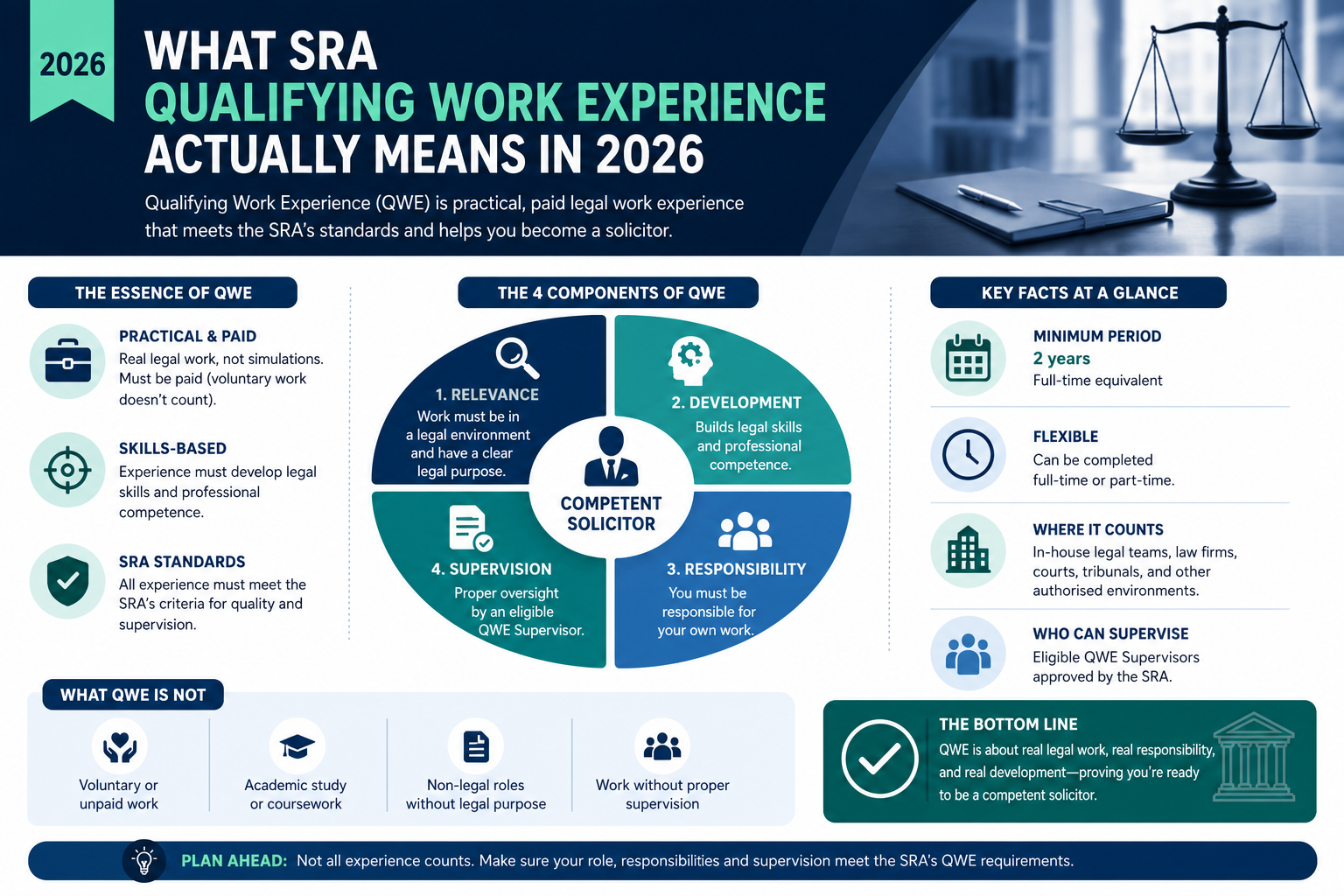
Understanding how to calculate your QWE period is essential for planning your clear pathway to qualification. The SRA’s guidance on the two-year requirement has specific nuances that candidates frequently misinterpret.
Full-time calculation: Two years of full-time work typically means working at least 37.5 hours per week for 48 weeks per year (allowing for standard annual leave). This gives you approximately 1,850 hours of qualifying experience over the two-year period.
Part-time and flexible arrangements: If you work part-time, you simply need to accumulate the equivalent hours. Working 20 hours per week would take approximately four years to reach the required total. The SRA doesn’t mandate continuous employment, you can have gaps between placements without losing credit for previous experience.
What Counts Toward Your Hours
Not every hour you spend at a legal workplace counts as QWE. The experience must involve work that allows you to develop solicitor competencies. This includes:
- Legal research and analysis
- Client communication and advice
- Drafting legal documents
- Case or matter management
- Negotiation and advocacy
- Legal project management
What doesn’t count: Purely administrative tasks, reception duties, general office management, or work that doesn’t engage with legal knowledge or skills won’t qualify. If you spend 40 hours per week at a law firm but 15 of those hours involve non-legal administrative work, only the 25 hours of legal work count toward your QWE.
This distinction causes significant problems for candidates who assume their entire employment period qualifies automatically. Your confirming solicitor must honestly assess which portions of your work genuinely developed legal competencies.
Who Can Actually Confirm Your SRA Qualifying Work Experience
This is where many candidates encounter their first major obstacle. The rules about who can confirm your QWE are specific, and getting this wrong can invalidate months or years of experience.
Solicitors of England and Wales
The primary category of people authorised to confirm QWE is solicitors of England and Wales who hold a current practising certificate. This person must:
- Be a solicitor regulated by the SRA
- Have a valid practising certificate at the time they confirm your experience
- Have direct knowledge of your work and competency development
- Be willing to confirm that your experience meets the QWE requirements
Importantly, this person doesn’t need to be your line manager or even work in the same organisation. They simply need sufficient knowledge of your work to make an informed confirmation.
Other Legal Professionals Who Can Confirm QWE
The SRA also permits certain other legal professionals to confirm your experience:
CILEX lawyers and fellows: Chartered Legal Executives who are authorised by CILEx Regulation can confirm QWE, provided they have appropriate knowledge of your work.
Compliance officers for legal practice (COLPs): These individuals, who hold responsibility for legal compliance in their organisations, can confirm QWE even if they’re not solicitors themselves, though this is less common.
Foreign-qualified lawyers: In certain circumstances, lawyers qualified in other jurisdictions can confirm QWE, particularly for overseas legal experience. However, this requires careful documentation and may need additional verification.
Who Cannot Confirm Your QWE
Understanding who lacks authority to confirm your experience is equally important:
- Paralegals (even highly experienced ones)
- Barristers (unless they also hold a solicitor’s practising certificate)
- Retired solicitors without current practising certificates
- Non-lawyer managers or supervisors
- HR professionals
- Academic law lecturers (unless they’re also practising solicitors)
One of the most common mistakes is asking a senior paralegal or legal manager to confirm QWE, only to discover later that the confirmation is invalid. Always verify your confirming solicitor’s SRA registration and practising certificate status before they sign your confirmation.
Common Mistakes That Invalidate QWE
Even candidates who understand the basic requirements often make critical errors that jeopardise their qualification timeline. These mistakes typically fall into several categories.
Mistake 1: Assuming All Legal Employment Qualifies
Working at a law firm doesn’t automatically mean your entire employment period counts as QWE. The SRA requires that your work actually develops solicitor competencies. If you spend six months primarily doing administrative tasks before transitioning to legal work, only the legal work period qualifies.
Real-world example: A candidate worked as a “legal assistant” for 18 months but spent the first six months exclusively on document management, filing, and reception coverage. When applying for admission, they discovered only 12 months of their experience qualified, leaving them short of the two-year requirement.
Mistake 2: Failing to Secure Confirmation Before Moving On
Many candidates complete a placement, move to a new role, and only later attempt to get their previous experience confirmed. By that time, their former supervisor may have left the organisation, retired, or let their practising certificate lapse.
Best practice: Obtain written confirmation of your QWE at the end of each placement or at regular intervals (every six months) during longer placements. This ensures you have valid documentation even if circumstances change.
Mistake 3: Inadequate Documentation of Competency Development
The SRA requires evidence that your experience developed the competencies in their Statement of Solicitor Competence. Simply stating “I worked at X firm for two years” isn’t sufficient. You need to demonstrate which competencies you developed and how.
Maintain a detailed log of:
- Specific tasks and responsibilities
- Legal areas you worked in
- Skills you developed
- Feedback received from supervisors
- Examples of work that demonstrate competency development
This documentation supports your confirming solicitor’s assessment and provides evidence if the SRA requests additional information.
Mistake 4: Misunderstanding the Timing Requirements
Some candidates believe they must complete QWE before taking the SQE exams. This isn’t true, you can complete QWE before, during, or after your assessments. However, you must have completed all QWE requirements before you can be admitted as a solicitor.
The flexibility in timing means you can prepare for the SQE while simultaneously gaining qualifying experience, potentially shortening your overall qualification timeline.
Mistake 5: Not Verifying Supervisor Credentials
Always confirm that your proposed supervisor:
- Holds a current SRA practising certificate (check the SRA register)
- Has sufficient knowledge of your work to make an informed confirmation
- Understands the QWE requirements and their responsibilities
A confirmation from someone who lacks proper authority is worthless, regardless of their seniority or experience.
What Types of Work Actually Count as Qualifying Experience
The SRA’s competency-based approach means QWE isn’t limited to traditional law firm work. However, understanding what genuinely qualifies requires careful analysis.
Legal Work in Traditional Settings
Work in law firms, barristers’ chambers, and in-house legal departments typically qualifies if it involves:
- Conducting legal research and providing advice
- Drafting contracts, pleadings, or other legal documents
- Client interviewing and relationship management
- Case preparation and matter progression
- Negotiation and dispute resolution
- Compliance and regulatory work
Even in these settings, purely administrative tasks don’t count. Time spent on billing, file management, or general office duties should be excluded from your QWE calculation.
Pro Bono and Voluntary Legal Work
Volunteering and pro bono work can absolutely count toward QWE, provided:
- The work involves developing solicitor competencies
- You have appropriate supervision from a qualified confirming person
- The organisation operates in a legal capacity (law clinics, advice centres, legal charities)
Many candidates successfully combine paid employment in non-legal roles with part-time pro bono legal work to accumulate their required hours. This approach offers flexibility for career changers and those unable to secure full-time legal positions immediately.
Overseas Legal Experience
International legal experience can qualify if it meets the competency requirements. The SRA recognises that legal skills are transferable across jurisdictions, even if specific legal knowledge differs.
Key considerations for overseas QWE:
- The work must develop competencies relevant to solicitors in England and Wales
- You need confirmation from an appropriate person (which may include foreign-qualified lawyers in some circumstances)
- Documentation should clearly explain how the experience relates to SRA competencies
- You may need to provide additional context about the legal system and your role
Candidates with foreign legal experience should carefully document how their work translates to English and Welsh legal practice.
Non-Traditional Legal Roles
QWE can be gained in less obvious settings:
- Legal technology companies (if work involves legal analysis)
- Regulatory bodies and government legal departments
- Legal publishing and research organisations
- Compliance and risk management roles with significant legal content
The key question is always: does this work develop the competencies required of a solicitor?
How to Document and Submit Your QWE Properly
Proper documentation is essential for a smooth admission process. The SRA’s requirements are specific, and incomplete or unclear documentation causes unnecessary delays.
The QWE Confirmation Process
Your confirming solicitor must complete a formal confirmation through the SRA’s mySRA portal. This confirmation includes:
- Details of your employment or placement
- The period of experience being confirmed
- The nature of work undertaken
- Which competencies you developed
- Confirmation that the experience meets QWE requirements
Important: The confirmation must be submitted by the confirming solicitor themselves through their own mySRA account. You cannot submit it on their behalf.
Creating Your QWE Record
Maintain a comprehensive record throughout your qualifying period:
Basic information:
- Organisation name and type
- Your role and responsibilities
- Start and end dates (or ongoing status)
- Hours worked per week
- Total hours of qualifying work
Competency development:
- Specific examples of work in each competency area
- Skills developed and how they were applied
- Feedback received and improvements made
- Challenging situations and how you handled them
Supporting evidence:
- Work samples (appropriately redacted for confidentiality)
- Performance reviews or feedback
- Training completed
- Certificates or acknowledgments
This detailed record makes it easier for your confirming solicitor to complete their confirmation accurately and provides evidence if the SRA requests additional information.
Timing Your Confirmation Submissions
You don’t need to wait until you’ve completed all two years of QWE to start submitting confirmations. In fact, it’s often better to submit confirmations in stages:
- After completing each distinct placement
- Every six months during longer placements
- Before any significant changes in your role or organisation
This approach ensures you don’t lose track of experience or face difficulties contacting former supervisors years later.
Understanding the SQE and QWE Relationship
The relationship between the SQE assessments and QWE is more flexible than many candidates realise.
You Don’t Need QWE to Take the SQE
Unlike the old training contract system, you can sit SQE1 and SQE2 without having completed (or even started) your qualifying work experience. This flexibility allows you to:
- Take the exams while studying full-time
- Complete assessments before securing a legal position
- Demonstrate your qualification readiness to potential employers
However, you cannot be admitted as a solicitor until you’ve completed all requirements: passing both SQE assessments, completing two years of QWE, and meeting the character and suitability requirements.
Strategic Timing Considerations
Different candidates benefit from different approaches:
Exams first, then QWE: This approach works well for recent graduates who want to demonstrate their qualification readiness when applying for positions. Passing the SQE can make you a more attractive candidate for roles that will provide QWE.
QWE alongside exam preparation: Many candidates gain qualifying experience while preparing for the SQE. This approach provides practical context for your studies and allows you to complete all requirements simultaneously.
QWE first, then exams: Career changers or those already working in legal roles might accumulate QWE before attempting the assessments. This provides practical experience that can inform your exam preparation.
There’s no single “correct” sequence, choose the approach that fits your circumstances and career goals.
Special Circumstances and Edge Cases
Certain situations require additional consideration when planning your QWE.
Career Changers and Non-Law Backgrounds
If you’re switching to law from another profession, you might have relevant experience that partially qualifies. For example:
- Compliance officers in regulated industries may have developed some relevant competencies
- Business managers with contract negotiation experience might count certain work
- Government policy roles with legal elements could partially qualify
However, this experience must be confirmed by an appropriate person and clearly demonstrate development of solicitor competencies. Don’t assume that general business experience automatically qualifies, seek guidance from the SRA if you’re uncertain.
Apprenticeships and Structured Training
Solicitor apprenticeships typically include built-in QWE as part of the programme structure. If you’re following an apprenticeship route, your employer and training provider should ensure your experience meets QWE requirements and arrange appropriate confirmation.
Part-Time and Flexible Working
Part-time QWE is entirely acceptable, but requires careful hour tracking. If you work 20 hours per week, you’ll need approximately four years to accumulate the required hours. Ensure your confirming solicitor understands your part-time status and confirms the actual hours of qualifying work, not just the employment period.
Gaps in Employment
Gaps between placements don’t invalidate previous QWE. If you complete six months of qualifying experience, take a year off for personal reasons, then return to complete another 18 months, all of that experience counts (provided it’s within six years of your admission application).
Frequently Asked Questions
Can I count work experience gained before I decided to become a solicitor?
Yes, provided the work meets QWE requirements and can be confirmed by an appropriate person. The SRA allows you to count qualifying experience gained up to six years before your admission application, regardless of when you decided to pursue qualification. However, you’ll need to secure confirmation from someone who supervised that work and still holds the necessary credentials.
What happens if my confirming solicitor retires or is struck off after confirming my QWE?
Once your QWE has been properly confirmed through the SRA’s system, it remains valid even if your confirming solicitor later retires or faces regulatory issues. The confirmation is recorded at the time it’s made, based on the solicitor’s status at that moment. This is another reason to secure confirmations promptly rather than waiting until you’re ready to apply for admission.
Can I complete QWE in multiple short placements instead of one long placement?
Absolutely. You can accumulate QWE through multiple placements of varying lengths, there’s no minimum duration for individual placements. Some candidates complete their QWE through six-month placements at different organisations, while others combine several shorter experiences. Each placement needs separate confirmation from an appropriate person who supervised that specific period.
Does my QWE need to cover all competency areas in the Statement of Solicitor Competence?
No. The SRA recognises that individual placements may not cover all competencies. Your QWE should provide opportunities to develop “some or all” of the required competencies. However, by the end of your two-year period, you should have developed a broad range of competencies across different areas. The SQE assessments test your knowledge and skills, while QWE provides practical application.
What if I’m working in a legal role but my employer won’t confirm my QWE?
This is a difficult situation. Your employer isn’t legally required to confirm QWE, though most will do so as a professional courtesy. If your direct employer won’t confirm, consider whether another solicitor in the organisation who has knowledge of your work might do so. Alternatively, you might need to seek additional experience elsewhere that can be properly confirmed. This highlights the importance of discussing QWE confirmation with employers before accepting positions.
Can I use the same confirming solicitor for multiple periods of QWE at different organisations?
No. Your confirming solicitor must have direct knowledge of the specific work they’re confirming. If you work at three different organisations, you need three different confirming solicitors (one from each organisation) who can attest to your work in their respective settings. A solicitor cannot confirm experience at an organisation where they have no knowledge of your work.
Conclusion: Your Clear Pathway to QWE Success
Navigating SRA qualifying work experience successfully requires understanding not just the basic two-year requirement, but the nuances of what qualifies, who can confirm it, and how to document it properly. The flexibility of the QWE system offers genuine advantages over the old training contract model, but that flexibility demands greater personal responsibility for ensuring your experience meets regulatory requirements.
Your practical next steps:
- Verify your confirming solicitor’s credentials before beginning any placement, check the SRA register to confirm they hold a current practising certificate
- Maintain detailed records of your work, including specific tasks, competencies developed, and hours spent on qualifying activities
- Secure confirmations promptly at the end of each placement or every six months during longer placements, rather than waiting until you’re ready to apply for admission
- Understand what counts as qualifying work in your specific role, and honestly assess which portions of your time involve genuine legal work versus administrative tasks
- Plan your timeline strategically, considering whether to complete QWE before, during, or after your SQE assessments based on your individual circumstances
The path to qualification is clearer when you understand these requirements from the start. Whether you’re just beginning your legal career journey or approaching the end of your QWE period, following these guidelines will help you qualify with confidence and avoid the common mistakes that delay admission for so many candidates.
For more detailed guidance on related topics, explore our resources on understanding qualifying work experience for SQE and comparing the SQE route to traditional training contracts.