

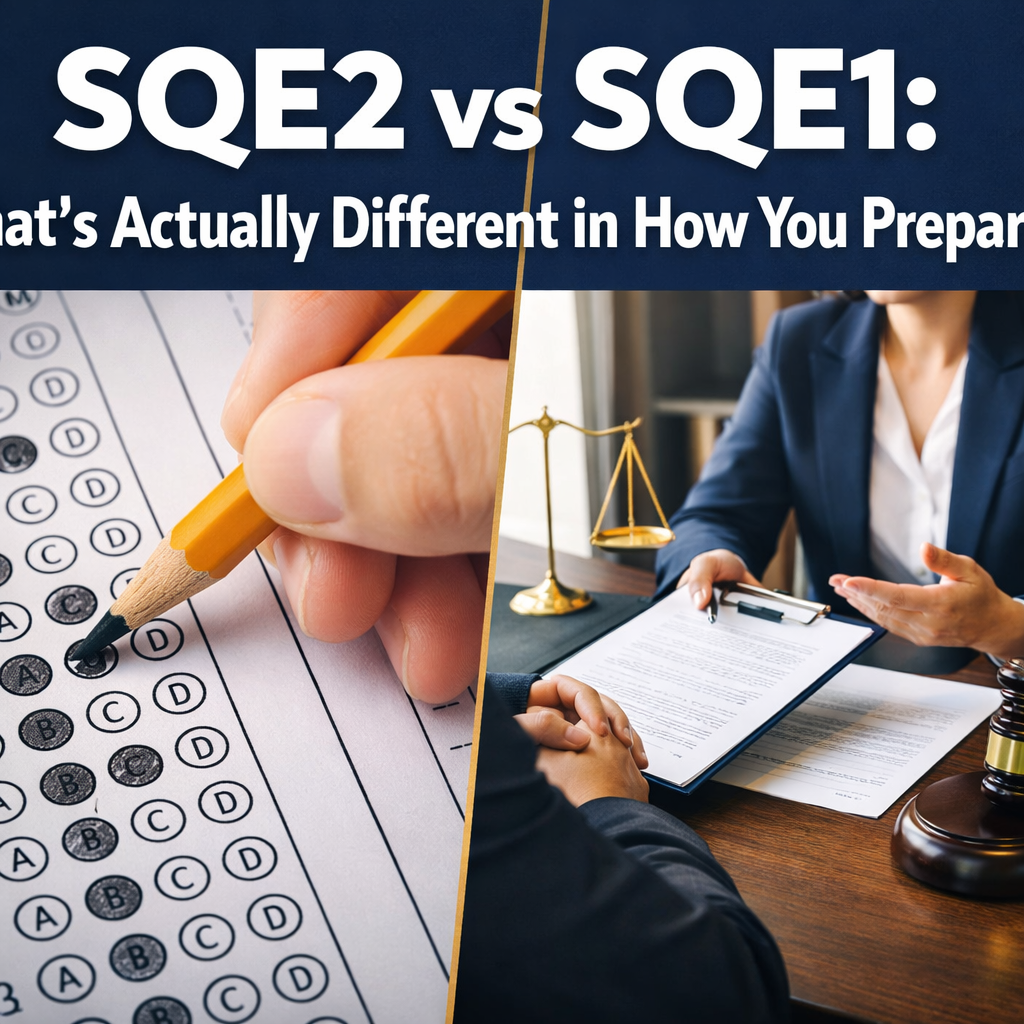

The SQE2 pass rate sits around 80%,significantly higher than SQE1’s fluctuating figures, yet candidates who breeze through the first exam often stumble at the second. Why? Because passing SQE2 vs SQE1 demands a fundamentally different preparation strategy. One tests what you know; the other tests what you can do under pressure with real clients watching.
Understanding the distinction between these two assessments isn’t just academic curiosity. It determines whether you spend months memorising case law when you should be practising client interviews, or whether you invest in the wrong study materials entirely. The pathway from SQE1 to SQE2 requires a complete mental shift, from knowledge absorption to skills demonstration, and most candidates don’t realise this until they’re already behind.
This guide breaks down exactly how your preparation must change between the two exams, what works for one but fails for the other, and the practical steps you need to take to qualify with confidence.
Key Takeaways
- SQE1 preparation centres on memorising legal principles and practising multiple-choice questions, while SQE2 requires developing practical skills through role-play and written exercises
- The time investment differs significantly: SQE1 demands intensive content coverage across 180 MCQs, whereas SQE2 needs focused skills practice across specific legal tasks
- Study materials for SQE1 emphasise textbooks and question banks; SQE2 preparation relies on mock assessments, feedback sessions, and simulated client interactions
- SQE2 runs four times yearly (January, April, July, October) with an approximately 80% pass rate, compared to SQE1’s variable pass rates depending on the sitting
- Transitioning between exams requires shifting from passive knowledge retention to active skills application, a change many candidates underestimate
What Are SQE1 and SQE2: The Core Differences
The Solicitors Qualifying Examination splits into two distinct assessments, each measuring different competencies. SQE1 evaluates your functioning legal knowledge through 180 multiple-choice questions divided across two papers: Functioning Legal Knowledge 1 (FLK1) and Functioning Legal Knowledge 2 (FLK2). You sit at a computer, work through scenarios, and select the best answer from five options. The format is standardised, timed, and entirely knowledge-focused.
SQE2 takes a different approach entirely. This assessment tests your practical legal skills through 16 stations covering client interviewing, advocacy, case and matter analysis, legal research, legal writing, and legal drafting. You interact with actors playing clients, draft documents under timed conditions, and demonstrate that you can apply legal knowledge in realistic professional scenarios. The Solicitors Regulation Authority (SRA) designs SQE2 to mirror the actual work solicitors perform daily.
The SQE2 vs SQE1 key differences extend beyond format. SQE1 can be attempted before completing any qualifying work experience (QWE), while most candidates tackle SQE2 after gaining some practical exposure. The cost structure differs too, SQE1 currently costs around £3,980 for both papers, while SQE2 sits at approximately £4,590 (verify current fees with the SRA before booking). More importantly, the preparation timeline and methods diverge completely.
The Knowledge vs Skills Divide
SQE1 asks: Do you know the law? You need to understand legal principles, recognise correct applications, and eliminate wrong answers quickly. Success depends on memorisation, pattern recognition, and exam technique for multiple-choice questions.
SQE2 asks: Can you perform as a solicitor? You need to demonstrate client care, communicate clearly, research efficiently, and produce professional work product. Success depends on practice, feedback, and refining your performance through repetition.
This fundamental difference shapes everything about how you prepare. The study materials, time allocation, practice methods, and even your mindset must shift completely when you move from one exam to the other.
How SQE1 Preparation Actually Works
Preparing for SQE1 resembles intensive academic study. You’re covering a vast syllabus across multiple legal areas: Business Law and Practice, Dispute Resolution, Contract, Tort, Legal System of England and Wales, Constitutional and Administrative Law, EU Law (retained provisions), Legal Services, Property Practice, Wills and Administration of Estates, Solicitors Accounts, Land Law, Trusts, and Criminal Law and Practice.
The Content Coverage Challenge
The sheer volume of material creates the first major challenge. You need broad coverage rather than deep specialisation. Unlike university exams where you might focus on three or four topics, SQE1 tests everything. This means your preparation must be systematic and comprehensive.
Most successful candidates follow this pattern:
Phase 1: Content Acquisition (8-12 weeks)
- Work through each subject area using textbooks, online courses, or prep providers
- Create condensed notes or flashcards for key principles
- Focus on understanding rather than memorisation initially
- Cover all topics at least once before moving to intensive practice
Phase 2: Question Practice (6-8 weeks)
- Complete hundreds of multiple-choice questions across all topics
- Identify weak areas through performance tracking
- Revisit content for topics where you score below 60%
- Develop time management skills for the actual exam conditions
Phase 3: Intensive Revision (2-4 weeks)
- Focus on high-yield topics that appear frequently
- Complete full mock exams under timed conditions
- Review incorrect answers to understand reasoning
- Consolidate knowledge through spaced repetition
The how long to prepare for the SQE varies by background, law graduates might need 4-6 months, while non-law graduates or career changers often require 6-9 months for SQE1 alone.
Study Materials That Actually Work for SQE1
Your choice of study materials significantly impacts preparation efficiency. The most effective resources for SQE1 include:
Question banks: These are non-negotiable. You need exposure to hundreds of MCQs that mirror the actual exam format. Look for providers whose questions match the SRA’s style and difficulty level. Our practice question packs, written by qualified solicitors, specifically replicate the exam’s approach to testing legal knowledge.
Condensed manuals: Comprehensive textbooks help initially, but you’ll eventually need shorter revision guides that distil principles into memorable formats. Many candidates create their own condensed notes as they progress.
Online courses: Video content works well for visual learners and provides structure. However, passive watching isn’t enough, you must actively test yourself through questions.
Flashcard systems: Digital flashcards using spaced repetition algorithms help with long-term retention. Focus on legal tests, key cases, and statutory provisions that appear repeatedly.
For specific subject guidance, resources like our SQE1 contract law guide and business law breakdown help you understand how examiners frame questions in high-stakes areas.
The MCQ Technique You Must Master
Multiple-choice questions on SQE1 aren’t straightforward. The SRA designs questions with plausible distractors, wrong answers that seem correct if you misunderstand a principle or miss a key fact. Developing MCQ technique is as important as knowing the law.
Effective MCQ strategies include:
- Reading the question stem carefully before looking at options
- Identifying the legal area and relevant principles first
- Eliminating obviously wrong answers to improve odds
- Watching for qualifier words like “always,” “never,” “must,” or “may”
- Managing time strictly (approximately 90 seconds per question)
- Flagging difficult questions to revisit rather than getting stuck
Many candidates struggle with SQE1 weak areas like Solicitors Accounts or Legal Services because these topics receive less attention in traditional law degrees. Targeted practice in these areas prevents costly mark losses.

How SQE2 Preparation Differs Completely
When you transition to SQE2, everything changes. You’re no longer sitting alone with a computer screen selecting answers. You’re performing legal tasks that solicitors do daily, and you’re being assessed on how well you execute them.
The Skills-Based Assessment Model
SQE2 consists of 16 stations across two days, testing these core competencies:
Client interviewing and advising: You meet with an actor playing a client, gather relevant information, identify legal issues, and provide preliminary advice. Assessors evaluate your communication skills, ability to build rapport, legal analysis, and client care.
Advocacy: You present oral arguments before an actor playing a judge or tribunal member. This tests your ability to structure submissions, cite relevant law, respond to questions, and maintain professional demeanour under pressure.
Case and matter analysis: You receive a file of documents and must analyse the legal position, identify issues, and determine next steps. This tests your ability to work with realistic case materials.
Legal research: You’re given a legal problem and access to research materials. You must find relevant law and apply it to the scenario within a time limit.
Legal writing: You draft letters, emails, or file notes demonstrating clear professional communication.
Legal drafting: You prepare formal legal documents like witness statements, contract clauses, or particulars of claim.
Each station runs for a set time (typically 15-20 minutes), and you move between stations throughout the assessment days. The format is intense, fast-paced, and requires you to switch between different skills rapidly.
Why SQE1 Study Methods Fail for SQE2
Candidates who try to prepare for SQE2 the same way they prepared for SQE1 consistently underperform. Here’s why:
Reading isn’t practising: You can read about client interviewing techniques, but until you actually interview someone and receive feedback, you won’t improve. SQE2 demands active practice, not passive consumption.
Knowledge alone isn’t enough: You might know the law perfectly, but if you can’t communicate it clearly to a confused client or draft it into a coherent document, you’ll fail the assessment.
Time pressure feels different: In SQE1, you have time to think through each question. In SQE2, you must perform immediately, there’s no pause button when a client asks an unexpected question or a judge challenges your submission.
Feedback is essential: Unlike MCQs where you can self-assess, you need external feedback on your performance. You can’t objectively evaluate whether your client interview demonstrated appropriate empathy or whether your advocacy was persuasive.
The SQE2 Preparation Framework
Successful SQE2 preparation follows a skills-development model rather than a knowledge-acquisition model:
Phase 1: Skills Introduction (2-3 weeks)
- Learn the structure and expectations for each skill area
- Watch demonstrations of good performance
- Understand the assessment criteria assessors use
- Complete initial practice attempts to establish baseline
Phase 2: Deliberate Practice (8-12 weeks)
- Complete multiple practice stations for each skill type
- Receive detailed feedback on performance
- Identify specific weaknesses (e.g., failing to summarise advice, poor document structure)
- Repeat exercises focusing on improvement areas
- Record yourself to review performance objectively
Phase 3: Integrated Practice (4-6 weeks)
- Complete full mock assessments under timed conditions
- Practice switching between different skills rapidly
- Build stamina for two full assessment days
- Refine time management within each station
- Address any remaining weak skills
The SQE2 pass rate of approximately 80% (based on recent sittings) suggests that candidates who prepare properly generally succeed. However, those who underestimate the skills component or rely solely on legal knowledge often struggle.
Essential SQE2 Study Resources
Your SQE2 preparation toolkit looks completely different from SQE1:
Mock assessment providers: You need access to realistic practice stations with actor-clients and assessors who provide feedback. Many prep providers offer intensive courses with multiple mock assessments.
Peer practice groups: Practising with other candidates allows you to role-play different scenarios, give each other feedback, and learn from observing others’ approaches.
Recording equipment: Video or audio recording your practice sessions lets you review your performance objectively. You’ll notice verbal tics, unclear explanations, or poor structure that you miss in the moment.
Skills manuals: Books specifically focused on legal skills (like client interviewing or advocacy) provide frameworks and techniques. Resources such as Client Interview, Attendance Note and Legal Analysis for SQE2 offer practical guidance written by solicitors who understand the assessment.
Qualifying work experience: If possible, gain some QWE before attempting SQE2. Real client exposure, even in a limited capacity, dramatically improves your performance in simulated scenarios.
The Role of Qualifying Work Experience
While you can technically sit SQE2 before completing your two years of qualifying work experience, most candidates benefit from gaining at least some practical exposure first. QWE provides context that makes SQE2 preparation more intuitive.
During QWE, you observe how experienced solicitors:
- Structure client meetings and build rapport
- Draft professional documents efficiently
- Research unfamiliar legal issues under time pressure
- Communicate complex advice in plain English
- Maintain professional standards under stress
This exposure accelerates your SQE2 preparation because you’re refining skills you’ve already observed rather than learning them from scratch. For guidance on documenting your experience, see our article on volunteering and pro bono work.

The Transition Strategy: Moving From SQE1 to SQE2
The gap between passing SQE1 and starting SQE2 preparation is critical. Many candidates make the mistake of treating them as consecutive academic exams, but they require fundamentally different preparation approaches.
Timing Your SQE2 Attempt
SQE2 runs four times per year (January, April, July, October), giving you flexibility in scheduling. Consider these factors when choosing your sitting:
Post-SQE1 recovery time: Most candidates need at least 2-4 weeks after SQE1 to decompress before starting SQE2 preparation. Burnout is real, and jumping immediately into skills practice while mentally exhausted reduces effectiveness.
Preparation duration: Allow 3-6 months for thorough SQE2 preparation, depending on your practical experience level. Those with significant QWE or prior legal practice may need less time; those coming straight from academic study need more.
QWE timing: If possible, complete at least 6-12 months of QWE before attempting SQE2. The practical exposure makes a measurable difference in performance.
Course availability: If you’re using a prep provider, check when their intensive courses run and book early, popular courses fill quickly.
Bridging the Knowledge-Skills Gap
The transition from SQE1 to SQE2 requires deliberate mental reframing:
From passive to active: SQE1 rewards passive recognition (selecting the right answer). SQE2 rewards active performance (producing the right work product). Shift your study approach from consuming content to creating output.
From individual to interpersonal: SQE1 is solitary, you and the computer. SQE2 involves human interaction, clients, judges, colleagues. Develop your interpersonal skills alongside your legal skills.
From theoretical to practical: SQE1 tests legal principles in abstract scenarios. SQE2 tests application in messy, realistic situations with incomplete information and time pressure. Embrace ambiguity and learn to make professional judgments.
From self-assessment to external feedback: SQE1 gives immediate right/wrong feedback. SQE2 requires nuanced evaluation of performance quality. Seek regular feedback from tutors, peers, or mentors.
Common Transition Mistakes to Avoid
Mistake 1: Treating SQE2 as “easier” The higher pass rate doesn’t mean SQE2 is easier, it means it tests different competencies. Candidates who underestimate it often fail.
Mistake 2: Relying solely on legal knowledge Knowing the law is necessary but insufficient. You must demonstrate professional skills, and that requires practice, not just study.
Mistake 3: Insufficient practice volume One or two mock interviews won’t prepare you. You need dozens of practice attempts across all skill areas to develop competence.
Mistake 4: Ignoring feedback Receiving feedback but not acting on it wastes the opportunity to improve. Systematically address identified weaknesses.
Mistake 5: Poor time management SQE2 stations are strictly timed. Practise under realistic time constraints from the beginning, not just in final preparation.
For candidates concerned about what happens if you fail the SQE, understanding these transition challenges helps you avoid common pitfalls and pass first time.
Cost and Resource Planning Across Both Exams
The financial investment in SQE qualification extends beyond exam fees. Understanding the full cost picture helps you plan effectively.
Direct Exam Costs
SQE1 fees: Approximately £3,980 for both FLK1 and FLK2 (verify current fees with the SRA)
SQE2 fees: Approximately £4,590 (verify current fees with the SRA)
Resit costs: If you fail individual papers, you pay per paper for resits. This can add thousands to your total cost if you need multiple attempts.
Preparation Costs
SQE1 preparation:
- Self-study with books and question banks: £500-£1,500
- Online courses: £1,500-£3,000
- Full-service prep providers: £3,000-£8,000+
SQE2 preparation:
- Skills manuals and resources: £200-£500
- Mock assessment sessions: £500-£1,500
- Intensive prep courses: £2,000-£6,000+
The cost of the SQE route varies dramatically based on your preparation choices. Self-study is cheapest but requires strong discipline and self-assessment skills. Full-service providers cost more but offer structure, feedback, and support.
Funding Options
Law firm sponsorship: Some firms sponsor SQE candidates, covering exam fees and preparation costs. Competition is fierce, but this is the ideal scenario. Learn more about whether law firms pay for the SQE.
Student loans: Postgraduate loans may cover some costs, though they rarely cover the full amount.
Savings and part-time work: Many candidates self-fund through savings or work part-time during preparation.
Payment plans: Some prep providers offer payment plans to spread costs over several months.
Resource Allocation Strategy
Rather than spending equally on both exams, consider this strategic approach:
Invest more in SQE1 preparation: The knowledge base is broader, the pass rates are more variable, and the volume of material is larger. Comprehensive preparation here pays dividends.
Invest strategically in SQE2 feedback: You need quality feedback more than quantity of materials. Prioritise resources that provide personalised assessment of your performance over generic skills guides.
Use free resources effectively: For SQE1, free resources like our practice questions provide valuable exposure to exam-style MCQs. For SQE2, peer practice groups cost nothing but deliver significant value.
Practical Next Steps: Your Preparation Roadmap
Understanding the differences between SQE2 vs SQE1 preparation is the first step. Implementing an effective study plan is what actually gets you qualified.
If You’re Starting SQE1 Preparation
Step 1: Assess your starting point
- Take a diagnostic test to identify strong and weak areas
- Determine how much study time you can realistically commit weekly
- Calculate your target completion date working backwards from your preferred exam sitting
Step 2: Choose your preparation approach
- Decide between self-study, online courses, or full-service providers based on budget and learning style
- Invest in a comprehensive question bank, this is non-negotiable
- Consider starting with our SQE1 sample question pack to assess question quality before committing to larger purchases
Step 3: Build your study schedule
- Allocate time proportionally across all subject areas
- Schedule regular practice question sessions (at least 3-4 times weekly)
- Include weekly review sessions to consolidate learning
- Plan for full mock exams in the final 4-6 weeks
Step 4: Track and adjust
- Monitor your performance across different topics
- Identify patterns in the types of questions you miss
- Adjust your study focus based on performance data
- Don’t neglect high-yield topics like dispute resolution or property practice
If You’re Transitioning to SQE2
Step 1: Take a preparation break
- Allow 2-4 weeks after SQE1 for mental recovery
- Use this time to research SQE2 requirements and format
- Begin gathering information about prep providers and resources
Step 2: Gain practical exposure
- If you haven’t started QWE, begin immediately
- Seek opportunities to observe client meetings, court hearings, or document drafting
- Volunteer for tasks that develop the skills SQE2 tests
Step 3: Start skills practice early
- Begin with the skills you find most challenging (often advocacy or client interviewing)
- Record yourself practising and review objectively
- Join or form a peer practice group
- Seek feedback from qualified solicitors whenever possible
Step 4: Book structured preparation
- Research prep providers and read reviews from past candidates
- Book mock assessment sessions well in advance
- Consider intensive courses 4-6 weeks before your exam date
- Ensure you’ll complete multiple full mock assessments before the real thing
If You’re Considering the SQE Route
Step 1: Understand the full pathway
- Research the complete SQE route including QWE requirements
- Compare with alternative routes like apprenticeships or CILEX
- Assess whether you can study for SQE on your own or need structured support
Step 2: Plan your timeline
- Map out a realistic timeline from start to qualification
- Factor in time for both exams plus two years of QWE
- Consider whether you’ll work while studying or study full-time
- Understand how long the SQE is valid for to avoid time pressure
Step 3: Secure funding
- Calculate total costs including exams, preparation, and living expenses
- Explore funding options and firm sponsorships
- Create a financial plan that covers the full qualification period
Step 4: Begin preparation
- Start with SQE1 preparation using proven resources
- Build a strong knowledge foundation before attempting the exams
- Connect with other candidates for support and motivation
Frequently Asked Questions
Can I prepare for SQE1 and SQE2 simultaneously?
This isn’t recommended. The preparation methods are too different, and attempting both simultaneously dilutes your focus. Most candidates need 4-6 months for SQE1 and 3-6 months for SQE2. Trying to compress this timeline usually results in underperformance on both exams. Focus on SQE1 first, pass it, then transition to SQE2 preparation.
How much harder is SQE2 compared to SQE1?
They’re not directly comparable because they test different competencies. SQE1 is harder in terms of volume of material and knowledge breadth. SQE2 is harder in terms of performance pressure and skills demonstration. The approximately 80% pass rate for SQE2 versus more variable rates for SQE1 suggests that candidates who prepare properly find SQE2 manageable, but it requires a completely different preparation approach.
Do I need qualifying work experience before attempting SQE2?
No, it’s not a formal requirement, you can sit SQE2 before completing QWE. However, most candidates perform better with at least some practical experience first. Even 6-12 months of QWE provides valuable context that makes skills practice more intuitive. If you must sit SQE2 before gaining QWE, invest extra time in mock assessments and feedback sessions to compensate.
What happens if I pass SQE1 but fail SQE2?
Your SQE1 pass remains valid, and you can resit SQE2. You’ll need to pay the resit fee and prepare again, focusing on the specific skills where you underperformed. The SRA provides feedback indicating which stations you failed, allowing you to target your preparation. There’s no limit on resit attempts, though each attempt costs money and time.
Can I use the same study materials for both exams?
No. SQE1 requires textbooks, manuals, and question banks focused on legal knowledge. SQE2 requires skills manuals, mock assessment access, and feedback from qualified assessors. While your legal knowledge from SQE1 underpins SQE2 performance, you need entirely different preparation resources for the skills-based assessment.
How long should I wait between SQE1 and SQE2?
Most candidates wait 3-6 months between exams. This allows time for mental recovery after SQE1, proper SQE2 preparation, and ideally some QWE. Rushing into SQE2 immediately after SQE1 often leads to burnout and underperformance. Plan your timeline to allow adequate preparation for each exam separately.
Conclusion
The difference between SQE2 vs SQE1 preparation isn’t subtle, it’s fundamental. SQE1 demands comprehensive knowledge acquisition and MCQ mastery across a broad legal syllabus. SQE2 requires practical skills development through active practice, feedback, and performance refinement. Treating them as similar exams with similar preparation needs is the most common mistake candidates make.
Success in both exams requires recognising what each actually tests and adapting your preparation accordingly. For SQE1, invest in comprehensive coverage, extensive question practice, and systematic revision. For SQE2, prioritise skills practice, seek regular feedback, and gain practical exposure through QWE whenever possible.
The pathway to qualification is clearer when you understand these differences from the start. Plan your timeline realistically, allocate resources strategically, and prepare each exam using methods proven to work for that specific assessment format.
Your next steps:
- If preparing for SQE1, start with our sample question pack to experience exam-style MCQs written by qualified solicitors
- Review the complete SQE2 vs SQE1 differences guide for detailed comparison
- Calculate your total timeline and costs to create a realistic qualification plan
- Begin building the knowledge foundation or skills practice your current stage requires
The SQE route offers a clear pathway to qualification, but only when you prepare appropriately for each distinct assessment. Understand the differences, adapt your approach, and qualify with confidence.