



Around 80% of candidates pass SQE2 on their first attempt, a significantly higher rate than SQE1, yet many still approach sqe2 preparation time with the same intensive, knowledge-cramming mindset that worked for multiple-choice exams. That’s a mistake. SQE2 tests entirely different competencies, and the preparation timeline reflects a fundamental shift from memorising legal principles to demonstrating practical skills under exam conditions.
If you’ve just passed SQE1 or are planning your route to qualification, understanding how long you should dedicate to SQE2 preparation will help you allocate time effectively, avoid burnout, and qualify with confidence. This guide breaks down realistic sqe2 preparation time, explains why it differs from SQE1, and provides a step-by-step pathway to exam readiness.
Key Takeaways
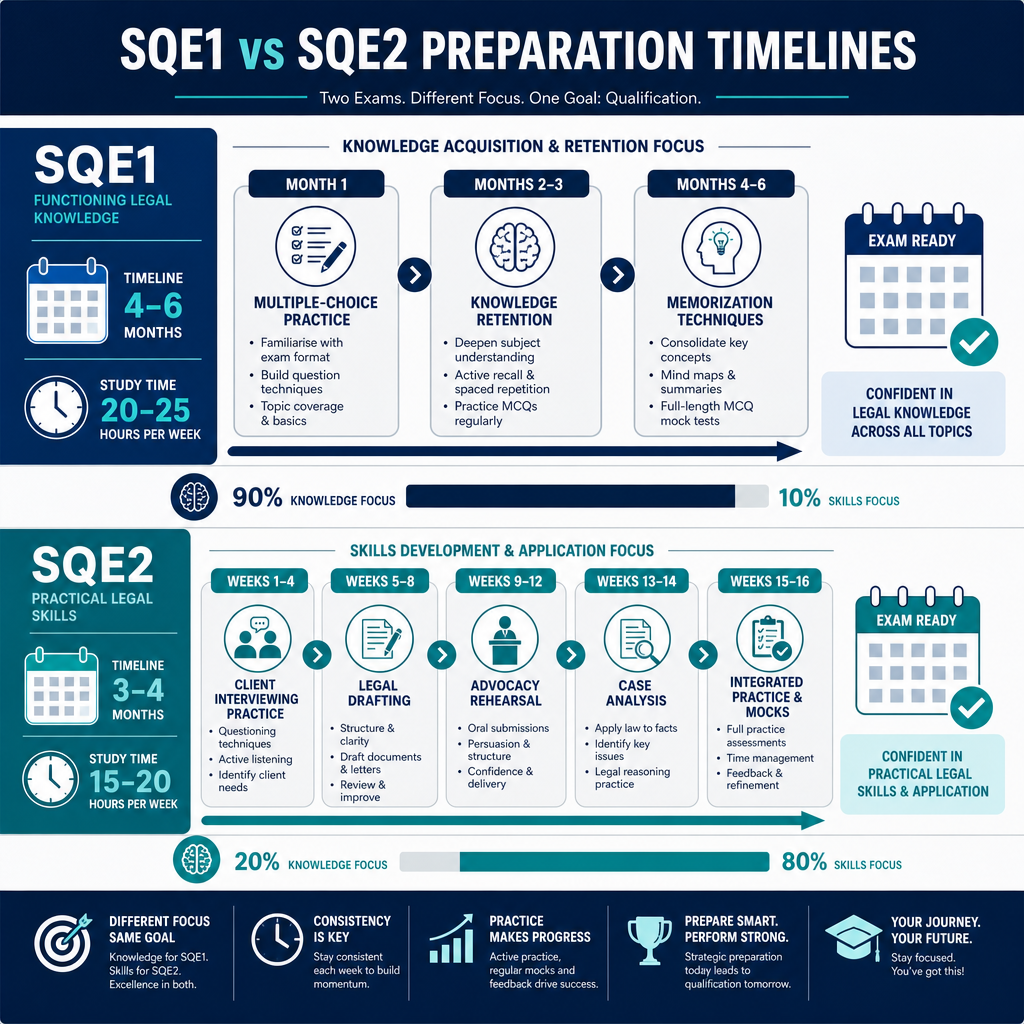
- SQE2 typically requires 3-4 months of focused preparation, shorter than SQE1’s 4-6 months, because it tests skills application rather than knowledge memorisation.
- The exam assesses practical legal skills including client interviewing, advocacy, case and matter analysis, legal research, legal writing, and legal drafting across 16 stations.
- Candidates with prior legal practice experience or LPC completion may need less preparation time, while those without practical exposure should allow the full timeline.
- Skills development requires consistent, deliberate practice rather than passive study, mock assessments and feedback loops are essential.
- Planning your sqe2 preparation time around the four annual assessment windows (January, April, July, October) helps you structure a realistic study schedule.
Why SQE2 Preparation Time Differs From SQE1
The SQE2 vs SQE1 key differences go far beyond exam format. SQE1 tests functioning legal knowledge through 180 multiple-choice questions covering two Functioning Legal Knowledge (FLK) assessments. Success depends on memorising rules, cases, and statutory provisions across subjects like contract law, tort, criminal law, property practice, and business law.
SQE2, by contrast, assesses whether you can apply that knowledge in realistic legal scenarios. The exam comprises 16 oral and written skills stations covering client interviewing, advocacy, case analysis, legal research, legal writing, and legal drafting. You’re evaluated on how you communicate with clients, construct legal arguments, draft documents, and analyse complex matters, not on recalling obscure case names.
This fundamental difference means your sqe2 preparation time focuses on skills development rather than content absorption. You can’t cram practical competencies the way you might memorise statutory provisions. Instead, you need consistent, deliberate practice to build fluency in each assessed skill.
The Skills-Based Learning Curve
Skills acquisition follows a different timeline than knowledge retention. Research in professional education shows that developing competency in practical tasks requires:
- Repeated practice with varied scenarios
- Immediate feedback to correct technique
- Incremental complexity as proficiency grows
- Consolidation periods between practice sessions
This is why most candidates find 3-4 months of focused preparation sufficient for SQE2, compared to the 4-6 months typically needed for SQE1. You’re not building a vast knowledge base from scratch, you’re refining techniques and building confidence in applying what you already know.
Prior Experience Matters More for SQE2
Your background significantly impacts sqe2 preparation time. Candidates with prior legal practice experience, paralegal work, or LPC completion often need less preparation because they’ve already developed foundational skills. If you’ve conducted client interviews, drafted legal documents, or appeared in court, you’re adapting existing competencies to the SQE2 format rather than learning from zero.
Conversely, if you’re coming straight from academic study with limited practical exposure, you’ll need the full preparation timeline to develop these skills from the ground up. This isn’t a disadvantage, it simply means being realistic about your starting point and planning accordingly.
Realistic SQE2 Preparation Timelines by Candidate Profile
Not every candidate needs the same sqe2 preparation time. Your optimal timeline depends on your background, available study hours, and prior practical experience. Here’s how to assess where you fit:
Law Graduates With Limited Practical Experience: 3-4 Months
If you’ve completed a law degree and passed SQE1 but have minimal hands-on legal work experience, plan for 3-4 months of structured preparation. This timeline allows you to:
- Develop client interviewing techniques from scratch
- Practice legal drafting across multiple document types
- Build advocacy skills through repeated mock exercises
- Refine case analysis and legal research methods
- Complete multiple full mock assessments
Aim for 15-20 hours per week of focused practice. This includes attending skills workshops, completing practice exercises, reviewing feedback, and conducting mock assessments. The consistency matters more than total hours, regular practice sessions build muscle memory for each skill.
LPC Graduates or Paralegals: 2-3 Months
If you’ve completed the Legal Practice Course or worked as a paralegal, you likely have foundational skills in client communication, legal drafting, and case analysis. Your sqe2 preparation time can be shorter, typically 2-3 months,because you’re adapting existing competencies to the SQE2 assessment format.
Focus your preparation on:
- Understanding SQE2-specific assessment criteria
- Practicing within strict time constraints
- Refining technique based on SRA competency statements
- Identifying and addressing any skill gaps
- Completing timed mock assessments
You may need only 10-15 hours per week if your practical skills are current and well-developed. However, if your LPC or paralegal experience is several years old, consider extending your timeline to refresh skills that may have atrophied.
Career Changers and Non-Law Graduates: 4-5 Months
If you’re entering the legal profession from another field or completed a non-law degree before SQE1, allow 4-5 months for SQE2 preparation. You’re not just learning exam technique, you’re developing professional skills that may be entirely new to you.
This extended timeline provides space to:
- Build confidence in professional client interactions
- Develop legal writing style and drafting conventions
- Learn advocacy techniques and courtroom etiquette
- Understand case analysis frameworks
- Practice extensively before attempting the exam
Plan for 20-25 hours per week of preparation, including skills workshops, practice exercises, and feedback sessions. Consider working with a mentor or joining study groups where you can practice client interviews and advocacy with peers.
Qualified Lawyers From Other Jurisdictions: 2-3 Months
If you’re a qualified lawyer from another jurisdiction, your sqe2 preparation time depends on how closely your training aligns with England and Wales practice. Common law jurisdictions (Australia, Canada, New Zealand, some US states) typically require 2-3 months to adapt to SQE2 format and English legal procedures.
Civil law jurisdictions or systems with significantly different procedural rules may need 3-4 months to familiarise yourself with English legal practice conventions, particularly in areas like advocacy and legal drafting where style and format differ substantially.
Breaking Down the 16 SQE2 Assessment Stations
Understanding what you’re preparing for helps you allocate your sqe2 preparation time effectively. The exam comprises 16 stations across six skill areas, each testing specific competencies:
| Skill Area | Number of Stations | Time Per Station | What’s Assessed |
|---|---|---|---|
| Client Interviewing | 2 | 30 minutes | Communication, information gathering, relationship building, legal analysis |
| Advocacy | 2 | 20 minutes | Oral presentation, legal argument, persuasion, professional conduct |
| Case and Matter Analysis | 2 | 50 minutes | Problem identification, legal analysis, practical solutions, written communication |
| Legal Research | 2 | 50 minutes | Research skills, source evaluation, application to client matter, written advice |
| Legal Writing | 4 | 30 minutes | Professional correspondence, clarity, structure, tone, legal accuracy |
| Legal Drafting | 4 | 30 minutes | Document preparation, technical accuracy, completeness, appropriate style |
Each station is independently assessed against SRA competency statements. You need to demonstrate threshold competence across all skills, there’s no compensation between stations. This means your preparation must address every skill area, not just your strengths.
Time Allocation Within Your Preparation Schedule
Don’t divide your sqe2 preparation time equally across all six skills. Instead, allocate more time to areas where you’re weakest and to skills with more assessment stations:
- Legal Writing and Drafting (8 stations combined): 35-40% of preparation time
- Client Interviewing and Advocacy (4 stations combined): 25-30% of preparation time
- Case Analysis and Legal Research (4 stations combined): 25-30% of preparation time
- Mock Assessments and Review: 10-15% of preparation time
This weighted approach ensures you’re exam-ready across all competencies while prioritising the skills that carry the most assessment weight.

Month-by-Month SQE2 Preparation Plan
Here’s a practical breakdown of how to structure your sqe2 preparation time over a typical 3-4 month period. Adjust the timeline based on your candidate profile and available study hours.
Month 1: Foundation and Familiarisation
Goals: Understand assessment criteria, develop baseline competency in each skill, identify strengths and weaknesses.
Activities:
- Review SRA competency statements for each skill area
- Complete introductory exercises in all six skills
- Attend skills workshops or watch instructional videos
- Practice basic client interviewing with peers
- Draft simple legal documents (letters, emails)
- Complete one diagnostic mock assessment
Time commitment: 15-20 hours per week
By the end of month one, you should understand what each station requires and have a clear sense of which skills need the most work. This diagnostic phase is crucial, don’t rush into intensive practice without first understanding the assessment framework.
Month 2: Intensive Skills Development
Goals: Build proficiency in weaker skill areas, increase complexity of practice scenarios, develop time management.
Activities:
- Focus 60% of time on weakest two skill areas
- Complete timed practice exercises for all skills
- Practice client interviews with increasingly complex scenarios
- Draft multiple document types under time pressure
- Conduct peer advocacy exercises
- Complete two full mock assessments
- Review feedback and adjust technique
Time commitment: 18-22 hours per week
Month two is your intensive development phase. You’re moving from understanding what’s required to actually performing at threshold competence. Expect this period to feel challenging, you’re building new neural pathways for professional skills.
Month 3: Refinement and Exam Technique
Goals: Achieve consistent threshold competence, refine exam technique, build confidence under pressure.
Activities:
- Complete timed practice in all skill areas
- Focus on time management and pacing
- Conduct three full mock assessments
- Review and implement feedback from all practice
- Practice stress management techniques
- Refine weaker skills based on mock results
- Review key legal principles for quick reference
Time commitment: 15-20 hours per week
By month three, you’re polishing technique rather than learning fundamentals. Your practice should feel increasingly comfortable, and your mock assessment scores should show consistent improvement.
Month 4 (If Needed): Consolidation and Final Preparation
Goals: Maintain competency, address any remaining gaps, enter exam with confidence.
Activities:
- Complete two final full mock assessments
- Light practice in all skill areas to maintain fluency
- Review feedback from all previous practice
- Prepare mentally and physically for exam day
- Reduce study intensity in final week to avoid burnout
Time commitment: 10-15 hours per week, tapering to 5-10 in final week
If you’re following a four-month timeline, use this final month for consolidation rather than intensive new learning. Your skills are developed, now you’re maintaining readiness and managing exam anxiety.
Common Mistakes That Extend SQE2 Preparation Time
Many candidates waste valuable preparation time on ineffective strategies. Avoid these common pitfalls:
Treating SQE2 Like SQE1
The biggest mistake is approaching SQE2 with an SQE1 mindset. You can’t passively read about client interviewing or advocacy, you must actively practice these skills. If you find yourself reading more than doing, you’re not preparing effectively.
Neglecting Feedback Loops
Skills development requires feedback. Practicing without reviewing your performance or receiving external input means you’ll reinforce bad habits rather than improve. Build feedback mechanisms into your preparation: peer review, tutor assessment, or self-evaluation against SRA criteria.
Focusing Only on Strengths
It’s tempting to practice skills you’re already good at, they feel comfortable and boost confidence. But SQE2 requires threshold competence across all areas. You must address weaknesses, even when it’s uncomfortable. Allocate more time to your weakest skills, not your strongest.
Insufficient Mock Assessments
Many candidates complete only one or two full mock assessments before the exam. This is inadequate. You need multiple full mocks to build stamina, refine time management, and identify persistent weaknesses. Aim for at least four full mock assessments during your preparation.
Starting Too Late
Unlike SQE1, where intensive cramming can sometimes work, SQE2 skills need time to develop. Starting your preparation only 4-6 weeks before the exam rarely provides sufficient time for meaningful skills development. Respect the timeline, start early enough to allow for proper practice and refinement.
Balancing SQE2 Preparation With Work and Life
Most candidates prepare for SQE2 while working, completing qualifying work experience, or managing other commitments. Here’s how to make your sqe2 preparation time sustainable:
Part-Time Study Strategies
If you’re working full-time, extend your preparation timeline to 4-5 months and aim for 10-15 hours per week of focused practice. Structure your schedule around:
- Two weeknight sessions (2-3 hours each) for targeted skills practice
- One weekend session (4-6 hours) for mock assessments and intensive practice
- Daily micro-practice (15-30 minutes) for legal writing or drafting exercises
Consistency matters more than total hours. Regular, focused practice sessions build skills more effectively than sporadic marathon study days.
Using Qualifying Work Experience for Preparation
If you’re completing qualifying work experience (QWE) while preparing for SQE2, look for opportunities to develop assessed skills in your workplace:
- Volunteer for client meetings to practice interviewing techniques
- Draft letters, emails, and documents under supervision
- Observe court hearings or tribunals to understand advocacy
- Conduct legal research for real matters
- Request feedback on your written work
This integrated approach reduces your required study time because you’re developing skills through practical work. However, you’ll still need dedicated exam preparation to understand assessment criteria and practice under timed conditions.
For more guidance on how QWE fits into your qualification journey, see our article on understanding your route to qualification.
Managing Burnout Risk
SQE preparation is a marathon, not a sprint. If you’ve just completed intensive SQE1 preparation, consider taking 2-4 weeks before starting SQE2 study. This recovery period prevents burnout and allows you to approach skills development with fresh energy.
Build rest days into your schedule. Skills development benefits from consolidation periods where your brain processes and integrates new techniques. One full rest day per week, plus lighter study weeks every 3-4 weeks, helps maintain sustainable preparation.
Choosing Your SQE2 Assessment Window
The SRA offers SQE2 assessments four times per year: January, April, July, and October. Your choice of assessment window should align with your sqe2 preparation time and personal circumstances.
Post-SQE1 Timing Considerations
Most candidates sit SQE2 within 6-12 months of passing SQE1. This timeline allows for:
- Adequate preparation time (3-4 months)
- Recovery period after SQE1 (2-4 weeks)
- Flexibility to accommodate work or personal commitments
- Time to gain some practical experience if needed
If you passed SQE1 in September, for example, you might target the April or July SQE2 window. This provides 4-6 months for recovery and preparation without losing momentum.
Seasonal and Personal Factors
Consider your personal circumstances when selecting an assessment window:
- Work commitments: Avoid peak busy periods in your job
- Personal events: Don’t schedule around weddings, moves, or major life events
- Weather and travel: January assessments may involve winter travel complications
- Holiday periods: July/August preparation overlaps with summer holidays
Choose a window that allows you to dedicate consistent time to preparation without major competing demands.
Booking Early for Preferred Dates
SQE2 assessment centres have limited capacity. Book your preferred window as soon as you’re confident in your timeline, popular centres and dates fill quickly. Early booking also creates a concrete deadline that helps structure your preparation schedule.
Resources and Support for SQE2 Preparation
Effective sqe2 preparation time requires quality resources and, often, external support. Here’s what to consider:
Preparation Courses vs Self-Study
Unlike SQE1, where self-study with practice questions can be effective, SQE2 preparation typically benefits from structured courses or coaching. Skills development requires feedback, which is difficult to obtain through self-study alone.
Consider a preparation course if you:
- Have limited practical legal experience
- Learn better with structured guidance
- Want access to mock assessments with expert feedback
- Can afford the investment (courses typically cost £1,500-£3,000)
Self-study may work if you:
- Have significant practical experience
- Can arrange peer practice and feedback
- Have access to quality practice materials
- Are confident in self-directed learning
For more on choosing between courses and self-study, see our guide on how to prepare for SQE.
Essential Practice Materials
Regardless of whether you take a course, you’ll need:
- Skills manuals covering each assessment area
- Practice scenarios for all six skills
- Model answers showing threshold competence
- Assessment criteria from SRA competency statements
- Timed mock assessments replicating exam conditions
Many providers offer these materials separately if you’re self-studying. Prioritise resources that include feedback mechanisms or model answers you can compare against your own work.
Study Groups and Peer Practice
Form or join a study group with other SQE2 candidates. Peer practice is invaluable for:
- Client interviewing (taking turns as solicitor and client)
- Advocacy (practicing oral arguments with peer feedback)
- Document review (exchanging drafts for critique)
- Mock assessments (simulating exam conditions together)
Online forums and social media groups can help you connect with other candidates for virtual practice sessions if you can’t meet in person.
Frequently Asked Questions
How long should I wait between SQE1 and SQE2?
Most candidates wait 4-6 months between passing SQE1 and sitting SQE2. This allows for 2-4 weeks of recovery after SQE1, followed by 3-4 months of focused SQE2 preparation. However, there’s no mandatory waiting period, you can sit SQE2 before SQE1 if you prefer, though most find the knowledge from SQE1 helpful for SQE2 skills application.
Can I prepare for SQE2 in less than 3 months?
Candidates with significant practical legal experience or recent LPC completion may successfully prepare in 2-3 months. However, attempting SQE2 with less than 8-10 weeks of preparation is risky unless you have extensive prior skills development. The 80% pass rate reflects candidates who prepared adequately, rushing preparation significantly increases failure risk.
Should I take a preparation course or self-study for SQE2?
SQE2 preparation typically benefits more from structured courses than SQE1 because skills development requires feedback. If you have limited practical experience, a course provides valuable coaching and mock assessments. However, experienced practitioners or those with strong self-directed learning skills may succeed with self-study using quality practice materials and peer feedback arrangements.
How many hours per week should I study for SQE2?
Most candidates dedicate 15-20 hours per week over 3-4 months. Part-time students working full-time may reduce this to 10-15 hours per week but should extend the timeline to 4-5 months. The key is consistency, regular practice sessions build skills more effectively than sporadic intensive study.
What happens if I fail SQE2?
You can retake SQE2 as many times as needed, though each attempt incurs the full assessment fee (currently around £2,000-£2,500, subject to SRA updates). Most candidates who fail identify specific skill weaknesses and target those areas in their resit preparation. The pass rate for resit candidates is typically lower than first-time attempts, emphasising the importance of adequate initial preparation.
Do I need to pass SQE2 before completing qualifying work experience?
No. You can complete SQE1, SQE2, and qualifying work experience in any order. Many candidates complete QWE while preparing for or between SQE assessments. You must pass both SQE1 and SQE2 and complete two years of QWE before applying for admission as a solicitor, but the sequence is flexible. For more details, see our article on SQE vs training contract pathways.
Conclusion: Plan Your SQE2 Preparation Time Strategically
Your sqe2 preparation time should reflect the skills-based nature of the assessment, your prior experience, and your personal circumstances. Most candidates need 3-4 months of focused preparation, significantly less than SQE1’s typical 4-6 month timeline, because you’re refining practical skills rather than building a vast knowledge base.
Start by honestly assessing your current skill level and practical experience. If you’re coming straight from academic study with limited hands-on legal work, allow the full 3-4 months and commit to 15-20 hours per week of active practice. If you have prior legal practice experience or LPC completion, you may need only 2-3 months with 10-15 hours per week.
Structure your preparation around the six assessed skills, allocating more time to weaker areas and skills with more assessment stations. Complete multiple full mock assessments to build stamina and refine exam technique. Seek feedback consistently, skills development requires knowing what you’re doing well and what needs improvement.
Choose your assessment window strategically, allowing adequate preparation time while considering work commitments and personal circumstances. Book early to secure your preferred dates and create a concrete deadline that structures your study schedule.
Remember that SQE2 tests whether you can perform as a competent solicitor, not whether you can recall legal rules. Your preparation should focus on doing rather than knowing, practicing rather than reading, and refining technique through repeated application and feedback.
With realistic planning, consistent practice, and targeted preparation, you’ll develop the practical legal skills needed to pass SQE2 and take the next step on your clear pathway to qualification. For additional guidance on your legal career journey, explore our comprehensive SQE preparation resources and trusted guidance throughout your qualification process.