



The Solicitors Regulation Authority reports that over 40% of SQE candidates in recent sittings hold overseas qualifications, yet most foreign lawyers drastically underestimate how long the foreign lawyer SQE pathway actually takes. A New York attorney might assume six months of study will suffice, while an Indian advocate discovers their timeline stretches to eighteen months once qualifying work experience and character checks are factored in. Understanding your realistic timeline based on your home jurisdiction isn’t just helpful, it’s essential for planning your legal career journey with confidence.
The foreign lawyer SQE route offers qualified international lawyers a clear pathway to practise in England and Wales without repeating a full law degree. However, the timeline varies significantly depending on your home jurisdiction’s legal system, your existing qualifications, and whether you can secure UK-based qualifying work experience. This guide breaks down realistic 2026 timelines by jurisdiction, helping you understand your route and take practical next steps.
Key Takeaways
- Foreign lawyers from common law jurisdictions typically complete the SQE pathway in 12-18 months, while civil law lawyers may need 18-24 months due to different legal foundations.
- All international candidates must pass both SQE1 and SQE2 assessments and complete two years of qualifying work experience, regardless of home jurisdiction.
- US, Canadian, Australian, and other common law lawyers often find SQE1 preparation faster due to familiar legal concepts, but still face challenges with England and Wales-specific rules.
- Civil law jurisdictions require additional study time for common law principles, particularly in areas like equity, trusts, and case law methodology.
- Your timeline depends heavily on securing qualifying work experience, which can be completed overseas or in the UK, and navigating SRA character and suitability requirements.
Understanding the Foreign Lawyer SQE Pathway in 2026
The SQE route represents a fundamental shift in how international lawyers qualify to practise in England and Wales. Unlike the previous Qualified Lawyers Transfer Scheme (QLTS), which offered exemptions based on jurisdiction, the SQE applies a consistent standard to all candidates. Every foreign lawyer must demonstrate competence through the same two-stage assessment, regardless of where they originally qualified.
This standardised approach means your home jurisdiction matters less for exemptions and more for preparation strategy. A solicitor from Scotland faces the same SQE1 and SQE2 assessments as a lawyer from Singapore or South Africa. The key difference lies in how your existing legal knowledge translates to the England and Wales legal framework.
The SQE exam pathway for foreign lawyers requires three core components: passing SQE1 (testing functioning legal knowledge), passing SQE2 (assessing practical legal skills), and completing two years of qualifying work experience. There are no shortcuts based on years of practice or seniority in your home jurisdiction.
What the SRA Requires from International Candidates
The Solicitors Regulation Authority sets clear requirements for foreign lawyers seeking admission. Beyond the SQE assessments, you must demonstrate character and suitability, which involves disclosure of any regulatory issues, criminal convictions, or professional misconduct in any jurisdiction. This process can add 2-4 months to your timeline if your home jurisdiction requires extensive documentation.
You’ll also need to provide evidence of your overseas qualification, typically including certified translations if your original documents aren’t in English. The SRA requires proof that your qualification allows you to practise law in your home jurisdiction, simply holding a law degree isn’t sufficient unless you’re also admitted to the bar or equivalent regulatory body.
Character and suitability checks typically involve:
- Criminal record certificates from every country where you’ve lived for six months or more since age 18
- Regulatory history from your home jurisdiction’s legal regulator
- Financial probity checks, including bankruptcy or insolvency history
- Professional references from qualified lawyers who can vouch for your character
For detailed guidance on registering as a foreign lawyer in the UK, the SRA provides step-by-step instructions, but expect the administrative process to take 3-6 months from initial application to final admission.
SQE1 and SQE2: What Foreign Lawyers Face
SQE1 consists of two computer-based assessments (FLK1 and FLK2) totalling 180 multiple-choice questions covering functioning legal knowledge. The assessment tests your understanding of core legal principles across business law, dispute resolution, property practice, wills and estates, criminal law, and constitutional law. For foreign lawyers, the challenge isn’t necessarily the breadth of topics but the England and Wales-specific rules and procedures.
SQE2 assesses practical legal skills through 16 stations covering client interviewing, advocacy, case and matter analysis, legal research, legal writing, and legal drafting. These skills are tested in realistic scenarios that mirror day-to-day solicitor work. International lawyers often find SQE2 more intuitive than SQE1 because practical skills translate more readily across jurisdictions.
Current SRA guidance indicates that SQE2 pass rates hover around 80% (based on the January 2026 sitting), significantly higher than SQE1 pass rates, which vary by sitting but typically range from 45-55%. This suggests that candidates who invest adequate preparation time generally succeed, but how many people pass SQE first time remains a critical consideration for timeline planning.
Realistic Timelines by Home Jurisdiction

Your home jurisdiction’s legal system fundamentally shapes your SQE preparation timeline. Common law lawyers benefit from familiar legal concepts and case law methodology, while civil law lawyers must bridge conceptual gaps in areas like equity, trusts, and precedent-based reasoning. Here’s what realistic timelines look like across major jurisdictions in 2026.
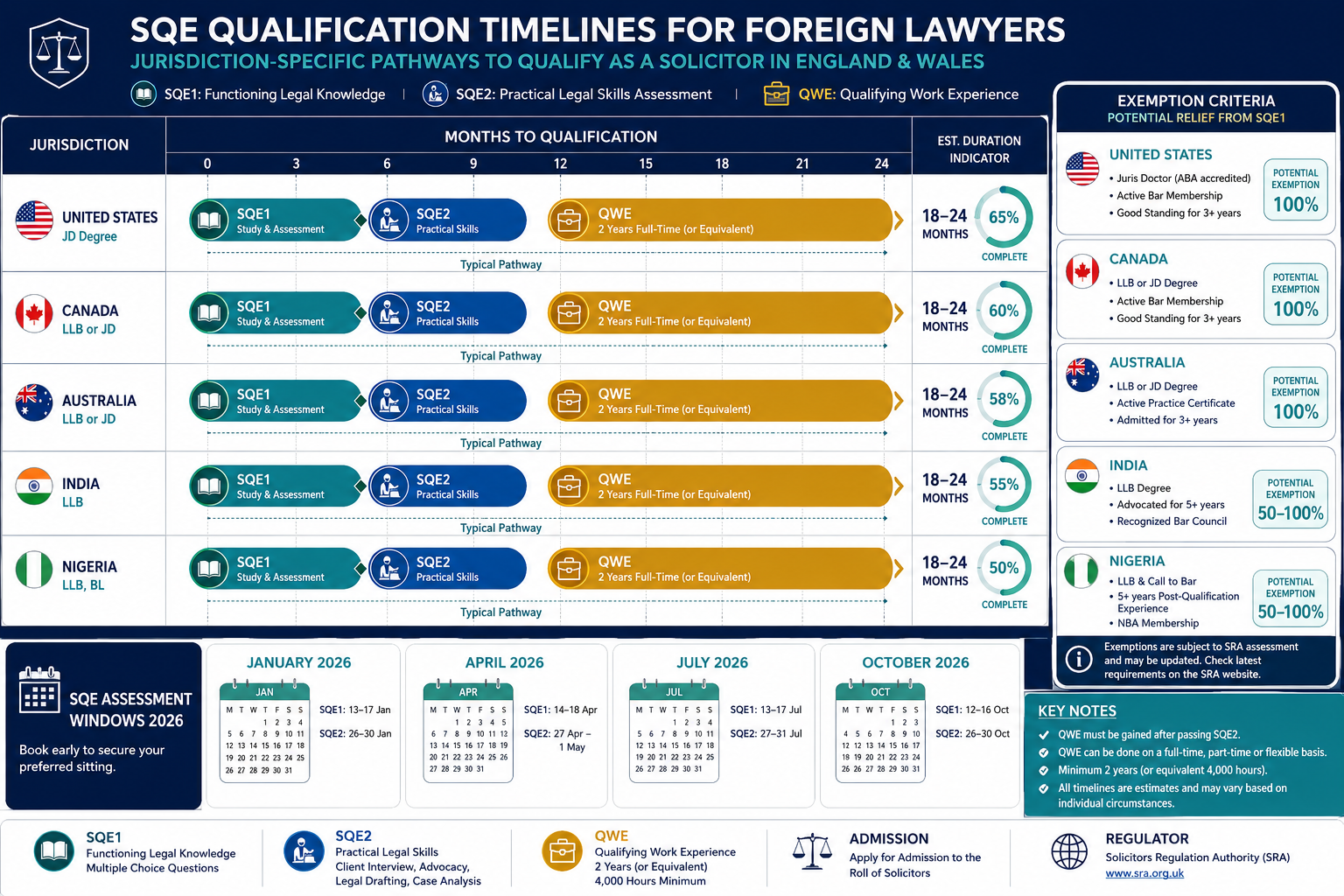
Common Law Jurisdictions: United States, Canada, Australia
United States (12-18 months total)
US attorneys typically need 4-6 months of focused study for SQE1, particularly if they’ve practised in areas covered by the assessment. The biggest challenge isn’t legal concepts but England and Wales-specific procedures, statutes, and terminology. US lawyers must unlearn certain assumptions, for example, UK property law operates fundamentally differently from US real estate law, and criminal procedure follows distinct rules.
For SQE2, US lawyers generally need 2-3 months of preparation, focusing on UK-specific advocacy styles, client care standards, and drafting conventions. The practical skills tested in SQE2 align well with US legal training, but the format and expectations differ enough to require dedicated practice.
Qualifying work experience presents the biggest variable. If you secure a role with a UK law firm or in-house legal department, you can complete QWE concurrently with SQE preparation. However, many US lawyers continue working in the US while studying, extending their total timeline to 18-24 months as they accumulate QWE hours.
Canada (12-18 months total)
Canadian lawyers, particularly those from common law provinces like Ontario or British Columbia, follow similar timelines to US attorneys. The legal systems share enough common ground that SQE1 preparation typically requires 4-6 months. Quebec lawyers (trained in civil law) face a longer timeline, closer to 18-24 months, as they must master common law concepts alongside England and Wales-specific rules.
For international students building a legal career in the UK, Canadian qualifications are generally well-regarded, which can help with securing QWE positions.
Australia and New Zealand (12-16 months total)
Australian and New Zealand lawyers often have the shortest timelines among foreign lawyers. The legal systems share significant overlap with England and Wales, particularly in areas like contract law, tort, and property. Many Australian lawyers report needing only 3-5 months for SQE1 preparation, focusing primarily on procedural differences and specific UK statutes.
SQE2 preparation typically requires 2-3 months, with Australian lawyers finding the advocacy and client interviewing components particularly familiar. The main timeline extension comes from QWE requirements and the administrative process of gathering character and suitability documentation from Australian regulatory bodies.
Civil Law Jurisdictions: Germany, France, Spain
Germany (18-24 months total)
German lawyers face a longer timeline due to fundamental differences between civil law and common law systems. SQE1 preparation typically requires 8-12 months, with particular challenges in understanding equity, trusts (which don’t exist in German law), and case law methodology. German legal training emphasises codified law and systematic interpretation, while the SQE tests application of precedent and common law reasoning.
Many German lawyers benefit from structured SQE preparation courses that explicitly teach common law concepts from first principles. Self-study is possible but generally extends the timeline by 3-6 months as candidates work through unfamiliar legal frameworks.
SQE2 preparation requires 3-4 months, with German lawyers often excelling at legal research and writing but needing additional practice in advocacy and client interviewing, which receive less emphasis in German legal training.
France (18-24 months total)
French lawyers encounter similar challenges to German lawyers, with the added complexity that French legal terminology and concepts sometimes create false cognates, terms that sound similar but mean different things in English law. SQE1 preparation typically requires 8-12 months, with trusts, equity, and land law presenting the steepest learning curves.
The French legal system’s emphasis on written submissions rather than oral advocacy means SQE2 preparation often requires 4-5 months, particularly for the advocacy and client interviewing stations. However, French lawyers’ strong foundation in legal analysis and drafting serves them well in SQE2’s written components.
Spain and Other Romance Language Jurisdictions (18-24 months total)
Spanish lawyers and those from other Romance language civil law jurisdictions face similar timelines to French and German lawyers. Language can present an additional challenge if English isn’t your first language, not because the SQE requires perfect English, but because legal English contains technical terminology and nuanced distinctions that take time to master.
For foreign lawyers considering the SQE route, civil law jurisdictions should budget extra time for foundational common law concepts before diving into England and Wales-specific rules.
Mixed Jurisdiction Lawyers: Scotland, South Africa, India
Scotland (10-14 months total)
Scottish solicitors have perhaps the most streamlined pathway among foreign lawyers. Scots law shares significant overlap with English law, particularly in commercial areas, though important differences exist in property law, criminal law, and civil procedure. SQE1 preparation typically requires 3-5 months, focusing on areas where English law diverges from Scots law.
SQE2 preparation requires 2-3 months, with Scottish solicitors finding the practical skills assessment largely familiar. The main timeline consideration is QWE, many Scottish solicitors already work for firms with English offices, making concurrent QWE accumulation straightforward.
South Africa (14-18 months total)
South African lawyers benefit from a mixed legal system that combines Roman-Dutch civil law with English common law influences. This hybrid background means SQE1 preparation typically requires 5-7 months, longer than pure common law jurisdictions but shorter than pure civil law systems.
Areas like trusts, equity, and contract law feel familiar to South African lawyers, while property law and criminal procedure require more focused study due to England and Wales-specific rules. SQE2 preparation typically requires 3-4 months, with South African lawyers’ strong advocacy training translating well to the assessment format.
India, Pakistan, and Other Commonwealth Jurisdictions (14-20 months total)
Lawyers from India, Pakistan, Bangladesh, and other Commonwealth jurisdictions trained in common law systems typically need 5-8 months for SQE1 preparation. The legal systems share common law foundations, but significant procedural and substantive differences exist, particularly in areas like land law, criminal procedure, and professional conduct rules.
Indian advocates often find SQE2 preparation (3-4 months) challenging in client interviewing and legal drafting, as Indian legal practice emphasises court advocacy over client-facing skills and transactional work. However, the strong foundation in legal research and oral advocacy serves candidates well in those SQE2 components.
For insights on how foreign work experience affects UK legal careers, Commonwealth lawyers should understand that UK firms increasingly value international experience but still prioritise candidates who demonstrate understanding of English legal practice.
Building Your Personal Timeline: Key Variables
Beyond your home jurisdiction, several personal factors significantly impact your realistic timeline for qualifying via the foreign lawyer SQE route. Understanding these variables helps you create a practical, achievable plan rather than an optimistic timeline that sets you up for disappointment.
Study Time and Preparation Intensity
Full-time study (30-40 hours per week) allows most common law lawyers to prepare for SQE1 in 3-4 months and SQE2 in 2-3 months. This intensive approach suits lawyers taking a career break or those who’ve saved sufficient funds to focus exclusively on qualification.
Part-time study (10-15 hours per week) while working full-time extends timelines significantly. Common law lawyers typically need 6-9 months for SQE1 and 3-5 months for SQE2 when studying part-time. Civil law lawyers should budget 10-15 months for SQE1 and 4-6 months for SQE2 when balancing work and study.
For guidance on studying for the SQE part-time, consider that sustainable part-time study requires disciplined scheduling and realistic expectations about progress.
Preparation course vs self-study also impacts timelines. Structured courses provide clear learning pathways and reduce time spent figuring out what to study, potentially shortening preparation by 1-3 months. However, preparing for the SQE without a traditional course is entirely feasible if you’re self-directed and comfortable creating your own study plan.
Qualifying Work Experience Logistics
The two-year QWE requirement presents the biggest timeline variable for foreign lawyers. You have several options, each with different implications:
Concurrent QWE (while preparing for SQE): If you secure a legal role in the UK or with an international firm that provides qualifying work experience, you can accumulate QWE hours while studying. This approach doesn’t extend your timeline beyond exam preparation but requires finding suitable employment, which can take 3-6 months of job searching.
Overseas QWE: The SRA allows you to complete QWE outside England and Wales, provided the work involves applying legal knowledge and skills. Many foreign lawyers continue their existing legal practice while preparing for the SQE, documenting their work to meet QWE requirements. This approach works well but requires careful documentation and confirmation from a solicitor or compliance officer that your work meets SQE standards.
For details on overseas qualifying work experience options, note that the SRA requires QWE to be confirmed by a solicitor or compliance officer, which can be challenging if you’re working outside the UK without connections to English-qualified solicitors.
Sequential QWE (after passing SQE): Some foreign lawyers prefer to pass both SQE assessments before seeking UK legal roles, using their SQE success to strengthen job applications. This approach extends your total timeline by 2+ years but may make sense if you’re currently established in your home jurisdiction and want to secure qualification before relocating.
Character and Suitability Processing Time
Don’t underestimate the administrative timeline for character and suitability checks. The process typically requires:
- 1-2 months: Gathering criminal record certificates from all relevant jurisdictions
- 1-2 months: Obtaining regulatory history and good standing certificates from your home jurisdiction’s legal regulator
- 1-3 months: SRA review of your application and supporting documents
If you’ve lived or worked in multiple countries, or if your home jurisdiction has slow administrative processes, budget 4-6 months for character and suitability documentation. Start this process early, ideally before you begin SQE preparation, to avoid delays between passing the assessments and final admission.
Practical Next Steps for Foreign Lawyers
Creating your personal timeline starts with honest assessment of your current position and realistic planning around the variables discussed above. Here’s how to build a step-by-step pathway that works for your circumstances.
Assess Your Starting Point
Evaluate your legal knowledge gaps: Take a diagnostic practice test or review SQE1 sample questions to identify which areas require most study. Common law lawyers typically find business law and contract law familiar but struggle with England and Wales-specific property law and criminal procedure. Civil law lawyers often need foundational work in equity, trusts, and case law methodology before tackling substantive topics.
Determine your study capacity: Calculate realistic weekly study hours based on work commitments, family responsibilities, and personal circumstances. Be honest, overestimating your available time leads to missed deadlines and discouragement. Most successful candidates study consistently rather than intensively, building sustainable habits over months rather than cramming.
Research QWE options: Investigate whether your current legal work could qualify as QWE with proper documentation, or whether you need to secure a new role. If you’re working overseas, identify solicitors or compliance officers who could potentially confirm your QWE. If you need UK-based experience, start researching firms and roles that accept foreign-qualified lawyers.
Create Your Timeline
Map backward from your target admission date: If you want to be admitted as a solicitor by January 2027, work backward through the required steps. Account for SQE2 (typically 3-4 months after SQE1), SQE1 preparation, QWE accumulation, and character and suitability processing. This backward planning reveals your actual start date and helps identify whether your target is realistic.
Build in buffer time: Add 20-30% buffer to your estimated timelines for each component. Unexpected work demands, family emergencies, or simply needing more study time than anticipated are normal. Candidates who build buffer time into their plans experience less stress and higher success rates than those working to tight deadlines.
Schedule around SQE assessment windows: In 2026, SQE assessments run in January, April, July, and October windows. Plan your preparation to align with these dates, ensuring you’re ready for your target sitting rather than rushing to meet the next available date.
For realistic guidance on how long to prepare for the SQE exam, remember that quality preparation beats rushed cramming every time.
Invest in Targeted Preparation
Choose preparation resources strategically: Whether you opt for a structured course or self-study, ensure your resources specifically address England and Wales law rather than general common law principles. Many foreign lawyers waste time studying materials that don’t align with SQE assessment objectives.
Practice with realistic questions: The SQE uses specific question formats and testing approaches. Regular practice with SQE-style questions helps you understand what examiners expect and identifies knowledge gaps more effectively than passive reading. Our SQE1 practice questions are written by qualified solicitors who understand the assessment methodology.
Focus on high-value topics: Not all SQE topics carry equal weight. Business law, property practice, and dispute resolution comprise significant portions of SQE1, while client interviewing and legal research feature prominently in SQE2. Prioritise these areas in your study plan.
Document Everything for QWE
Start documenting your qualifying work experience from day one, even if you haven’t yet passed the SQE assessments. Detailed contemporaneous records make QWE confirmation much easier than trying to reconstruct months or years of work retrospectively.
Keep records of:
- Specific legal tasks and matters you worked on
- Skills developed and applied (legal research, drafting, client interaction, etc.)
- Dates and duration of each experience
- Supervisors or colleagues who can confirm your work
The SRA requires QWE to be confirmed by a solicitor or compliance officer, so maintain relationships with qualified solicitors who can vouch for your experience when the time comes.
Frequently Asked Questions
Can I take SQE1 and SQE2 in the same year?
Yes, but it’s challenging. You must pass SQE1 before sitting SQE2, and most candidates need 2-4 months between assessments for adequate SQE2 preparation. If you pass SQE1 in January, you could potentially sit SQE2 in July or October of the same year, but this compressed timeline suits only well-prepared candidates with significant study time available.
Do I need to complete QWE before taking the SQE assessments?
No. You can take SQE1 and SQE2 before, during, or after completing qualifying work experience. However, you cannot be admitted as a solicitor until you’ve passed both assessments and completed two years of QWE. Many foreign lawyers prefer to pass the assessments first, then use their SQE success to secure UK legal roles where they complete QWE.
Will my years of practice in my home jurisdiction count toward QWE?
Potentially, yes. The SRA allows overseas legal work to count as QWE if it involves applying legal knowledge and skills in a practical setting. However, you must have the work confirmed by a solicitor or compliance officer, which can be challenging if you’re working outside the UK. The work must also meet SQE competency standards, so routine administrative tasks or purely business-focused roles may not qualify.
How much does the foreign lawyer SQE route cost in total?
Budget £7,000-£15,000 for the complete pathway, including SQE1 assessment fees (approximately £3,980 for both FLK1 and FLK2), SQE2 assessment fees (approximately £4,450), preparation materials or courses (£1,000-£5,000), and character and suitability application fees. This doesn’t include living expenses during study or potential income loss if you reduce work hours to study. For detailed cost breakdowns, see our SQE cost and funding options guide.
What happens if I fail SQE1 or SQE2?
You can retake either assessment, but each attempt requires paying the full assessment fee again. There’s no limit on attempts, but what happens if you fail the SQE three times becomes a serious consideration, financially and emotionally. Most candidates who fail once benefit from identifying specific knowledge gaps and adjusting their preparation approach before retaking.
Can I practise law in the UK while completing the SQE pathway?
Not as a solicitor. However, you can work in legal roles under different titles (legal consultant, foreign legal consultant, paralegal) while completing the SQE pathway. Many international law firms employ foreign-qualified lawyers in these capacities, allowing you to gain UK legal experience and complete QWE while preparing for the assessments. You cannot hold yourself out as a solicitor or use that title until you’re formally admitted by the SRA.
Conclusion
The foreign lawyer SQE pathway offers international lawyers a clear, standardised route to qualify as solicitors in England and Wales, but realistic timeline planning is essential for success. Your home jurisdiction’s legal system significantly impacts preparation time, common law lawyers typically complete the pathway in 12-18 months, while civil law lawyers should budget 18-24 months for the additional foundational learning required.
Beyond jurisdiction, your personal circumstances matter enormously. Full-time study accelerates timelines, while part-time preparation extends them. Securing qualifying work experience, whether in the UK or overseas, presents the biggest variable, potentially adding months or years depending on your employment situation. Character and suitability processing adds another 3-6 months of administrative time that many candidates underestimate.
Start by honestly assessing your current legal knowledge, available study time, and QWE options. Build a realistic timeline that accounts for your specific circumstances rather than optimistic best-case scenarios. Invest in targeted preparation resources that focus on England and Wales law, and practice regularly with SQE-style questions to build exam confidence.
The journey from foreign lawyer to England and Wales solicitor requires commitment, but thousands of international lawyers successfully navigate this pathway each year. With clear planning, consistent effort, and realistic expectations, you can qualify with confidence and launch the next chapter of your legal career journey.
Ready to begin? Explore our SQE practice questions written by qualified solicitors, review our step-by-step guidance for foreign lawyers, and take the first practical step toward your UK qualification today.