



Between 2021 and 2026, the route to becoming a solicitor in England and Wales underwent its most significant transformation in decades. The Solicitors Qualifying Examination (SQE) replaced the Legal Practice Course (LPC) as the mandatory assessment, fundamentally reshaping how aspiring solicitors qualify. Yet five years into this new system, confusion persists about what a training contract actually means now, whether you still need one, and how qualifying work experience differs from the traditional two-year contract. This guide cuts through the complexity to show you exactly what changed, what stayed the same, and what it means for your legal career journey in 2026.
Key Takeaways
- The training contract is no longer mandatory for qualification; qualifying work experience (QWE) replaced it as the practical requirement under the SQE route
- You can now complete your two years of QWE across multiple organisations, part-time roles, or even alongside your studies, offering unprecedented flexibility
- Traditional training contracts still exist and remain highly competitive, but they now run parallel to the SQE rather than being tied to the LPC
- The SQE route has made qualification more accessible for career changers, international lawyers, and non-law graduates, but securing employment remains challenging
- Costs, timelines, and employer sponsorship have all shifted significantly, requiring candidates to plan their qualification pathway more strategically than ever before
The Traditional Training Contract: What It Was and Why It Changed
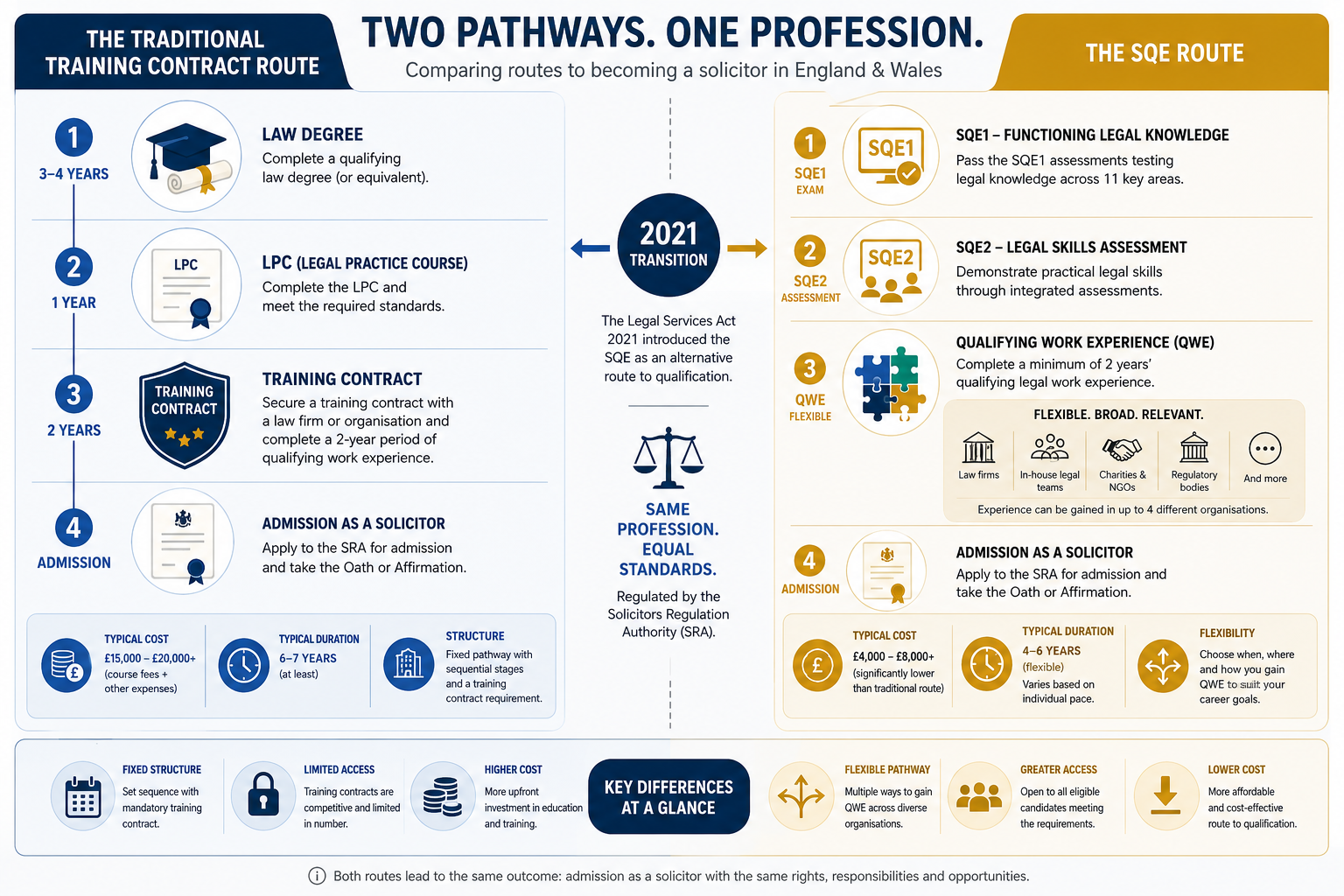
For decades, the training contract represented the gold standard pathway to becoming a solicitor. This structured two-year period of employment at a law firm combined practical experience with formal training, typically following completion of the LPC. Trainees rotated through different practice areas, known as “seats”, gaining exposure to corporate law, litigation, property, and other specialisms under the supervision of qualified solicitors.
The training contract system worked well for large commercial firms with established training programmes, but it created significant barriers for many aspiring solicitors. Competition for contracts was fierce, with top firms receiving thousands of applications for a handful of positions. Smaller firms often struggled to provide the breadth of experience required by the Solicitors Regulation Authority (SRA), and many capable candidates found themselves unable to qualify simply because they couldn’t secure a contract.
The system also lacked flexibility. Candidates typically needed to complete their training contract at a single organisation, making it difficult to gain diverse experience or accommodate personal circumstances. International lawyers and career changers faced particular challenges, as their previous experience often didn’t count toward the training contract requirement.
By 2019, the SRA recognised these limitations and introduced the SQE as a more flexible, accessible route to qualification. The traditional training contract wasn’t abolished, it evolved into something broader and more adaptable.
Understanding Qualifying Work Experience Under the SQE
Qualifying work experience (QWE) represents the most significant practical change for candidates pursuing qualification in 2026. Unlike the rigid training contract structure, QWE offers remarkable flexibility while maintaining professional standards.
You need to complete two years (or 2,240 hours) of work experience that allows you to develop some or all of the competencies required to be a solicitor. This experience must be confirmed by a solicitor or compliance officer for legal practice (COLP), but it doesn’t need to happen at a traditional law firm or follow any prescribed structure.
Key features of QWE include:
- Flexibility in timing: Complete your QWE before, during, or after passing SQE1 and SQE2
- Multiple organisations: Gain experience across different employers, practice areas, or even countries
- Part-time work: Hours count proportionally, so part-time roles are fully recognised
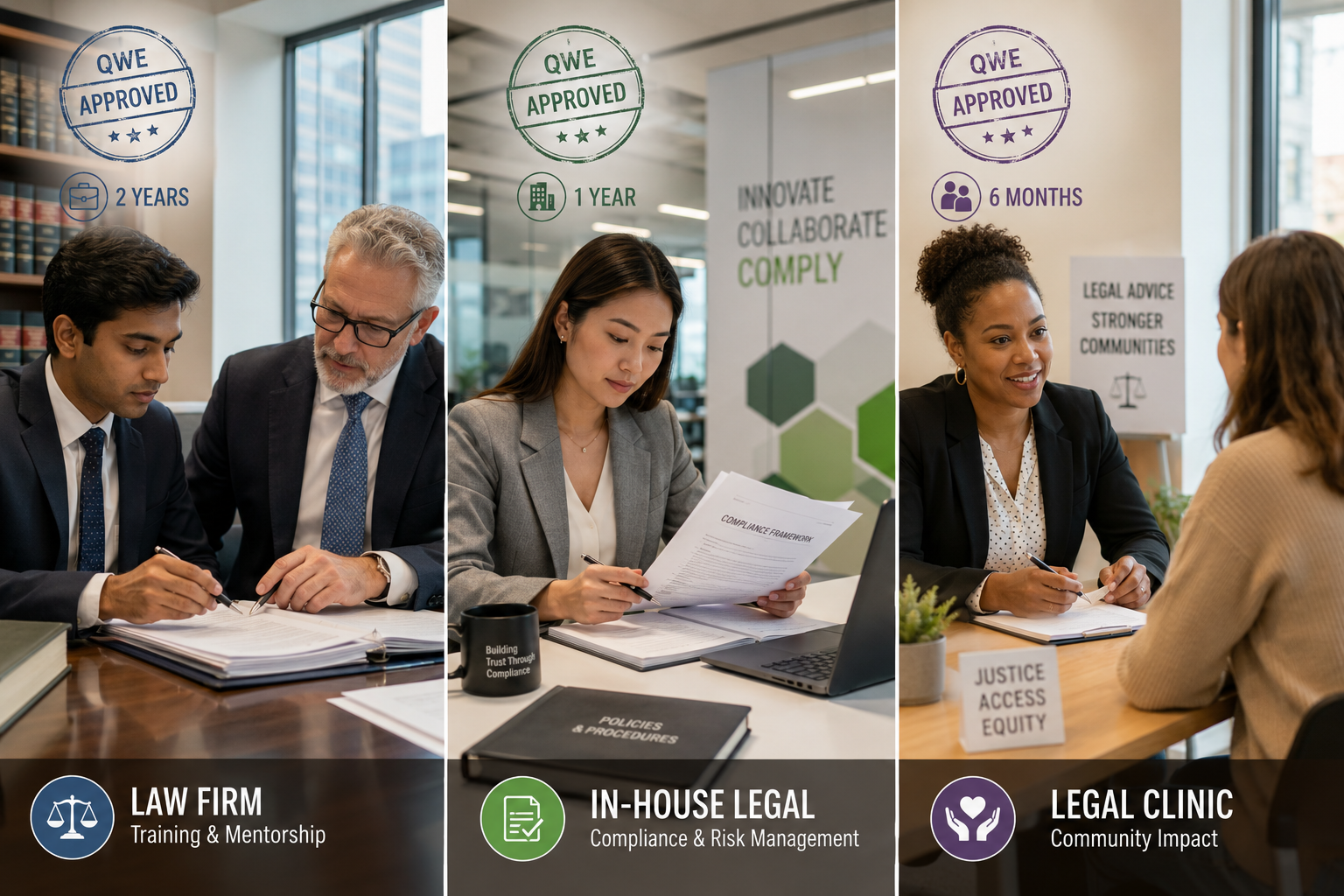
- Diverse settings: Law firms, in-house legal departments, legal clinics, advice centres, and even some non-legal roles with a legal component can qualify
- No formal application: Unlike training contracts, you don’t apply for QWE, you simply document qualifying experience you’ve already gained
This flexibility has opened doors for many candidates who previously struggled to qualify. Career changers can count relevant experience from their previous roles. Parents returning to work can build QWE gradually through part-time positions. International lawyers can have their overseas experience recognised more easily.
However, this flexibility comes with responsibility. You must ensure your experience genuinely develops the competencies the SRA requires, and you need a qualified solicitor to confirm this. Understanding qualifying work experience for SQE becomes crucial for planning your pathway effectively.
Do You Still Need a Training Contract in 2026?
This question causes more confusion than almost any other aspect of the SQE route. The straightforward answer: no, you don’t need a traditional training contract to qualify as a solicitor in 2026. The QWE requirement has replaced it.
However, the reality is more nuanced. Traditional training contracts still exist and remain highly sought after for several compelling reasons:
Why training contracts remain valuable:
- Structured development: Firms with training contracts provide organised seat rotations, formal training, and clear progression pathways
- Financial support: Many firms pay competitive salaries during training and cover SQE exam and preparation costs
- Qualification guarantee: Completing a training contract typically leads to a newly qualified (NQ) solicitor position at the same firm
- Professional network: Training at an established firm builds connections and credibility in the legal market
- Comprehensive experience: Seat rotations ensure exposure to multiple practice areas, satisfying QWE requirements automatically
The key difference in 2026 is that training contracts now run alongside the SQE rather than being tied to the LPC. Firms structure their programmes differently, some require candidates to pass SQE1 before starting, others support candidates through both SQE1 and SQE2 during the contract period.
For candidates without a training contract, the challenge shifts from securing the contract itself to building sufficient QWE through alternative routes and then finding employment as a newly qualified solicitor. This path offers more flexibility but requires greater self-direction and often involves more financial risk.
Our guide on SQE vs. training contract: what no one tells you about actually qualifying explores these trade-offs in detail, helping you decide which route aligns with your circumstances.
What Actually Changed Between 2021 and 2026
The transition from the LPC-based system to the SQE route brought fundamental changes that continue to reshape the qualification landscape:
Assessment Structure
Before (LPC era): Candidates completed a one-year LPC course covering core practice areas and electives, followed by a two-year training contract. Assessment was course-based, with different providers offering varying standards.
Now (SQE era): All candidates take the same standardised assessments, SQE1 tests functioning legal knowledge through 180 multiple-choice questions, while SQE2 evaluates practical legal skills through written and oral tasks. This centralised approach ensures consistent standards regardless of where you studied.
Cost and Funding
Before: LPC courses cost between £12,000 and £18,000, with additional maintenance costs during the study year. Training contract salaries then provided income during the practical phase.
Now: The cost of taking the SQE exam includes exam fees (currently around £3,980 for both SQE1 and SQE2, though candidates should verify current fees with the SRA) plus preparation course costs ranging from £3,000 to £10,000 depending on the provider. However, you can potentially earn while gaining QWE, offsetting some costs.
Qualification Timeline
Before: The pathway was relatively fixed: law degree (or GDL for non-law graduates), one-year LPC, two-year training contract, typically 4-5 years minimum after starting university.
Now: The timeline is highly variable. You can take SQE1 and SQE2 whenever you’re ready, gain QWE flexibly, and potentially qualify faster or slower depending on your circumstances. Some candidates complete the entire SQE route in under two years, while others spread it over five or more years while working.
Accessibility for Different Backgrounds
Before: The system favoured traditional law graduates with the financial means to complete the LPC and the credentials to secure competitive training contracts.
Now: The SQE route has opened pathways for career changers, international lawyers, apprentices, and those from less privileged backgrounds. However, jobs after SQE: why some firms never call back highlights that employment challenges persist despite qualification becoming more accessible.
Employer Involvement
Before: Firms committed to training contracts early, often recruiting two years before the contract started, and provided structured training throughout.
Now: Employer involvement varies dramatically. Some firms maintain traditional training programmes aligned with the SQE. Others hire qualified solicitors without providing training support. Many candidates complete the SQE independently before seeking employment, shifting financial and career risk to the individual.
How Firms Approach Training Contracts in 2026
Law firms have adapted their training programmes in diverse ways since the SQE’s introduction, creating a fragmented landscape that candidates must navigate carefully.
Large Commercial Firms
Most major City and international firms maintain structured training contracts similar to the pre-SQE era, but with key modifications:
- Recruitment typically occurs two years in advance through vacation schemes and assessment centres
- Many firms now require candidates to pass SQE1 before starting the training contract
- Firms usually fund SQE2 preparation and exam fees during the contract
- Salaries remain competitive, with top firms paying £50,000+ for trainees in 2026
- Training contracts still involve seat rotations and formal training programmes
- Do law firms pay for the SQE? Yes, most large firms cover costs for their trainees, though policies vary
Mid-Sized and Regional Firms
These firms show more variation in their approach:
- Some maintain traditional training contracts with SQE integration
- Others have moved to “training solicitor” roles that provide QWE without the formal training contract structure
- Funding support varies, some firms cover SQE costs, others expect candidates to self-fund
- Recruitment may be more flexible, with opportunities arising throughout the year
- Salaries are typically lower than large commercial firms but still provide financial stability during qualification
Small Firms and Alternative Employers
Smaller practices, in-house legal teams, and alternative legal service providers typically:
- Rarely offer formal training contracts
- May provide QWE opportunities for candidates who have already passed the SQE
- Expect candidates to self-fund their qualification journey
- Offer more flexible working arrangements but less structured training
- Provide valuable experience that counts toward QWE but without the employment security of a training contract
Understanding these different approaches helps you target your applications strategically and set realistic expectations about support and progression.
The Reality of Qualifying Without a Training Contract
Many candidates in 2026 pursue qualification without securing a traditional training contract, either by choice or necessity. This pathway offers flexibility but requires careful planning and resilience.
Building Your QWE Portfolio
Without a training contract, you need to actively construct a QWE portfolio that demonstrates the breadth of competencies the SRA requires. Successful strategies include:
Paralegal roles: Many law firms hire paralegals who can gain QWE while earning a salary. These positions provide practical legal experience, though they may not offer the same breadth as training contract seat rotations.
In-house positions: Corporate legal departments, charities, and public sector organisations employ legal professionals who can supervise QWE. These roles often provide focused experience in specific areas.
Legal clinics and pro bono work: Is volunteering or pro bono work the key to qualifying? explores how unpaid work can contribute to QWE, though you’ll need paid employment to support yourself financially.
Portfolio approach: Combining part-time roles, freelance work, and volunteer positions to accumulate the required hours and competencies across different settings.
Financial Considerations
Self-funding your qualification involves significant costs and opportunity costs:
- SQE exam fees and preparation courses (£7,000-£14,000 total)
- Living expenses during study periods
- Potentially lower salaries in paralegal or junior roles compared to training contract salaries
- No guarantee of employment after qualification
However, this route also offers advantages: you can work while studying, potentially qualify faster, and gain diverse experience that may differentiate you in the job market.
The Employment Challenge
The most significant hurdle for candidates qualifying without training contracts is securing employment as a newly qualified solicitor. Firms often prefer candidates who completed training contracts, creating a challenging dynamic for independent qualifiers.
Strategies that improve employment prospects include:
- Building a strong professional network through legal events, LinkedIn, and industry connections
- Gaining experience in niche or high-demand practice areas
- Demonstrating commercial awareness and business development potential
- Considering alternative legal careers in legal tech, compliance, or legal operations
- Being geographically flexible and willing to relocate for opportunities
Comparing Costs: Training Contract vs Independent SQE Route
Understanding the financial implications of each pathway helps you make informed decisions about your qualification journey.
| Cost Element | Training Contract Route | Independent SQE Route |
|---|---|---|
| SQE1 Exam Fee | Usually firm-funded | £1,558 (self-funded, verify current fees) |
| SQE1 Preparation | Usually firm-funded (£3,000-£5,000) | £3,000-£5,000 (self-funded) |
| SQE2 Exam Fee | Usually firm-funded | £2,422 (self-funded, verify current fees) |
| SQE2 Preparation | Usually firm-funded (£3,000-£5,000) | £3,000-£5,000 (self-funded) |
| Income During QWE | £25,000-£50,000+ salary over 2 years | Variable (paralegal/other roles) |
| Total Out-of-Pocket | £0-£2,000 (if firm-funded) | £10,000-£15,000+ |
| Opportunity Cost | Lower (earning while training) | Higher (potentially lower salaries) |
These figures illustrate why securing a training contract remains financially attractive, though the independent route offers flexibility that may justify the additional cost for some candidates.
Pass Rates and Success Factors: What the Data Shows
Understanding SQE pass rates helps set realistic expectations and identify success factors for your qualification journey.
As of 2026, SQE pass rates vary significantly depending on candidate background and preparation approach. Recent data shows:
- SQE1 overall pass rate: Approximately 53-58% across all sittings (though this varies by sitting)
- SQE2 pass rate: Generally higher than SQE1, around 65-70%
- First-time pass rates: Candidates with structured preparation courses and legal education backgrounds perform better
- Repeat attempt rates: What happens if you fail the SQE 3 times? outlines the rules, but most successful candidates pass within two attempts
Factors correlating with higher pass rates:
- Structured preparation: Candidates using comprehensive preparation courses outperform those relying solely on self-study
- Legal education background: Law graduates and those with prior legal qualifications show higher pass rates
- Adequate study time: How long to prepare for the SQE? suggests 3-6 months of focused study for each exam
- Practice question exposure: Regular practice with exam-style questions significantly improves performance
- Support systems: Candidates with training contracts or study groups demonstrate better outcomes
The standardised nature of the SQE means that preparation quality matters more than ever. Unlike the LPC, where course providers varied in rigour, every candidate faces the same assessment, making thorough preparation essential.
Alternative Pathways: Apprenticeships and International Routes
The SQE era has also clarified alternative pathways to qualification that don’t follow the traditional university-to-training-contract route.
Solicitor Apprenticeships
Becoming a solicitor without a degree or through apprenticeship has become more viable under the SQE system. Solicitor apprenticeships combine work, study, and earning:
- Typically last 5-6 years for school leavers
- Apprentices work at a law firm while studying for the SQE
- Employers fund the qualification and pay a salary throughout
- QWE is gained during the apprenticeship period
- Successful completion leads to qualification without university debt
This route suits candidates who prefer practical learning, want to avoid student debt, and can commit to a longer qualification timeline.
International Lawyers and Cross-Qualification
The SQE has simplified the process for overseas-qualified lawyers to practise in England and Wales. How foreign lawyers can qualify as UK solicitors: step-by-step explains that:
- Lawyers from some jurisdictions may receive exemptions from SQE1 or parts of it
- QWE requirements may be satisfied by overseas legal experience
- The process is more transparent and accessible than the previous Qualified Lawyers Transfer Scheme (QLTS)
- International candidates should verify their specific circumstances with the SRA
CILEX and Alternative Legal Qualifications
The harsh truth about apprenticeships, CILEX & alternative legal paths examines other routes into legal practice, including:
- CILEX qualification for legal executives, which can lead to solicitor qualification via the SQE
- Paralegal experience that builds toward QWE
- Legal operations and compliance roles that provide legal experience without traditional qualification
These alternatives offer different trade-offs in terms of time, cost, and career prospects.
Practical Next Steps: Planning Your Qualification Route
Whether you’re pursuing a training contract or planning to qualify independently, these practical steps will help you navigate your legal career journey with confidence.
If You’re Targeting Training Contracts
- Start early: Major firms recruit 18-24 months in advance; begin applications in your penultimate year of university
- Gain relevant experience: Vacation schemes, legal work experience, and extracurricular activities strengthen applications
- Prepare for SQE1: Many firms now expect candidates to pass SQE1 before starting, so plan your study timeline accordingly
- Research firm cultures: Target firms whose values, practice areas, and training approaches align with your career goals
- Develop commercial awareness: Firms assess business understanding and sector knowledge during recruitment
If You’re Qualifying Independently
- Pass SQE1 first: Demonstrating you’ve passed SQE1 makes you more attractive for paralegal roles and QWE opportunities
- Build your QWE strategically: Seek roles that provide diverse experience across multiple competency areas
- Document everything: Keep detailed records of your work experience, skills developed, and supervising solicitors
- Network actively: Attend legal events, join professional associations, and build relationships in your target practice areas
- Plan financially: Budget for exam fees, preparation courses, and potential periods of lower income
Universal Preparation Strategies
Regardless of your route, these strategies support success:
- Invest in quality preparation: Can I study for SQE on my own? explores self-study options, but most successful candidates use structured courses
- Practice extensively: Regular exposure to exam-style questions builds confidence and identifies knowledge gaps
- Understand the assessment: SQE2 vs SQE1 key differences: complete 2026 guide helps you prepare appropriately for each exam
- Know the scoring system: What is the SQE pass mark? explains how results are calculated
- Plan for contingencies: Understand how long the SQE is valid for and what happens if you need to retake
Frequently Asked Questions
Do I need a training contract to become a solicitor in 2026?
No, you don’t need a traditional training contract to qualify as a solicitor under the SQE route. Instead, you must complete two years of qualifying work experience (QWE), which can be gained across multiple organisations, part-time roles, or even alongside your studies. However, training contracts remain valuable for the structured training, financial support, and employment security they provide.
Can I complete my QWE before passing the SQE exams?
Yes, you can complete your QWE before, during, or after passing SQE1 and SQE2. The SRA allows flexibility in the order you complete these requirements. Many candidates gain some QWE through paralegal work before taking the exams, while others pass the exams first and then focus on accumulating the required work experience.
How much does it cost to qualify via the SQE without firm sponsorship?
Qualifying independently typically costs £10,000-£15,000, including SQE1 and SQE2 exam fees (approximately £3,980 total, though candidates should verify current fees with the SRA) and preparation courses (£6,000-£10,000). This doesn’t include living expenses during study periods or the opportunity cost of potentially lower salaries while gaining QWE. In contrast, training contracts usually cover these costs and provide a salary.
What’s the difference between a training contract and QWE?
A training contract is a specific type of employment relationship, a two-year structured programme at a law firm that automatically satisfies QWE requirements. QWE is the broader requirement under the SQE route: any legal work experience totalling two years (2,240 hours) that develops solicitor competencies and is confirmed by a qualified solicitor. You can gain QWE through training contracts, paralegal roles, in-house positions, legal clinics, or a combination of different experiences.
Are training contracts harder to get now than before the SQE?
Competition for training contracts remains intense, though the dynamics have shifted slightly. Some firms have reduced training contract numbers as they experiment with alternative recruitment models, while others maintain similar intake levels. The main difference is that firms now often require candidates to pass SQE1 before starting, adding an additional hurdle. However, the overall competitiveness, with thousands of applicants for limited positions at top firms, remains similar to the pre-SQE era.
Can I switch from the LPC route to the SQE route?
If you completed the LPC before September 2021, you can still qualify under the old system until 2032 by securing a training contract. However, many candidates who started under the LPC system have switched to the SQE route, particularly if they struggled to secure training contracts. The SQE route may offer more flexibility for these candidates, though they’ll need to pass both SQE1 and SQE2 and complete QWE. Do firms prefer LPC or SQE? explores employer perspectives on both qualifications.
Conclusion
The shift from training contracts to qualifying work experience represents the most significant change in solicitor qualification in a generation. By 2026, the SQE route has matured from a new experiment into the established pathway, offering unprecedented flexibility for aspiring solicitors from diverse backgrounds.
Traditional training contracts haven’t disappeared, they’ve evolved to run alongside the SQE, maintaining their value for structured training, financial support, and employment security. However, they’re no longer the only route to qualification. The QWE requirement has opened doors for career changers, international lawyers, apprentices, and those who build their qualification journey independently.
This flexibility comes with new responsibilities. Without the structured pathway of the training contract system, you must plan strategically, document your experience carefully, and navigate a more complex qualification landscape. Success requires understanding the practical differences between routes, making informed financial decisions, and preparing thoroughly for standardised assessments that test every candidate equally.
Whether you secure a training contract or qualify independently, the fundamental goal remains the same: demonstrating the competence, character, and commitment required to practise as a solicitor. The SQE route simply offers more pathways to reach that destination.
Your practical next steps:
- Decide whether to pursue training contracts or build QWE independently based on your circumstances and career goals
- Begin SQE1 preparation with quality materials that mirror the actual exam format
- Gain relevant legal experience that counts toward QWE, documenting your competency development carefully
- Build your professional network through legal events, LinkedIn, and industry connections
- Stay informed about regulatory updates from the SRA, as qualification requirements continue to evolve
The route to qualification may have changed, but the opportunity to build a rewarding legal career remains as strong as ever. With clear guidance, strategic planning, and thorough preparation, you can qualify with confidence and launch your legal career successfully in 2026 and beyond.