



The SQE2 pass rate has climbed to around 80% in the most recent sitting (January 2026), up from the high 70s a year earlier, reassuring on the surface, but it still means roughly one in five candidates walks away without qualifying. Behind that statistic lies a crucial question: what separates those who pass from those who don’t, and how should these numbers shape the way you prepare?
Understanding the sqe2 pass rate isn’t about memorising percentages. It’s about recognising patterns in candidate performance, identifying where most people stumble, and building a preparation strategy that addresses the actual challenges the assessment presents. The data reveals clear trends about which skills trip up candidates, how different backgrounds affect outcomes, and what level of preparation genuinely correlates with success.
This guide breaks down what the SQE2 pass rate statistics actually tell you, translates the numbers into practical preparation insights, and shows you how to use this information to qualify with confidence.
Key Takeaways
- The SQE2 pass rate has ranged from 69% to 84% since 2021 and reached 80% in the most recent sitting, meaning even in a strong sitting, roughly one in five candidates does not pass on their first attempt
- Pass rates vary significantly by skill area, with legal research and writing showing lower success rates than client interviewing
- First-time candidates generally outperform resit candidates, highlighting the importance of thorough initial preparation
- Candidates with structured preparation and realistic practice in exam conditions consistently achieve higher pass rates
- Understanding where others fail helps you target your study efforts on the highest-risk assessment areas
Understanding the SQE2 Pass Rate: Current Statistics and Trends
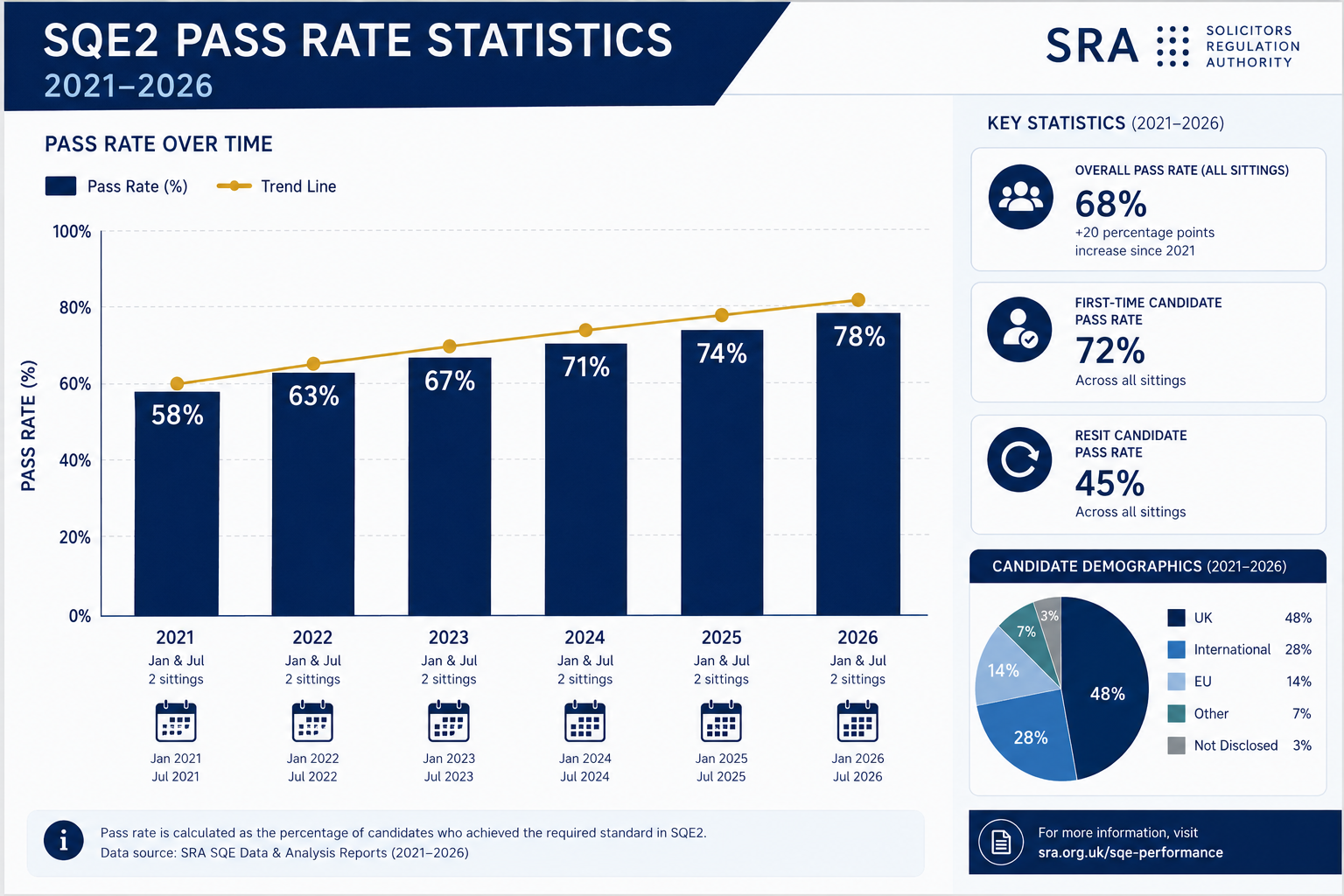
The sqe2 pass rate provides a snapshot of how candidates perform across the practical legal skills assessment. According to data published by the Solicitors Regulation Authority (SRA), pass rates for SQE2 have ranged from 69% to 84% since the assessment launched in 2021, with the most recent sitting (January 2026) reaching 80% and the historical average sitting around 76%. This figure represents all candidates sitting the exam, including both first-time takers and those resitting after previous attempts.
Breaking down these numbers reveals important patterns. First-time candidates typically achieve pass rates closer to 75-80%, while resit candidates see rates drop to approximately 50-60%. This gap suggests that candidates who prepare thoroughly from the outset have a significant advantage over those attempting to patch gaps after an initial failure.
The SQE2 assessment tests five practical skills across multiple legal contexts: client interviewing, advocacy, case and matter analysis, legal research, and legal drafting. Pass rates vary across these skill areas. Legal research and drafting tasks tend to show slightly lower pass rates compared to client interviewing and advocacy, indicating these written components present particular challenges for many candidates.
When comparing the SQE2 vs SQE1 key differences, the pass rates tell an interesting story. SQE1 typically sees pass rates around 50-55%, making SQE2 appear more achievable. However, this doesn’t mean SQE2 is easier, it reflects that candidates reaching SQE2 have already demonstrated foundational legal knowledge and tend to be better prepared for practical assessments.
Regional and demographic variations also appear in the data. Candidates who completed their legal education in England and Wales show marginally higher pass rates than international candidates, likely reflecting familiarity with English legal practice conventions. However, the gap is smaller than many expect, suggesting that focused preparation can level the playing field.
What These Numbers Don’t Tell You
Raw pass rates only reveal part of the picture. They don’t show how close unsuccessful candidates came to passing, nor do they indicate which specific skills within each assessment area caused the most difficulty. The SRA uses a criterion-referenced approach, meaning you must demonstrate competence against set standards rather than simply outperform other candidates.
This matters for your preparation. A 70% pass rate doesn’t mean you need to be in the top 70% of candidates, it means you need to meet the competency threshold across all assessed skills. Understanding what is the pass mark for SQE helps clarify what “meeting the standard” actually requires.
The statistics also don’t capture preparation time. Candidates who dedicate 3-4 months to structured SQE2 preparation typically outperform those who attempt the assessment after just 4-6 weeks of study, regardless of prior legal experience. This suggests that familiarity with the assessment format and sustained skills practice matter more than raw legal knowledge.
How Pass Rates Should Shape Your Preparation Strategy

The sqe2 pass rate data offers concrete guidance for building an effective preparation strategy. Rather than simply aiming to “pass,” use these statistics to identify high-risk areas and allocate your study time accordingly.
Target the Skills With Lower Pass Rates
Legal research and legal drafting consistently show lower pass rates than oral skills like client interviewing and advocacy. This pattern suggests candidates underestimate the complexity of these written tasks or fail to practice them under realistic exam conditions.
Your preparation should reflect this reality. Dedicate proportionally more time to legal research and drafting exercises, particularly practicing under timed conditions with unfamiliar fact patterns. Many candidates spend excessive time perfecting their interview technique while neglecting the written components that actually pose greater risk.
Focus on these specific challenges within legal research and drafting:
- Identifying relevant legal sources quickly within the 30-minute research window
- Structuring written advice that directly addresses the client’s question
- Applying research findings to specific facts rather than providing generic legal summaries
- Managing time effectively across multiple drafting tasks
Learn From First-Time vs Resit Statistics
The significant gap between first-time and resit pass rates reveals an important truth: getting it right the first time matters. Candidates who fail SQE2 often struggle to identify exactly what went wrong, making targeted improvement difficult.
This insight should influence your initial preparation approach. Rather than viewing SQE2 as something you can “have a go at” and improve on if needed, treat your first attempt as your best opportunity to pass. This means:
- Starting preparation early enough to cover all skill areas thoroughly
- Seeking feedback on practice assessments before sitting the real exam
- Addressing weaknesses immediately rather than hoping they won’t appear in your assessment
- Understanding the assessment criteria in detail before you begin practicing
Candidates who approach SQE2 with a “I’ll see how it goes” mindset significantly increase their risk of joining the resit cohort, where pass rates drop substantially. For context on what happens if preparation doesn’t go to plan, see what happens if you fail the SQE 3 times.
Use Pass Rates to Set Realistic Expectations
A pass rate in the high 70s to low 80s means SQE2 is passable but not guaranteed. This should calibrate your confidence appropriately. Overconfidence leads to inadequate preparation, while excessive anxiety can undermine performance on assessment day.
The statistics suggest that competent candidates who prepare systematically should expect to pass. However, “competent” here means demonstrating practical legal skills at the level expected of a newly qualified solicitor, not simply understanding legal principles. Many candidates with strong academic records struggle with SQE2 because they underestimate the gap between knowing the law and applying it in realistic client scenarios.
Set your preparation benchmark accordingly. If you’re consistently performing at or above the pass standard in realistic practice assessments, you’re likely ready. If you’re borderline or inconsistent, you need more preparation time. The pass rate data confirms that marginal candidates face significant risk, there’s no “lucky pass” in a criterion-referenced assessment.
Understand How Background Affects Your Risk Profile
Pass rate variations by candidate background offer personalised insights. If you’re an international candidate or someone without recent UK legal practice experience, the statistics suggest you face slightly elevated risk. This doesn’t mean you can’t pass, it means you should allocate extra preparation time to familiarising yourself with English legal practice conventions.
Specific areas where background matters include:
- Understanding UK professional conduct expectations in client interactions
- Familiarity with standard English legal document formats and terminology
- Knowledge of typical English legal procedures referenced in assessment scenarios
- Comfort with the communication style expected in English legal practice
Candidates from non-law backgrounds or those who qualified through apprenticeship routes should focus particularly on legal research and drafting, as these skills may be less developed than for traditional law graduates. The pass rate data suggests these candidates can succeed but benefit from acknowledging their specific preparation needs.
Common Mistakes That Explain the Failure Rate
Nearly 25-30% of candidates don’t pass SQE2 on their first attempt. Understanding why helps you avoid the same pitfalls. Analysis of candidate performance reveals recurring patterns among unsuccessful candidates.
Insufficient Practice Under Exam Conditions
Many candidates practice individual skills in isolation but fail to simulate the actual assessment environment. SQE2 assessments run to strict time limits, include unexpected elements, and require you to perform multiple skills in sequence without breaks.
Candidates who only practice untimed exercises or who review model answers without attempting tasks themselves consistently underperform. The assessment tests your ability to deliver competent work under pressure, not your theoretical understanding of what good work looks like.
Effective preparation requires:
- Completing full-length practice assessments under timed conditions
- Working with unfamiliar fact patterns you haven’t seen before
- Practicing without access to notes or reference materials (where exam conditions prohibit them)
- Simulating the stress and time pressure of the actual assessment day
Misunderstanding the Assessment Criteria
The SRA publishes detailed assessment criteria for each SQE2 skill area, yet many candidates fail to study these documents carefully. Unsuccessful candidates often produce work that demonstrates legal knowledge but doesn’t meet the specific competencies being assessed.
For example, in legal drafting tasks, candidates might produce a legally accurate document that fails to address the client’s specific instructions or includes unnecessary complexity. The assessment criteria emphasise practical effectiveness and client focus, not academic thoroughness.
Review the SRA’s assessment specifications and mark schemes before you begin practicing. Understand exactly what assessors look for in each skill area, then structure your practice to develop those specific competencies. For broader context on SQE scoring, see what is a good SQE score.
Weak Time Management
Time pressure causes more SQE2 failures than lack of legal knowledge. Candidates who run out of time on written tasks or who rush through client interviews without gathering essential information consistently score below the pass threshold.
Each SQE2 assessment station has strict time limits. Legal research tasks typically allow 30 minutes, drafting tasks 45-60 minutes, and oral assessments 15-20 minutes. These timings are tight but manageable if you practice working within them.
Develop specific time management strategies for each skill area:
- Legal research: Allocate 10 minutes for identifying sources, 15 minutes for reading and note-taking, 5 minutes for final review
- Legal drafting: Spend 5 minutes planning structure, 35-40 minutes writing, 10 minutes reviewing and editing
- Client interviewing: Use the first 2 minutes to establish rapport, 10-12 minutes for information gathering, final 3 minutes for summarising and next steps
Neglecting Oral Skills Preparation
While legal research and drafting show lower pass rates, oral skills still trip up many candidates. The mistake here is different: candidates assume that because they can hold a conversation, they can conduct a professional client interview or advocacy presentation.
SQE2 oral assessments test specific professional skills: active listening, appropriate questioning techniques, clear explanation of legal concepts, and professional demeanour. These require practice and feedback, not just confidence in speaking.
Many candidates also underestimate the challenge of thinking on your feet when the actor playing the client provides unexpected information or asks difficult questions. Unlike written tasks where you can pause and think, oral assessments require real-time professional responses.
Building a Pass-Rate-Informed Study Plan
Use the sqe2 pass rate insights to structure your preparation timeline and priorities. A strategic approach based on where candidates typically struggle gives you the best chance of joining the roughly 4 in 5 candidates who pass.
Allocate Time Based on Risk
Dedicate your preparation time proportionally to the risk each skill area presents. A suggested allocation based on pass rate patterns:
- Legal research: 25% of preparation time (higher risk area)
- Legal drafting: 25% of preparation time (higher risk area)
- Client interviewing: 20% of preparation time
- Advocacy: 15% of preparation time
- Case and matter analysis: 15% of preparation time
This weighting ensures you’re strongest in the areas where candidates most commonly fall short. Adjust based on your personal strengths, if you have extensive drafting experience but limited client-facing work, rebalance accordingly.
Create a Realistic Timeline
The pass rate gap between first-time and resit candidates suggests that rushing preparation increases failure risk. Most successful candidates dedicate 3-4 months to structured SQE2 preparation, even if they have prior legal experience.
A realistic timeline includes:
- Month 1: Understand assessment criteria, complete initial practice exercises for each skill area, identify personal weaknesses
- Month 2: Intensive practice on weaker skills, begin timed practice assessments, seek feedback on performance
- Month 3: Full-length mock assessments under exam conditions, final refinement of technique, review of common pitfalls
- Final 2 weeks: Light practice to maintain sharpness, review of key procedures and formats, mental preparation
Starting earlier gives you buffer time if you discover unexpected weaknesses. For guidance on overall preparation timelines, see how long to prepare for the SQE exam.
Incorporate Regular Feedback
Candidates who receive structured feedback on practice assessments before sitting SQE2 show higher pass rates than those who practice in isolation. Feedback helps you identify gaps between your performance and the assessment standard.
Seek feedback from:
- SQE2 preparation course tutors (if using a formal course)
- Qualified solicitors willing to review your practice work
- Study partners who can assess your oral skills and provide peer feedback
- Self-assessment against published mark schemes and model answers
Act on feedback immediately. If multiple reviewers identify the same weakness, prioritise addressing it before moving on to other areas. The pass rate data shows that marginal improvements in weak areas have more impact than perfecting skills you’ve already mastered.
Practice With Realistic Materials
The quality of your practice materials directly affects your readiness. Materials that accurately reflect SQE2 assessment format, difficulty level, and time pressure prepare you effectively. Generic legal skills exercises don’t provide the same benefit.
Look for practice materials that:
- Mirror the exact format and timing of SQE2 assessments
- Include detailed mark schemes showing how assessors evaluate performance
- Provide unfamiliar scenarios you haven’t encountered before
- Cover the full range of legal contexts that might appear in assessments
While preparing for SQE2, many candidates also benefit from understanding how many people fail SQE2 to maintain perspective on the challenge ahead.
Frequently Asked Questions
What is the current SQE2 pass rate?
The SQE2 pass rate has ranged from 69% to 84% across all candidates since 2021, reaching 80% in the January 2026 sitting, with first-time candidates achieving approximately 75-80% and resit candidates typically lower. These figures represent data from recent assessment sittings, though exact rates vary between sittings. The SRA publishes official statistics periodically, which should be checked for the most current figures.
Is SQE2 harder than SQE1?
SQE2 isn’t necessarily harder than SQE1, but it tests different competencies. SQE1 has a lower pass rate (around 50-55%) but tests legal knowledge through multiple-choice questions. SQE2 has a higher pass rate but requires demonstrating practical skills under time pressure. Many candidates find SQE2 more manageable because it assesses skills they can develop through practice, whereas SQE1 requires mastering a vast body of legal knowledge.
How many times can you resit SQE2?
You can attempt SQE2 as many times as needed within a six-year window, though each attempt requires paying the full assessment fee. However, the significantly lower pass rate for resit candidates (around 50-60% compared to 75-80% for first-timers) suggests that multiple attempts become progressively more challenging. Most successful candidates pass within their first two attempts.
Which SQE2 skills have the lowest pass rates?
Legal research and legal drafting consistently show lower pass rates than oral skills like client interviewing and advocacy. Candidates often underestimate the complexity of these written tasks or fail to practice them sufficiently under timed exam conditions. Case and matter analysis also presents challenges, particularly when scenarios involve multiple legal issues requiring prioritisation.
How long should I prepare for SQE2?
Most successful candidates dedicate 3-4 months to structured SQE2 preparation, even with prior legal experience. This timeline allows thorough practice across all five skill areas, multiple full-length mock assessments, and time to address identified weaknesses. Candidates who attempt SQE2 after only 4-6 weeks of preparation show notably lower pass rates, suggesting this compressed timeline increases failure risk.
Do I need a preparation course to pass SQE2?
While not mandatory, structured preparation significantly improves pass rates. Candidates using formal preparation courses or structured self-study programmes consistently outperform those who attempt SQE2 with minimal preparation. The key is accessing realistic practice materials, receiving feedback on performance, and understanding the assessment criteria thoroughly. Whether through a course or disciplined self-study, systematic preparation correlates strongly with success.
Conclusion
The SQE2 pass rate of around 80% (most recently) tells a clear story: SQE2 is passable with proper preparation but still fails a meaningful minority of candidates who underestimate its demands. The statistics reveal that first-time candidates who prepare systematically, practice under realistic conditions, and focus on higher-risk skills like legal research and drafting achieve the strongest outcomes.
Your preparation strategy should reflect these insights. Allocate more time to written skills where pass rates dip, practice extensively under timed conditions, and seek feedback before sitting the actual assessment. Understand that the gap between first-time and resit pass rates makes thorough initial preparation your best investment.
The numbers also provide reassurance: with focused effort targeting the specific competencies SQE2 assesses, most well-prepared candidates pass. Success doesn’t require exceptional talent, it requires understanding what the assessment demands and practicing those skills until you consistently meet the standard.
Take practical next steps now. Review the SRA’s assessment specifications to understand exactly what’s being tested. Create a realistic preparation timeline that gives you 3-4 months of structured practice. Identify which skills present your highest risk based on your background and experience, then allocate your study time accordingly.
For additional guidance on your legal career journey, explore our resources on how to prepare for SQE and understand your route to qualification. The SQE2 pass rate shows that success is achievable, your preparation strategy determines whether you join the successful majority or face the challenge of a resit.