



Over 70% of candidates who pass SQE1 underestimate what SQE2 actually tests, and it shows in the results. Unlike the multiple-choice format of the first exam, SQE2 demands that you demonstrate practical legal skills in real-time, face-to-face assessments that mirror the daily work of a qualified solicitor. This isn’t about recalling legal principles anymore; it’s about applying them under pressure, with clients, opponents, and assessors watching every move you make.
SQE2 represents the practical skills stage of the Solicitors Qualifying Examination, the standardised route to qualifying as a solicitor in England and Wales. Introduced by the Solicitors Regulation Authority (SRA), this assessment evaluates whether you can perform the core tasks that solicitors handle daily: interviewing clients, drafting legal documents, conducting advocacy, and providing written legal advice. Understanding exactly what SQE2 involves, its format, the skills tested, and the timing of assessments, is essential for anyone planning their route to qualification.
Key Takeaways
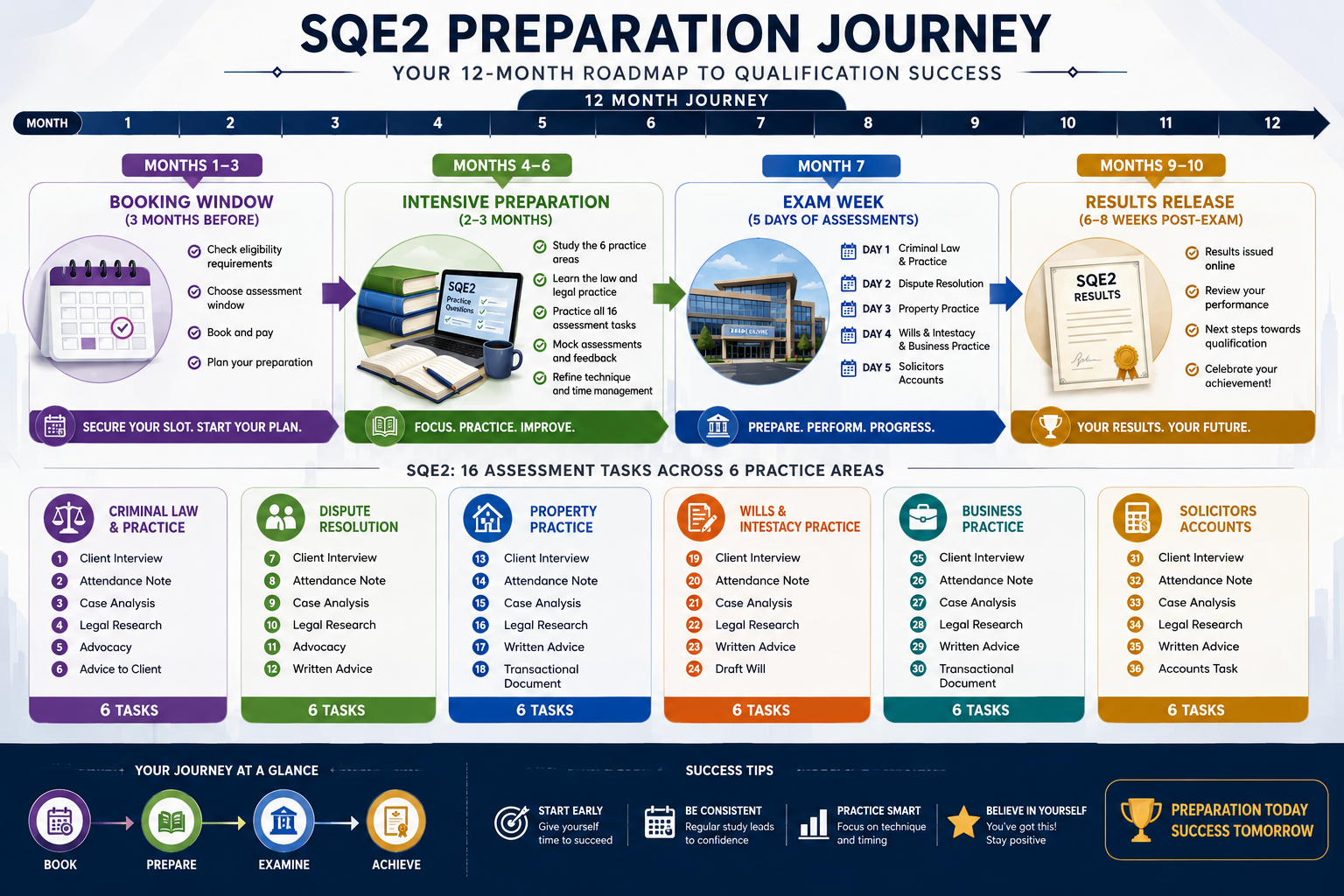
- SQE2 tests practical legal skills through 16 oral and written assessments across six practice areas: Criminal, Dispute Resolution, Property, Wills and Intestacy, Business, and Solicitors Accounts
- Candidates must pass SQE1 before sitting SQE2, and both exams must be passed before applying for admission as a solicitor alongside two years of qualifying work experience
- The assessment takes place over five consecutive days, with tasks including client interviewing, advocacy, case and matter analysis, legal research, legal writing, and legal drafting
- Current SQE2 pass rates have run in the high 70s to low 80s in recent sittings (80% in the January 2026 sitting), with variations depending on preparation quality and prior practical experience
- Booking windows open approximately three months before each assessment session, with results typically released six to eight weeks after completion
Understanding SQE2: The Practical Skills Assessment
SQE2 forms the second stage of the Solicitors Qualifying Examination and focuses exclusively on practical legal skills. While SQE1 tests your functioning legal knowledge through multiple-choice questions, SQE2 requires you to demonstrate that you can actually perform the tasks solicitors do every day.
The assessment is designed to be consistent, transparent, and accessible. Every candidate faces the same types of tasks, assessed against the same criteria, regardless of their educational background or route to qualification. This standardised approach means that whether you studied law at university, completed a law conversion course, or qualified overseas, you’ll be evaluated on the same practical skills.
The Six Practice Areas Tested in SQE2
SQE2 assessments are organised around six distinct practice areas, each reflecting common areas of legal practice:
Criminal Litigation covers police station advice, magistrates’ court and Crown Court proceedings, and criminal case preparation. You’ll need to demonstrate skills in client interviewing, advocacy, and case analysis within criminal law contexts.
Dispute Resolution encompasses civil litigation procedures, including pre-action protocols, court proceedings, and alternative dispute resolution. Tasks often involve drafting statements of case, conducting advocacy in civil matters, and analysing litigation strategies.
Property Practice tests your ability to handle residential and commercial property transactions, including freehold and leasehold matters, and property-related legal research and drafting.
Wills and the Administration of Estates requires you to demonstrate competence in taking instructions for wills, drafting wills, and advising on intestacy and estate administration.
Business Law and Practice covers company formation, corporate transactions, business contracts, and commercial legal advice. You’ll need to show you can draft commercial documents and advise business clients effectively.
Solicitors Accounts tests your understanding of the accounts rules that govern how solicitors handle client money, including ledger entries, reconciliation, and compliance with SRA regulations.
Each practice area is assessed through multiple tasks, ensuring comprehensive coverage of the skills solicitors need across different types of legal work.
The 16 Assessment Tasks: What You’ll Actually Do
SQE2 comprises 16 separate assessments spread across the six practice areas. Each assessment tests one or more of the following skills:
Client Interviewing and Attendance Note requires you to conduct a face-to-face interview with a simulated client (played by a trained actor), gather relevant information, provide preliminary advice, and produce a written attendance note summarising the meeting. These assessments typically last 15 minutes for the interview, followed by time to complete the attendance note.
Advocacy tasks place you in simulated court or tribunal settings where you must present legal arguments, examine witnesses, or make applications. You’ll be assessed on your ability to structure arguments, cite relevant law, and respond to questions from the assessor acting as a judge or tribunal member. Understanding why legal analysis skills matter becomes particularly important during advocacy assessments.
Case and Matter Analysis assessments provide you with a bundle of documents relating to a legal matter. You must analyse the materials, identify key issues, and provide written advice to a client or colleague. These tasks test your ability to spot relevant facts, apply legal principles, and communicate clearly in writing.
Legal Research tasks require you to identify relevant law using provided research materials, apply it to a specific scenario, and produce written advice. You’ll have access to legal databases or statute books during these assessments.
Legal Writing involves drafting client advice letters, emails to colleagues, or other forms of written legal communication. The focus is on clarity, accuracy, and appropriate tone for the intended recipient.
Legal Drafting assessments require you to produce formal legal documents such as statements of case, contracts, wills, or property documents. Precision, proper structure, and technical accuracy are essential.
Each assessment is carefully designed to replicate realistic scenarios that newly qualified solicitors encounter. The tasks are not theoretical exercises, they mirror actual client matters, court applications, and transactional work.
SQE2 Format and Structure: How the Assessment Works
Understanding the practical logistics of SQE2 helps you prepare effectively and manage expectations about what the assessment days will involve.
The Five-Day Assessment Schedule
SQE2 takes place over five consecutive working days, typically Monday through Friday. Each day includes multiple assessment stations, with candidates rotating through different tasks according to a pre-set timetable.
The schedule is intensive. You might complete a client interview in the morning, followed by a drafting task before lunch, then an advocacy assessment in the afternoon. The variety keeps you alert but also demands mental stamina and the ability to switch between different skills and practice areas quickly.
Candidates receive their individual timetables in advance, showing exactly which assessments they’ll complete each day and at what time. This allows you to mentally prepare for the sequence of tasks, though the specific content of each assessment remains confidential until you enter the assessment room.
Assessment Venues and Booking Windows
SQE2 assessments are conducted at designated centres across England and Wales. The SRA works with assessment providers to ensure venues meet consistent standards for space, technology, and accessibility.
Booking windows typically open approximately three months before each assessment session. The SRA publishes an annual schedule showing when assessments will take place, allowing candidates to plan their preparation timeline accordingly. As of 2026, there are usually three or four assessment windows per year, though candidates should verify current scheduling directly with the SRA as these details can change.
Fees for SQE2 are set by the SRA and cover all 16 assessments. Current guidance suggests the total cost is around £3,980, though this figure should be confirmed before booking as regulatory fees are subject to periodic review. For context on overall qualification costs, see our guide on how much the SQE costs.
What Happens During Each Assessment
When you arrive for an assessment, you’ll be directed to a specific station or room. For written tasks, you’ll typically work at a computer using word processing software, with access to any permitted research materials. For oral assessments like client interviews or advocacy, you’ll meet with trained actors or assessors in a private room.
Each assessment has strict time limits. Client interviews usually last 15 minutes, with additional time allocated for completing the attendance note. Advocacy tasks might run 20 minutes. Written tasks vary from 30 to 60 minutes depending on complexity.
You’ll receive clear instructions at the start of each assessment, including any documents or materials you need to review. For some tasks, you’ll have a short preparation period before the timed assessment begins. For others, you’ll start immediately.
Assessors observe and evaluate your performance against published assessment criteria. They’re trained to apply these criteria consistently across all candidates. After each assessment, you move to the next station according to your timetable, with short breaks built into the schedule.
Skills Tested in SQE2: What Assessors Look For
Success in SQE2 depends on demonstrating competence across multiple practical skills. Understanding what assessors evaluate helps you focus your preparation on the right areas.
Client Interviewing Skills
Effective client interviewing requires more than just asking questions. Assessors look for your ability to:
- Establish rapport and put the client at ease
- Ask open and closed questions appropriately to gather comprehensive information
- Listen actively and respond to what the client tells you
- Identify relevant legal issues from the client’s narrative
- Provide clear, preliminary advice in language the client understands
- Manage the interview structure within the time available
- Demonstrate professional conduct and empathy
Your attendance note must accurately record the key information gathered, the advice given, and any agreed next steps. It should be clear enough that a colleague reading it could understand the matter and continue working on it.
Advocacy and Oral Presentation
Advocacy assessments evaluate your ability to present legal arguments persuasively and professionally. Key skills include:
- Structuring submissions logically with clear introduction, main points, and conclusion
- Citing relevant legal authorities accurately
- Responding appropriately to questions or interventions from the bench
- Maintaining professional demeanour and appropriate formality
- Managing time effectively to cover all necessary points
- Adapting your approach based on the tribunal or court level
Strong advocacy isn’t about theatrical performance, it’s about clear, confident communication of legal arguments that help the decision-maker understand your client’s position.
Legal Research and Analysis
Research tasks test whether you can find relevant law and apply it correctly. Assessors evaluate:
- Your ability to identify the key legal issues in a scenario
- Efficient use of research materials to locate applicable law
- Accurate interpretation and application of statutes, cases, and regulations
- Clear explanation of how the law applies to the specific facts
- Practical advice that addresses the client’s needs
These assessments often provide access to legal databases or statute books, but you need to know what you’re looking for and how to use research tools efficiently within tight time constraints. Developing strong legal analysis skills is fundamental to performing well in these tasks.
Legal Writing and Drafting
Written assessments evaluate both the content and presentation of your work. For legal writing (such as advice letters), assessors look for:
- Clear, concise language appropriate for the intended reader
- Accurate legal content that addresses the relevant issues
- Logical structure that guides the reader through your advice
- Professional tone and proper formatting
- Practical recommendations or next steps
Legal drafting tasks (such as contracts, wills, or court documents) require additional precision:
- Correct use of legal terminology and standard clauses
- Proper document structure following professional conventions
- Attention to detail in dates, names, amounts, and legal descriptions
- Completeness, ensuring all necessary provisions are included
- Compliance with relevant rules or regulations governing the document type
Drafting errors that would have serious consequences in practice, such as incorrect property descriptions or missing essential clauses, will significantly impact your assessment score.
SQE2 Timing: When to Book and How to Prepare
Strategic timing of your SQE2 attempt can significantly impact your success. Understanding the sequence of requirements and realistic preparation timelines helps you plan effectively.
The SQE1 Prerequisite
You must pass SQE1 before you can sit SQE2. This sequencing makes sense, SQE1 tests your functioning legal knowledge, which forms the foundation for the practical skills assessed in SQE2. You can’t effectively interview a client about a property transaction or draft a will if you don’t understand the underlying legal principles.
Once you receive your SQE1 results confirming you’ve passed, you can book your SQE2 assessment. Many candidates book their SQE2 slot while still waiting for SQE1 results, then adjust their plans if needed. However, if you haven’t passed SQE1 by the time your SQE2 assessment date arrives, you won’t be permitted to sit the assessment.
For detailed comparison of the two stages, review our complete guide to SQE2 vs SQE1 differences.
Realistic Preparation Timelines
Most candidates need two to four months of focused preparation for SQE2, though this varies based on your prior experience and whether you’re studying full-time or alongside work.
If you have substantial practical legal experience,for example, you’ve worked as a paralegal or completed significant qualifying work experience, you may need less preparation time. You’re already familiar with client interactions, legal drafting, and professional conduct in practice settings.
If you’re coming straight from academic study with limited practical experience, allow more time to develop the skills SQE2 tests. You’ll need to practice client interviewing, advocacy, and drafting extensively to build confidence and competence.
Full-time preparation allows you to dedicate entire days to practice and skill development. Many candidates complete intensive preparation courses that run for four to eight weeks, combining instruction with extensive practice assessments.
Part-time preparation while working or studying requires careful time management. Spreading preparation over three to four months allows you to practice regularly without overwhelming your schedule. Consistency matters more than cramming, regular practice sessions build skills more effectively than sporadic intensive study.
Booking Strategy and Assessment Windows
The SRA typically offers SQE2 assessments three to four times per year. Booking windows open approximately three months before each assessment session, and popular dates can fill quickly.
Consider these factors when choosing your assessment date:
Your SQE1 results timeline: Ensure you’ll have received your SQE1 results with sufficient time to prepare for SQE2. Booking too soon after SQE1 may not allow adequate preparation time.
Work and personal commitments: The five-day assessment period requires your full attention. Avoid booking during periods when you have significant work deadlines, family commitments, or other major obligations.
Preparation course schedules: If you plan to take a preparation course, coordinate your assessment date with course availability. Many providers time their courses to finish shortly before assessment windows.
Qualifying work experience progress: While you don’t need to complete your two years of qualifying work experience before sitting SQE2, having some practical experience helps. Consider whether delaying your assessment to gain more work experience would benefit your performance.
Retake considerations: If you’re concerned about needing to retake any assessments, booking earlier in the year leaves more opportunities for retakes within the same calendar year. However, only book when you’re genuinely ready, rushing into an assessment before you’re prepared wastes both money and attempts.
SQE2 Pass Rates and Scoring: What the Numbers Tell Us
Understanding pass rates and how assessments are scored helps set realistic expectations and identify where candidates commonly struggle.
Current Pass Rate Data
As of the January 2026 sitting, SQE2 pass rates have reached around 80%, up from the high 70s a year earlier, though these figures vary by assessment session and should be checked against the SRA’s latest published statistics. This means even in a strong sitting, roughly one in five candidates does not pass all assessments on their first attempt.
Pass rates for SQE2 are generally higher than SQE1, which often sees pass rates around 50-60%. This difference likely reflects several factors: candidates sitting SQE2 have already demonstrated competence by passing SQE1, many have gained practical experience before attempting SQE2, and the skills-based nature of the assessment may suit some candidates better than multiple-choice knowledge testing.
However, these overall figures mask significant variation. Some individual assessments have notably lower pass rates than others, and pass rates differ between candidates with different backgrounds and preparation approaches. For more context on failure rates across the SQE, see our analysis of how many people fail SQE2.
How SQE2 Is Scored
Each of the 16 assessments is scored independently against published assessment criteria. Assessors evaluate your performance using detailed marking rubrics that specify what constitutes competent performance for each skill.
The scoring system is criterion-referenced rather than norm-referenced. This means you’re assessed against a fixed standard of competence, not compared to other candidates. In theory, all candidates could pass if they all meet the required standard, or all could fail if none do.
For each assessment, you receive one of several possible grades:
- Clear pass: Performance clearly meets the required standard
- Marginal pass: Performance meets the required standard but with some weaknesses
- Marginal fail: Performance falls slightly below the required standard
- Clear fail: Performance clearly does not meet the required standard
To pass SQE2 overall, you must achieve at least a marginal pass in all 16 assessments. If you fail any assessment, you’ll need to retake only those specific assessments you failed, not the entire SQE2.
Common Reasons for Assessment Failure
Analysis of SQE2 results reveals several common reasons candidates fail specific assessments:
Insufficient client interviewing skills: Failing to ask appropriate questions, not listening to client responses, providing incorrect legal advice, or poor time management during the interview.
Weak advocacy: Inability to structure legal arguments clearly, failure to cite relevant authorities, poor response to judicial questions, or unprofessional demeanour.
Drafting errors: Missing essential clauses, incorrect legal terminology, poor document structure, or errors in factual details like dates, names, or amounts.
Inadequate legal analysis: Failing to identify key legal issues, misapplying legal principles, or providing advice that doesn’t address the client’s actual needs.
Time management problems: Running out of time before completing the task, rushing through important elements, or spending too long on preliminary matters.
Professional conduct issues: Inappropriate communication with clients, failure to identify conflicts of interest, or not recognising when to seek supervisor guidance.
Many of these failures stem from insufficient practice rather than lack of legal knowledge. Candidates who pass SQE1 clearly understand the law, but knowing the law and applying it effectively in practice are different skills.
Preparing for SQE2: Practical Steps to Success
Effective SQE2 preparation requires more than reading about skills, you need extensive hands-on practice in realistic scenarios.
Formal Preparation Courses vs Self-Study
Most candidates use some form of structured preparation, whether formal courses or self-directed practice with study materials.
Formal preparation courses offer several advantages:
- Structured curriculum covering all assessment types
- Experienced instructors who understand assessment criteria
- Regular practice assessments with feedback
- Simulated client interviews and advocacy with trained actors
- Peer learning opportunities and group practice
- Accountability and motivation from scheduled sessions
Courses vary in length (typically four to twelve weeks), delivery method (in-person, online, or hybrid), and cost (ranging from around £2,000 to £6,000 or more). When evaluating courses, consider the amount of individual feedback provided, the number of practice assessments included, and whether the course schedule aligns with your assessment date.
Self-study approaches work for some candidates, particularly those with substantial practical experience. Self-study requires:
- Discipline to maintain a consistent practice schedule
- Access to practice materials and sample assessments
- Ability to self-evaluate performance objectively
- Opportunities to practice oral skills (interviewing and advocacy) with others
- Understanding of assessment criteria to guide your preparation
Pure self-study is challenging for SQE2 because many skills require feedback from others. You can’t effectively practice client interviewing alone, and self-assessing your own advocacy or drafting is difficult without expert input.
Many candidates adopt a hybrid approach: taking a shorter preparation course for structure and feedback, then supplementing with additional self-directed practice.
Building Core Skills Through Practice
Regardless of your preparation approach, focus on these key practice activities:
Client interviewing practice: Conduct mock interviews with friends, family, or study partners playing client roles. Record sessions and review them critically. Focus on question technique, active listening, and clear advice delivery. Practice completing attendance notes within time limits.
Advocacy exercises: Present legal arguments to anyone willing to listen and ask questions. Practice structuring submissions, citing authorities smoothly, and responding to interruptions. Time yourself to ensure you can cover necessary points within assessment time limits.
Drafting repetition: Draft multiple examples of each document type, wills, contracts, statements of case, property documents. Compare your drafts to model answers or professional examples. Focus on standard clauses, proper structure, and attention to detail.
Legal research drills: Practice using legal databases efficiently. Set yourself research tasks with time limits, forcing you to find relevant law quickly and apply it accurately.
Case analysis: Work through case files, identifying key issues and formulating advice. Practice writing clear, structured advice that addresses practical client needs, not just theoretical legal points.
Solicitors accounts problems: Complete numerous accounts exercises covering different scenarios. Ensure you understand the accounts rules thoroughly and can apply them accurately under time pressure.
The more you practice each skill, the more natural and confident your performance becomes. Aim for dozens of practice attempts for each assessment type, not just a handful.
Using Feedback Effectively
Feedback is crucial for improvement. Whether from course instructors, peers, or self-evaluation, use feedback to:
- Identify specific weaknesses in your performance
- Understand why certain approaches don’t meet assessment criteria
- Recognise patterns in your mistakes (e.g., consistently running out of time, regularly missing certain types of clauses)
- Track improvement over time
- Adjust your practice focus to address persistent weaknesses
Don’t just collect feedback, act on it. If multiple people tell you your client interviewing lacks empathy, consciously work on that specific skill. If your drafting consistently omits essential clauses, create checklists to ensure completeness.
Qualifying Work Experience and SQE2: Understanding the Connection
While SQE2 and qualifying work experience (QWE) are separate requirements, they’re closely connected in practice.
QWE Requirements Overview
To qualify as a solicitor, you must complete two years of qualifying work experience in addition to passing SQE1 and SQE2. This experience must involve legal work that allows you to develop some or all of the competencies required of solicitors.
QWE can be completed before, during, or after your SQE assessments. There’s no requirement to finish QWE before sitting SQE2, though many candidates find that practical experience significantly helps their SQE2 performance.
You can split QWE across up to four different organisations, and it doesn’t need to be continuous. Part-time work counts, as does work completed outside traditional law firms, in-house legal departments, legal clinics, and some voluntary roles can qualify.
Each period of QWE must be confirmed by a solicitor or compliance officer for legal practice (COLP) who can verify that you’ve gained relevant experience. For detailed guidance on documenting experience, see our article on whether volunteering counts as qualifying work experience.
How QWE Helps SQE2 Performance
Candidates with substantial practical experience before sitting SQE2 often perform better because they’ve already developed many of the skills being assessed:
- Client interaction experience makes client interviewing assessments feel more natural
- Drafting practice in real matters improves document quality and attention to detail
- Exposure to court or tribunal proceedings helps advocacy performance
- Real case analysis develops the practical judgment needed for case and matter analysis tasks
- Professional environment experience reinforces appropriate conduct and communication standards
Even relatively junior legal roles provide valuable exposure. Sitting in on client meetings, observing court hearings, drafting routine documents under supervision, and conducting legal research all build skills directly relevant to SQE2.
Strategic Timing of QWE and SQE2
Consider these approaches to timing your QWE and SQE2:
Complete significant QWE before SQE2: Gain six months to a year of practical experience, then sit SQE2 when you’ve developed relevant skills. This approach often leads to stronger performance but delays qualification.
Sit SQE2 relatively early, then focus on QWE: Pass both SQE assessments, then complete your two years of QWE knowing you’ve cleared the exam hurdles. This approach gets the assessments done but may require more intensive preparation to compensate for limited practical experience.
Parallel approach: Accumulate QWE while preparing for and sitting SQE assessments. This balanced approach allows practical experience to inform your preparation while maintaining momentum toward qualification.
There’s no single correct approach, the best timing depends on your circumstances, including job opportunities, financial considerations, and personal preferences. What matters is understanding how QWE and SQE2 connect and planning accordingly.
After SQE2: Next Steps Toward Admission
Passing SQE2 is a significant milestone, but it’s not the final step to becoming a solicitor.
Completing Your Qualification Requirements
To apply for admission as a solicitor, you must have:
- Passed SQE1
- Passed SQE2
- Completed two years of qualifying work experience
- Met the SRA’s character and suitability requirements
Once you’ve satisfied all these requirements, you can apply to the SRA for admission to the roll of solicitors. The application involves submitting evidence of your SQE passes, QWE confirmations, and character and suitability declarations.
The SRA reviews applications and, if satisfied, admits you as a solicitor of England and Wales. You’ll then need to obtain practising certificate if you want to practise as a solicitor, which involves additional fees and compliance requirements.
If You Don’t Pass All Assessments
If you fail any of the 16 SQE2 assessments, you can retake those specific assessments. You don’t need to retake assessments you passed, only the ones you failed.
The SRA allows unlimited attempts at SQE2, though each retake incurs additional fees. There’s no time limit for completing SQE2, but remember that SQE1 results remain valid for six years, so you must pass SQE2 within six years of passing SQE1.
When you receive your results, you’ll get feedback indicating which assessments you failed and general guidance on why. Use this feedback to identify specific areas for improvement before retaking.
Many candidates who fail some assessments on their first attempt pass comfortably on retake after targeted additional practice. Don’t view a partial fail as catastrophic, it’s feedback showing you where to focus your efforts. For guidance on what happens after multiple failures, see our article on what happens if you fail the SQE three times.
Career Planning After Qualification
Passing SQE2 and completing your qualification opens diverse career opportunities. Qualified solicitors work in:
- Private practice law firms (high street, regional, national, and international)
- In-house legal departments in corporations, charities, and public bodies
- Government legal services
- Legal advice centres and not-for-profit organisations
- Alternative legal service providers
- Legal technology companies
- Compliance and regulatory roles
Your career path depends on your interests, the experience you’ve gained during QWE, and the opportunities available when you qualify. Many candidates secure training contracts or paralegal positions that convert to qualified roles upon admission.
The legal job market remains competitive, particularly for newly qualified solicitors. Building a strong professional network during your qualification journey, gaining diverse experience through QWE, and developing specialisms in particular practice areas all improve your employment prospects. For insights into the current market, review our analysis of jobs after SQE and why some firms never call back.
Frequently Asked Questions
Can I sit SQE2 before completing SQE1?
No. You must pass SQE1 before you can sit SQE2. The SRA requires candidates to demonstrate functioning legal knowledge through SQE1 before progressing to the practical skills assessment in SQE2. If you attempt to book SQE2 without having passed SQE1, your booking will not be accepted.
How long are SQE2 results valid?
SQE2 results do not expire. Once you pass SQE2, that result remains valid indefinitely. However, remember that SQE1 results are valid for six years, so you must pass SQE2 within six years of passing SQE1. Additionally, you must complete your two years of qualifying work experience and apply for admission within a reasonable timeframe to maintain the relevance of your qualification.
Do I need to complete qualifying work experience before sitting SQE2?
No. You can sit SQE2 before, during, or after completing your two years of qualifying work experience. However, many candidates find that gaining some practical experience before SQE2 significantly helps their performance, as the assessment tests practical skills that develop through real legal work. The SRA only requires that you complete all qualification requirements, SQE1, SQE2, and QWE, before applying for admission.
What happens if I fail some but not all SQE2 assessments?
You only need to retake the specific assessments you failed. Your passes remain valid, and you don’t need to repeat assessments you’ve already passed. When you retake, you’ll only sit the failed assessments, not the entire SQE2. Each retake incurs additional fees for the assessments being retaken. There’s no limit on the number of retake attempts, though each failure should prompt careful reflection on what additional preparation you need.
Can international lawyers sit SQE2 without sitting SQE1?
Most international lawyers must pass both SQE1 and SQE2. However, qualified lawyers from certain jurisdictions may be eligible for exemptions from some or all SQE assessments under transitional arrangements or recognition agreements. Eligibility for exemptions depends on your jurisdiction of qualification and when you qualified. Check the SRA website for current exemption criteria, as these provisions change periodically. For detailed guidance, see our guide on how foreign lawyers can qualify as UK solicitors.
Is SQE2 harder than SQE1?
This depends on your strengths and background. SQE1 tests breadth of legal knowledge through 180 multiple-choice questions, while SQE2 tests practical skills through oral and written assessments. Candidates with strong academic backgrounds often find SQE1 more straightforward, while those with practical legal experience may find SQE2 more natural. Pass rates for SQE2 are generally higher than SQE1, suggesting many candidates find the practical skills assessment more manageable once they’ve passed the knowledge test. For a detailed comparison, review our article on whether SQE1 or SQE2 is harder.
Conclusion
SQE2 represents the practical gateway to qualifying as a solicitor, the assessment where you prove you can actually do the job, not just understand the theory. Success requires more than legal knowledge; it demands competent performance across client interviewing, advocacy, legal research, drafting, and case analysis, all demonstrated under time pressure in realistic scenarios.
Understanding the format, skills tested, and timing of SQE2 allows you to plan your qualification journey strategically. Pass SQE1 first, then allow adequate time for focused skills practice before booking your SQE2 assessment. Consider gaining practical experience through qualifying work experience before or alongside your SQE2 preparation, real legal work develops exactly the skills the assessment tests.
Prepare thoroughly through extensive practice of each assessment type, seek feedback on your performance, and address weaknesses systematically. Whether you choose formal preparation courses or structured self-study, consistency and realistic practice matter more than cramming.
Remember that SQE2 is one component of your qualification journey. Passing both SQE assessments and completing two years of qualifying work experience opens the door to admission as a solicitor and the diverse career opportunities that follow. Approach SQE2 with confidence, knowing that thorough preparation and practical skill development will serve you not just in the assessment, but throughout your legal career.
Your practical next steps: Verify your SQE1 results, research preparation courses or study materials, identify opportunities to gain practical legal experience, and book your SQE2 assessment when you’re genuinely ready. Qualify with confidence by understanding your route and taking each step deliberately.