



The training contract market has shifted dramatically. In 2024, Magic Circle firms collectively reduced their intake by 18%, while mid-tier regional practices expanded theirs by 22%. For aspiring solicitors navigating the qualification journey in 2026, the question isn’t whether training contracts exist, it’s whether pursuing one still makes strategic sense, and if so, where the real opportunities lie.
The landscape has fundamentally changed since the SQE replaced the LPC. Firms now recruit differently, value different experiences, and offer alternative pathways that didn’t exist three years ago. This article examines current training contract hiring data, identifies which firms are actually expanding their programmes, and provides straightforward advice on whether this traditional route still serves your legal career journey.
Key Takeaways
- Magic Circle and US firms have reduced training contract intakes by 15-20% since 2024, while regional and specialist firms have increased opportunities by up to 25%
- The SQE route has created new pathways to qualification, making training contracts optional rather than mandatory for many aspiring solicitors
- Firms increasingly value qualifying work experience from diverse sources, not just traditional two-year training contracts
- Regional markets (Manchester, Birmingham, Leeds) show stronger training contract growth than London in 2026
- Alternative routes including paralegal-to-solicitor progression and apprenticeships now account for 31% of newly qualified solicitors
The Training Contract Hiring Landscape: What the 2026 Data Actually Shows
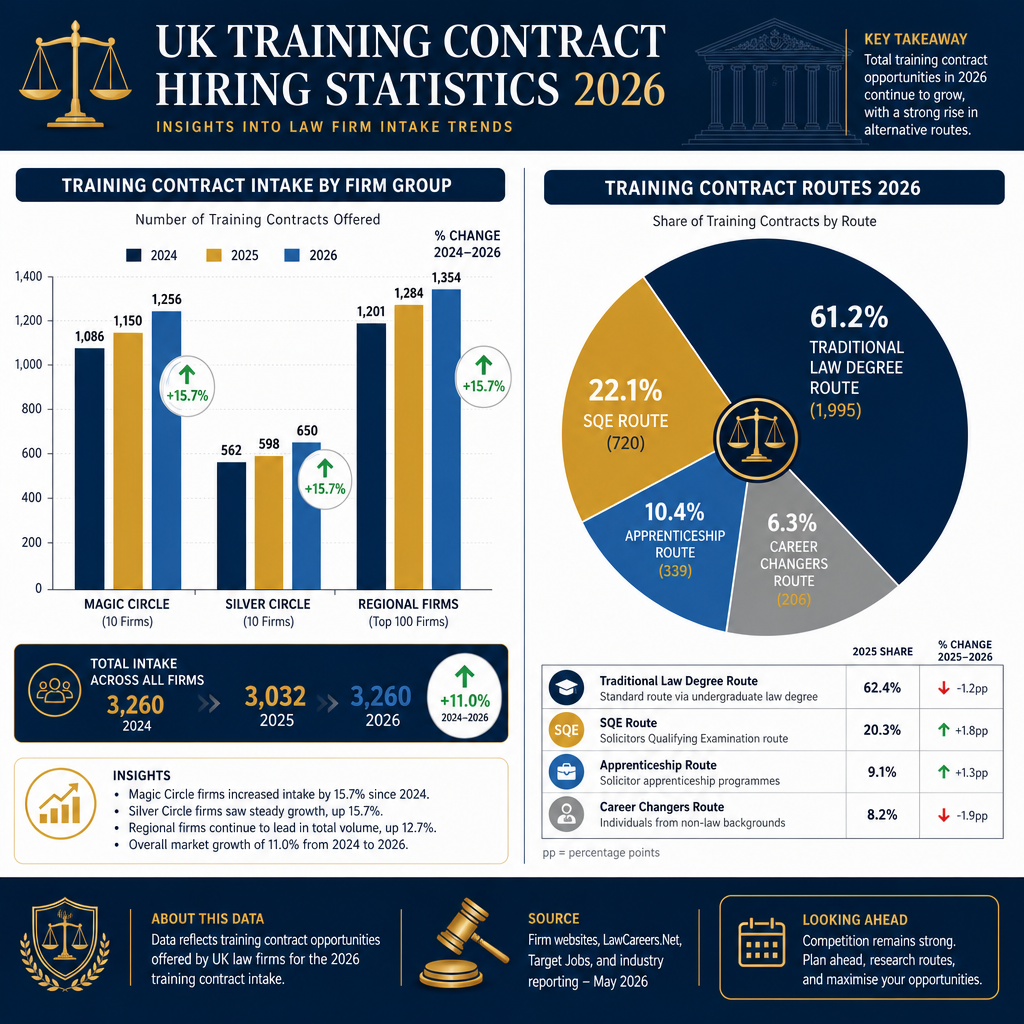
The numbers tell a clear story. According to the Law Society’s 2026 Training Contract Report, total training contract registrations across England and Wales reached 5,847 in the 2025-26 recruitment cycle, a 3.2% decrease from the previous year. However, this aggregate figure masks significant variation across different firm types and regions.
Magic Circle and Elite Firm Contraction
The five Magic Circle firms (Allen & Overy, Clifford Chance, Freshfields, Linklaters, and Slaughter and May) collectively offered 412 training contracts for 2026 starts, down from 503 in 2024. This 18% reduction reflects strategic shifts toward leaner graduate recruitment, increased use of fixed-term contracts, and greater reliance on lateral hires with SQE qualifications already completed.
US firms operating in London have followed a similar pattern. Firms like Kirkland & Ellis, Latham & Watkins, and Skadden reduced their combined UK training contract intake by 16% between 2024 and 2026. The emphasis has shifted toward recruiting qualified solicitors and offering qualifying work experience arrangements that don’t follow the traditional two-year training contract structure.
Regional and Mid-Tier Growth
The picture looks markedly different outside London’s elite tier. Regional firms in Manchester, Birmingham, Leeds, and Bristol have expanded training contract programmes significantly. Firms like Addleshaw Goddard, DWF, and Shoosmiths increased their combined intake by 24% in 2026 compared to 2024 figures.
Mid-tier national firms (those ranked 26-100 by revenue) collectively grew their training contract offerings by 19% over the same period. These firms cite the SQE’s flexibility and lower training costs as enabling factors. Without the requirement to fund expensive LPC courses, firms can invest more in structured training programmes and take on additional trainees.
Specialist and Boutique Opportunities
Specialist practices in areas like intellectual property, technology law, and family law have emerged as unexpected growth areas for training contract hiring. These smaller firms (typically 10-50 solicitors) increased their collective training contract registrations by 31% in 2026. Many cite the SQE route’s flexibility as making it economically viable to offer training contracts for the first time.
For aspiring solicitors, this shift creates genuine opportunities in practice areas that previously offered limited training contract access. Understanding which route to qualification best suits your circumstances has never been more important.
Who’s Actually Hiring: Firm-by-Firm Analysis
Understanding which specific firms are expanding or contracting their training contract programmes helps you target applications strategically. The 2026 data reveals clear patterns.
Firms Significantly Increasing Intake
Several firms stand out for substantial training contract expansion in 2026:
- Browne Jacobson: Increased from 18 to 28 training contracts (56% growth)
- Irwin Mitchell: Expanded from 45 to 62 contracts (38% growth)
- Shoosmiths: Grew from 32 to 44 contracts (38% growth)
- DWF: Increased from 55 to 71 contracts (29% growth)
- TLT: Expanded from 24 to 31 contracts (29% growth)
These firms share common characteristics: strong regional presence, diverse practice areas, and explicit strategies to leverage the SQE route’s flexibility. Most have also invested in structured training programmes that combine traditional supervision with modern learning technologies.
Firms Maintaining Stable Numbers
Many established firms have held their training contract numbers relatively steady:
- Slaughter and May: Maintained 80-85 contracts annually
- Herbert Smith Freehills: Stable at 60-65 contracts
- Pinsent Masons: Consistent 50-55 contracts
- Eversheds Sutherland: Maintained 70-75 contracts
These firms typically have well-established graduate recruitment pipelines and haven’t fundamentally altered their approach despite the SQE transition. They continue to value the traditional training contract model and invest heavily in structured training programmes.
Firms Reducing or Pausing Programmes
Some prominent firms have scaled back significantly:
- Allen & Overy (now A&O Shearman post-merger): Reduced from 100 to 75 contracts (25% reduction)
- Clifford Chance: Decreased from 95 to 80 contracts (16% reduction)
- Freshfields: Reduced from 90 to 75 contracts (17% reduction)
Several mid-sized London firms have paused training contract recruitment entirely, opting instead to recruit qualified solicitors or offer alternative qualifying work experience arrangements. This trend particularly affects firms in the 100-200 solicitor range that historically offered 5-10 training contracts annually.
The SQE Effect: How New Qualification Routes Change the Calculation
The SQE’s introduction has fundamentally altered whether a training contract remains the optimal path to qualification. Understanding these changes helps you make informed decisions about your legal career journey.
Training Contracts Are No Longer Mandatory
Previously, aspiring solicitors needed either a training contract or equivalent recognised training to qualify. The SQE route changes this entirely. You can now:
- Pass SQE1 and SQE2 assessments independently
- Complete two years of qualifying work experience in any legal setting
- Apply for admission without ever holding a formal training contract
This flexibility has created entirely new pathways. Many aspiring solicitors now work as paralegals, legal executives, or in-house legal assistants while completing their SQE assessments and accumulating qualifying work experience. For detailed guidance on this approach, see our article on qualifying without a training contract.
Cost Considerations Have Shifted
Traditional training contracts often came with significant financial support, LPC fees paid, maintenance grants provided. The SQE route typically costs £3,000-£4,000 for assessments plus preparation course fees (£3,000-£12,000 depending on provider).
However, fewer firms now offer comprehensive financial packages. In 2026, only 34% of training contracts include full SQE preparation course funding, compared to 67% of training contracts that funded LPC courses in 2020. This shift means aspiring solicitors increasingly self-fund their qualification route, making the training contract’s financial benefits less decisive.
Qualifying Work Experience Flexibility
The SQE’s qualifying work experience requirements accept a much broader range of legal work than traditional training contracts required. You can gain qualifying work experience through:
- Paralegal roles in law firms
- In-house legal department positions
- Legal advice centre work
- Pro bono and volunteer legal work (with limitations)
- Part-time legal roles combined with other employment
This flexibility particularly benefits career changers, part-time students, and those unable to secure traditional training contracts. The two-year requirement can be accumulated across multiple roles and doesn’t require continuous full-time employment. For international perspectives, our guide on overseas qualifying work experience explains additional options.
The Prestige Factor Remains
Despite these changes, training contracts at prestigious firms still carry significant career value. A Magic Circle or major US firm training contract provides:
- Structured exposure to high-value, complex transactions
- Mentorship from senior practitioners
- Brand recognition that aids future career moves
- Higher starting salaries post-qualification
- Stronger professional networks
For many aspiring solicitors, these benefits justify the intense competition (some firms receive 100+ applications per training contract place). However, the calculation has become more nuanced. Alternative routes now offer genuine career progression without the traditional training contract gatekeeping.
Regional Variations: Where the Real Opportunities Exist

Training contract hiring patterns vary dramatically by region in 2026. Understanding these geographical differences helps you identify realistic opportunities and make strategic location decisions.
London: Competitive but Contracting
London remains the largest training contract market by volume, with approximately 2,340 contracts registered for 2026 starts. However, this represents a 7% decrease from 2024 levels. Competition remains intense, the average London training contract receives 87 applications, with Magic Circle firms seeing 150+ applications per place.
The contraction primarily affects mid-tier London firms (50-200 solicitors). Many have shifted toward recruiting newly qualified solicitors rather than training their own. For aspiring solicitors targeting London, focusing on either the largest firms (which maintain stable numbers) or specialist boutiques (which are growing) offers the best prospects.
Manchester: The Growth Leader
Manchester has emerged as the UK’s fastest-growing training contract market. The city’s legal sector added 147 new training contract places between 2024 and 2026, a 34% increase. Major drivers include:
- Continued expansion of national firms’ Manchester offices
- Growth in technology and media law practices
- Lower cost base enabling firms to invest in training programmes
- Strong graduate talent pool from Manchester and Liverpool universities
Firms like DWF, Addleshaw Goddard, and Shoosmiths have all significantly expanded their Manchester training contract programmes. Competition remains substantial but averages 42 applications per place, roughly half London’s intensity.
Birmingham and the Midlands
Birmingham’s legal market has grown steadily, with training contract registrations up 18% between 2024 and 2026. The city benefits from strong corporate and commercial practices, particularly in manufacturing, automotive, and professional services sectors.
Regional firms like Gowling WLG, Mills & Reeve, and Anthony Collins have expanded their Birmingham training programmes. The market offers a practical middle ground, reasonable competition (averaging 38 applications per place) combined with quality training in substantial commercial matters.
Leeds and Yorkshire
Leeds maintains its position as a major regional legal centre, with training contract numbers up 12% in 2026. The city’s legal market serves a diverse regional economy spanning financial services, healthcare, manufacturing, and public sector work.
Firms including Pinsent Masons, Eversheds Sutherland, and Walker Morris offer substantial training programmes. Leeds particularly suits aspiring solicitors interested in commercial litigation and corporate recovery work, where the city has developed specialist expertise.
Scotland and Wales: Distinct Markets
Scotland operates under a separate legal system with its own qualification routes, though some firms offer training contracts that satisfy both Scottish and English qualification requirements. Wales has seen modest training contract growth (8% increase 2024-2026), primarily in Cardiff and Swansea.
For aspiring solicitors considering regional opportunities, the data clearly shows that looking beyond London significantly improves your chances of securing a training contract while still accessing quality training and career progression.
Alternative Pathways: When Training Contracts Don’t Make Sense
The training contract remains valuable, but it’s no longer the only, or always the best, route to qualification. Several alternative pathways now offer genuine career progression.
The Paralegal-to-Solicitor Route
Increasingly common in 2026, this pathway involves:
- Securing a paralegal role (typically £22,000-£32,000 starting salary)
- Self-funding SQE1 and SQE2 preparation and assessments
- Accumulating qualifying work experience through paralegal work
- Qualifying as a solicitor after two years
This route suits aspiring solicitors who struggle to secure training contracts or prefer earning while qualifying. The key advantage: you gain legal experience and income simultaneously. The challenge: you bear the financial cost of SQE preparation and must ensure your paralegal work meets qualifying work experience standards.
Many firms now offer “paralegal-to-solicitor” programmes that provide structured progression. These arrangements give paralegals access to training, supervision, and eventual qualification without formal training contract status. For practical guidance on this route, see our article on becoming a solicitor without a traditional degree path.
Solicitor Apprenticeships
Solicitor apprenticeships combine employment, on-the-job training, and SQE preparation in a six-year programme. Participants earn a salary (typically £18,000-£24,000 initially) while working toward qualification.
In 2026, approximately 340 solicitor apprenticeship places were available across England and Wales, a 28% increase from 2024. Major firms offering apprenticeships include:
- Pinsent Masons (20 places annually)
- Browne Jacobson (15 places)
- Irwin Mitchell (18 places)
- Various regional and high street firms (1-5 places each)
Apprenticeships particularly suit school leavers and career changers who want to avoid university debt. The extended timeline (six years versus the typical three-year degree plus two-year training contract) is offset by continuous earnings and no student loan burden. Our detailed guide on solicitor apprenticeships explains eligibility and application processes.
CILEX-to-Solicitor Conversion
Chartered Legal Executives (CILEX) can convert to solicitor status through the SQE route. This pathway suits legal executives who have built substantial experience but want full solicitor qualification.
The conversion process involves:
- Passing SQE1 and SQE2 (CILEX members may have some exemptions)
- Demonstrating qualifying work experience (existing CILEX experience often counts)
- Meeting character and suitability requirements
In 2026, approximately 420 CILEX members converted to solicitor status via the SQE route, a 45% increase from 2024. This pathway offers experienced legal professionals a clear route to solicitor qualification without requiring a training contract.
In-House Legal Department Routes
Many aspiring solicitors now gain qualifying work experience through in-house legal departments in corporations, charities, or public sector organisations. These roles often provide:
- Broader exposure to business operations
- Better work-life balance than law firm training contracts
- Competitive salaries (£28,000-£38,000 for junior roles)
- Qualifying work experience that satisfies SRA requirements
The challenge: in-house roles typically require some prior legal experience, making them more suitable as a second step after paralegal work or an initial law firm role. However, some larger organisations now offer structured graduate programmes that combine in-house legal work with SQE support.
Making the Decision: Is a Training Contract Right for Your Circumstances?
The training contract decision depends on your specific circumstances, career goals, and practical constraints. Consider these factors systematically.
When Training Contracts Make Strong Sense
Pursue a training contract if you:
- Want structured, comprehensive training: Training contracts provide systematic exposure to multiple practice areas with dedicated supervision
- Target specific practice areas or firm types: Certain specialisms (complex corporate M&A, international arbitration) are difficult to access without training contract experience
- Value financial support: If you need SQE funding and maintenance support, training contracts that offer comprehensive packages remain valuable
- Seek clear career progression: Training contracts typically lead to newly qualified solicitor roles at the same firm, providing career certainty
- Have strong academic credentials: If you have a first-class degree from a Russell Group university, you’re well-positioned to compete for competitive training contracts
When Alternative Routes May Serve Better
Consider alternatives if you:
- Face repeated training contract rejections: After 2-3 application cycles without success, alternative routes often prove more time-efficient
- Need immediate income: Paralegal roles and apprenticeships provide earnings while you qualify
- Have caring responsibilities: Part-time qualifying work experience offers flexibility that traditional training contracts rarely accommodate
- Are a career changer: If you’re over 30 with established career experience, paralegal-to-solicitor routes often suit better than competing with recent graduates for training contracts
- Want to avoid relocation: If you’re geographically constrained, alternative routes provide more location flexibility
The Hybrid Approach
Many aspiring solicitors now adopt a hybrid strategy:
- Apply for training contracts while working as a paralegal
- Begin SQE1 preparation independently
- Accumulate qualifying work experience through paralegal work
- Accept a training contract if offered, or continue the paralegal-to-solicitor route if not
This approach maximises optionality while ensuring continuous progress toward qualification. You’re not dependent on securing a training contract, but you remain open to one if the opportunity arises.
For detailed comparison of routes, our comprehensive guide on SQE versus training contract paths provides step-by-step guidance.
Practical Next Steps: How to Approach Training Contract Hiring in 2026
If you’ve decided to pursue a training contract, these practical steps improve your chances significantly.
Research Strategically
Don’t apply blindly to every firm. Instead:
- Identify 15-20 firms that genuinely match your interests and credentials
- Research each firm’s practice areas, culture, and training structure thoroughly
- Prioritise firms showing training contract growth (refer to the data above)
- Consider regional opportunities where competition is less intense
- Attend law fairs and firm open days to make direct connections
Strengthen Your Application Profile
Training contract applications succeed when you demonstrate:
- Relevant legal experience: Paralegal work, vacation schemes, legal volunteering
- Commercial awareness: Understanding of business issues affecting law firms and clients
- Strong academics: Minimum 2:1 degree (first-class for Magic Circle firms)
- Demonstrable skills: Written communication, client service, teamwork, resilience
- Genuine firm interest: Specific reasons why you’re applying to that particular firm
Invest time in gaining substantive legal experience before applying. Firms increasingly expect applicants to have completed vacation schemes, paralegal work, or substantial legal volunteering. Generic applications from candidates with no legal experience rarely succeed in 2026’s competitive market.
Master the Application Process
Training contract applications typically involve:
- Online application form: Competency questions, motivational statements, academic details
- Situational judgement tests: Online assessments testing decision-making and judgement
- Video interview: Pre-recorded responses to competency questions
- Assessment centre: Case study exercises, group tasks, partner interviews
Prepare systematically for each stage. Many firms use identical assessment providers, so preparation for one firm’s process helps with others. Consider investing in commercial assessment centre preparation courses if you reach that stage repeatedly without success.
Time Your Applications Carefully
Training contract recruitment operates on rolling and deadline-based cycles:
- Magic Circle and major commercial firms: Applications typically open July-August for training contracts starting two years later; deadlines usually December-January
- Regional and mid-tier firms: More varied timelines; many recruit on rolling basis throughout the year
- Smaller firms: Often recruit opportunistically when training contract need arises
Apply early in rolling recruitment cycles. Firms fill places progressively, and later applications face reduced availability even if you meet the criteria.
Prepare for Rejection and Persistence
Training contract rejection is common even for strong candidates. The average successful applicant applies to 12-15 firms before securing a training contract. Strategies for managing rejection:
- Request feedback after each rejection (many firms provide this)
- Identify patterns in feedback and address weaknesses systematically
- Continue gaining legal experience between application cycles
- Consider widening your geographical or firm-type parameters
- Maintain parallel progress on alternative qualification routes
Remember that training contract rejection doesn’t reflect your potential as a solicitor. The market is highly competitive, and many excellent solicitors qualified via alternative routes after training contract rejections.
Frequently Asked Questions
How many training contracts should I apply for?
Apply to 15-25 firms where you genuinely meet the criteria and have authentic interest. Quality matters more than quantity, tailored applications to 20 suitable firms outperform generic applications to 50 firms. Focus on firms where your profile matches their typical recruit and where you can articulate specific reasons for applying.
Can I still qualify as a solicitor if I never get a training contract?
Yes, absolutely. The SQE route allows you to qualify by passing SQE1 and SQE2 assessments and completing two years of qualifying work experience in any legal setting. Many solicitors now qualify via paralegal roles, in-house positions, or apprenticeships without ever holding a formal training contract. See our guide on qualifying without a training contract for detailed pathways.
Do firms prefer candidates who have already passed SQE1 before applying for training contracts?
Preferences vary by firm. Some firms (particularly smaller practices) increasingly prefer candidates who have passed SQE1, as it demonstrates commitment and reduces the firm’s training investment. However, most larger firms still recruit candidates pre-SQE and provide assessment support. Check each firm’s specific policy, many now offer both pre-SQE and post-SQE training contract routes.
Are training contract salaries keeping pace with qualification costs?
Training contract salaries vary enormously by firm and region. Magic Circle firms pay £50,000-£55,000 in year one, while regional firms typically offer £22,000-£32,000. However, fewer firms now provide comprehensive SQE funding. Calculate the total package (salary plus SQE funding plus benefits) rather than salary alone. In many cases, a lower-paying training contract with full SQE funding offers better overall value than a higher salary without assessment support.
How important is a vacation scheme for securing a training contract?
Vacation schemes significantly improve training contract prospects. Approximately 65% of training contracts at major commercial firms go to candidates who completed vacation schemes with that firm. Vacation schemes provide direct assessment opportunities and demonstrate genuine firm interest. However, many regional and smaller firms don’t operate vacation schemes, making them less critical for those markets. Prioritise vacation scheme applications alongside training contract applications.
Can international students secure training contracts in the UK?
Yes, but visa requirements add complexity. International students need graduate visa status (available to those who completed UK degrees) or employer sponsorship. Most large firms sponsor international candidates, but many smaller firms cannot. International students should prioritise firms with established sponsorship track records and ensure they understand visa requirements early in the application process. Our article on foreign lawyers qualifying in the UK provides additional context.
Conclusion
Training contracts remain valuable in 2026, but they’re no longer the only viable path to solicitor qualification. The data shows clear patterns: opportunities are contracting at elite London firms but expanding significantly in regional markets and specialist practices. Meanwhile, the SQE route has created genuine alternative pathways that suit many aspiring solicitors better than traditional training contracts.
Your decision should reflect your specific circumstances. If you have strong academic credentials, can compete effectively in a demanding application process, and want structured training at a prestigious firm, pursuing training contracts makes sense. Focus your applications on firms showing growth, particularly regional practices and specialist firms that have expanded their programmes.
However, if you face repeated rejections, need immediate income, or have circumstances that make traditional training contracts impractical, alternative routes now offer clear pathways to qualification. The paralegal-to-solicitor route, solicitor apprenticeships, and in-house qualifying work experience all lead to the same destination: admission as a solicitor of England and Wales.
The key is making an informed decision based on current market realities rather than outdated assumptions about how solicitor qualification works. Research thoroughly, apply strategically, and maintain flexibility in your approach. Whether through a training contract or an alternative route, multiple pathways now lead to a successful legal career.
Take practical next steps today: if pursuing training contracts, begin researching target firms and strengthening your application profile. If considering alternatives, explore paralegal opportunities and begin SQE1 preparation. Either way, you’re taking control of your legal career journey with a clear pathway forward.
For comprehensive guidance on your qualification route, explore our step-by-step SQE resources and practical career planning tools.