


More than 15,000 paralegals currently work across England and Wales, yet fewer than one in ten will ever secure a traditional training contract. For years, this bottleneck forced talented legal professionals to abandon their solicitor ambitions entirely. In 2026, the landscape has shifted dramatically. The Solicitors Regulation Authority now recognises a clear pathway from paralegal to solicitor that bypasses the training contract altogether, and thousands are already using it to qualify with confidence.
This route, known as Equivalent Means, allows paralegals to convert their practical legal experience into qualifying work experience (QWE) while preparing for the Solicitors Qualifying Examination (SQE). It’s not a shortcut, but it is a legitimate, cost-effective alternative that rewards real-world legal skills over traditional firm hierarchies.
Key Takeaways
- Paralegals can qualify as solicitors without securing a training contract by using the Equivalent Means route through the SQE pathway
- You need two years of qualifying work experience (QWE), which can be accumulated through paralegal roles, in-house positions, or legal clinic work
- The SQE route requires passing both SQE1 (functioning legal knowledge) and SQE2 (practical legal skills) assessments
- QWE can be gained part-time, across multiple employers, and even internationally, provided it meets SRA competency requirements
- The total cost of qualifying via Equivalent Means is typically £8,000-£12,000 less than the traditional training contract route
Understanding the Equivalent Means Route for Paralegals
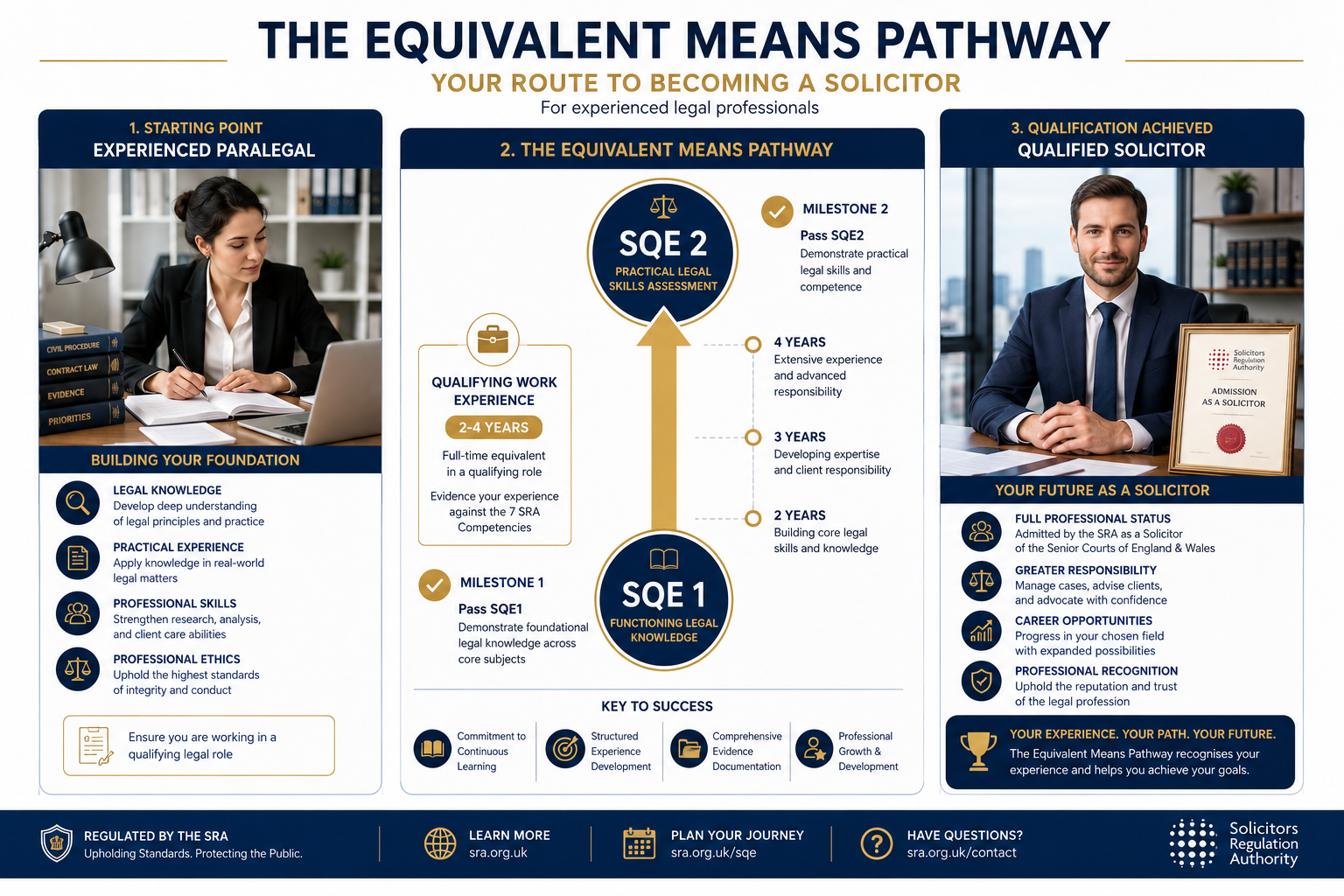
The Equivalent Means route represents a fundamental shift in how the legal profession recognises practical experience. Rather than requiring a formal training contract with a law firm, the SRA now accepts diverse legal work experience that demonstrates the same core competencies.
For paralegals, this changes everything. Your day-to-day work, drafting witness statements, conducting legal research, managing client files, preparing court bundles, can now count directly toward your solicitor qualification. The key is ensuring your experience meets the SRA’s competency framework and is properly documented.
What Counts as Qualifying Work Experience
The SRA defines QWE as work experience that provides you with the opportunity to develop some or all of the competencies needed to be a solicitor. This deliberately broad definition opens doors for paralegals working in various settings.
Qualifying roles typically include:
- Paralegal positions in law firms (any practice area)
- In-house legal assistant or paralegal roles
- Legal advice centre or clinic work
- Court clerk or tribunal support positions
- Compliance or regulatory roles with legal components
- Legal research positions in academic or commercial settings
The critical factor isn’t your job title, it’s whether your work allows you to develop competencies across the SRA’s Statement of Solicitor Competence. These competencies span ethics and professionalism, client relationship management, legal knowledge application, and business skills.
How QWE Differs from Traditional Training Contracts
Traditional training contracts follow a rigid structure: two years, full-time, with a single employer, divided into four six-month seats across different practice areas. This model served the profession for decades but created an artificial scarcity that locked out capable candidates.
QWE operates on entirely different principles. You can accumulate it part-time, meaning a paralegal working three days per week would need approximately three years and four months to complete two years of full-time equivalent experience. You can split it across multiple employers, six months here, a year there, provided each role contributes to your competency development.
Perhaps most significantly, QWE doesn’t require you to experience multiple practice areas. If you’ve spent three years as a litigation paralegal, that experience can form your entire QWE, provided it demonstrates breadth across the competency framework. This recognises that deep expertise in one area often develops transferable skills applicable across legal practice.
For those considering whether to pursue the SQE without a training contract, understanding these differences is essential to making an informed decision about your legal career journey.
The Step-by-Step Paralegal to Solicitor Qualification Process
Transitioning from paralegal to solicitor requires careful planning and systematic execution. The process isn’t linear, you can complete elements simultaneously, but understanding each component helps you build a realistic timeline.
Step One: Assess Your Current Experience
Before investing in SQE preparation, audit your existing paralegal experience against the SRA competency framework. This framework divides into four main areas, each containing specific competencies you must demonstrate.
The four competency areas are:
- Ethics, professionalism and judgment, Acting honestly, with integrity, and maintaining client confidentiality
- Technical legal practice, Applying legal knowledge, conducting research, and drafting legal documents
- Working with other people, Communicating effectively, negotiating, and managing client relationships
- Managing themselves and their own work, Planning work, managing time, and maintaining professional development
Review your current and previous paralegal roles. Which competencies have you developed? Where are the gaps? A litigation paralegal might have strong drafting and research skills but limited client interviewing experience. A conveyancing paralegal might excel at transaction management but lack advocacy exposure.
This assessment determines whether you can begin accumulating QWE immediately or need to seek additional experience in specific areas. Many paralegals discover they’re closer to qualification than they realised.
Step Two: Register with the SRA
Once you’ve decided to pursue qualification, register with the SRA through their mySRA portal. This creates your official record and allows you to begin logging QWE. Registration is free and can be completed before you start SQE preparation.
During registration, you’ll provide basic personal information and educational background. The SRA doesn’t require you to have a law degree, becoming a solicitor without a law degree is entirely possible through this route, though you’ll need to ensure your SQE preparation covers foundational legal knowledge.
Step Three: Prepare for and Pass SQE1
SQE1 tests functioning legal knowledge across two assessments (FLK1 and FLK2), comprising 180 multiple-choice questions in total. The exam covers core areas including business law, property practice, wills and estates, dispute resolution, criminal practice, and professional conduct.
Most paralegal candidates choose to prepare for the SQE without a traditional course, using self-study materials and practice questions instead. This approach typically costs £2,000-£4,000 compared to £8,000-£15,000 for full preparation courses.
Realistic preparation timelines:
- Full-time study: 3-4 months
- Part-time study (20 hours/week): 6-8 months
- Part-time study (10 hours/week): 10-12 months
As a working paralegal, you already possess significant legal knowledge. Focus your preparation on areas outside your daily practice and on mastering the multiple-choice question format, which differs from practical legal work.
The current SQE1 pass rate hovers around 53-58% depending on the sitting, making thorough preparation essential. Budget approximately £3,980 for the SQE1 exam fees (current guidance, subject to change), plus preparation materials.
Step Four: Complete Qualifying Work Experience
While preparing for or after passing SQE1, you’ll accumulate your two years of QWE. As a paralegal, you’re likely already doing this. The key is ensuring your experience is properly documented and confirmed.
Each QWE period requires a confirming solicitor or Compliance Officer for Legal Practice (COLP) to verify that your work provided opportunities to develop the required competencies. This person doesn’t need to supervise you daily, they simply need sufficient knowledge of your work to confirm its qualifying nature.
Documentation requirements include:
- Start and end dates of each QWE period
- Whether the experience was full-time or part-time (with hours specified)
- Which competencies the experience helped you develop
- Confirmation from an appropriate confirming solicitor
Many paralegals worry their current employer won’t support their qualification journey. In practice, most firms recognise that supporting paralegal development improves retention and creates a pipeline of qualified solicitors who already understand the firm’s systems and clients.
If your employer is unsupportive, you can still accumulate QWE. Consider volunteering at legal advice centres, taking on pro bono work, or seeking paralegal positions at firms with more progressive attitudes toward qualification. For guidance on whether volunteering counts as qualifying work experience, the SRA provides clear criteria.
Step Five: Prepare for and Pass SQE2
SQE2 assesses practical legal skills through 16 stations covering client interviewing, advocacy, case and matter analysis, legal research, legal writing, and legal drafting. Unlike SQE1’s multiple-choice format, SQE2 simulates real legal work.
For paralegals, SQE2 often feels more familiar than SQE1. You’ve likely conducted client meetings, drafted documents, and analysed case files. The exam simply requires you to demonstrate these skills under standardised conditions.
Current guidance indicates the SQE2 pass rate is approximately 80% (January 2026 sitting), significantly higher than SQE1. This reflects that candidates reaching SQE2 have already demonstrated legal knowledge and typically possess practical experience.
SQE2 runs across four assessment windows annually (January, April, July, October). Budget approximately £4,950 for exam fees (current guidance, subject to change). Preparation typically requires 2-3 months of focused practice, particularly on the specific formats used in each assessment station.
Step Six: Apply for Admission
Once you’ve passed both SQE1 and SQE2 and completed two years of QWE, you can apply for admission to the roll of solicitors. This final step involves submitting your application through the SRA portal, providing evidence of your qualifications, and undergoing a character and suitability assessment.
The character and suitability assessment examines whether you meet the professional standards expected of solicitors. The SRA considers factors including criminal convictions, financial issues, and professional conduct. Most paralegal candidates pass this assessment without difficulty, as their existing legal work demonstrates professional standards.
Admission typically takes 4-8 weeks from application submission. Once admitted, you’re a fully qualified solicitor with the same professional status as those who qualified through traditional training contracts.
Practical Considerations for Working Paralegals
Balancing full-time paralegal work with SQE preparation and QWE accumulation requires strategic planning. Most successful candidates adopt a phased approach rather than attempting everything simultaneously.
Managing Study Alongside Paralegal Work
The majority of paralegals preparing for the SQE continue working full-time throughout the process. This creates financial stability but demands disciplined time management.
Effective strategies include:
- Morning study sessions: Dedicate 6:00-8:00 AM to SQE preparation before work, when mental energy is highest
- Lunch break reviews: Use 20-30 minutes daily for quick revision or practice questions
- Weekend intensive blocks: Reserve Saturday or Sunday mornings for longer study sessions covering complex topics
- Annual leave strategically: Book leave in the weeks before SQE sittings for final intensive preparation
Many paralegals find their daily work reinforces SQE preparation. Researching a property matter for a client? That’s also SQE1 property practice revision. Drafting a witness statement? That’s SQE2 legal writing practice. Recognise these overlaps and use them to reduce separate study time.
Financial Planning for the SQE Route
The total cost of qualifying via the Equivalent Means route typically ranges from £12,000 to £20,000, depending on your preparation approach. This compares favourably to traditional routes, which often exceed £25,000-£30,000.
Typical cost breakdown:
| Expense Category | Cost Range |
|---|---|
| SQE1 exam fees | £3,980 |
| SQE2 exam fees | £4,950 |
| Preparation materials (self-study) | £2,000-£4,000 |
| Preparation course (if chosen) | £8,000-£15,000 |
| SRA registration and admission | £200-£300 |
| Total (self-study route) | £11,130-£13,230 |
| Total (with prep course) | £17,130-£24,230 |
As a working paralegal, you can spread these costs across 2-3 years while maintaining your salary. Many candidates save a portion of their monthly income specifically for SQE expenses, avoiding the need for career development loans.
Some employers offer SQE sponsorship or reimbursement, particularly if you commit to remaining with the firm post-qualification. Even partial sponsorship, covering exam fees or preparation materials, significantly reduces your financial burden. For more details on employer support, explore whether law firms pay for the SQE.
Addressing Common Paralegal Concerns
“Will my paralegal experience actually count as QWE?”
If your role involves applying legal knowledge, working with clients or colleagues, and developing professional judgment, it almost certainly qualifies. The SRA’s definition is deliberately inclusive. Document your experience carefully, focusing on competencies developed rather than tasks completed.
“What if I’ve only worked in one practice area?”
Single-practice-area experience can form valid QWE provided it demonstrates breadth across the competency framework. A conveyancing paralegal develops client relationship skills, technical legal knowledge, transaction management, and professional judgment, all required competencies. The SRA doesn’t mandate exposure to multiple practice areas.
“How do I find a confirming solicitor?”
Your current supervisor or the firm’s COLP is the obvious choice. If that’s not possible, any solicitor with sufficient knowledge of your work can confirm QWE. This might include a solicitor you’ve worked with on specific matters, a supervisor from a previous role, or even a solicitor you’ve assisted through pro bono work.
“Can I count paralegal experience from before I decided to qualify?”
Yes. QWE can be retrospective, provided it meets the competency requirements and can be properly confirmed. Many paralegals discover that experience from 2-3 years ago counts toward their qualification, significantly shortening their timeline.
Comparing Routes: Equivalent Means vs Traditional Training Contract
Understanding the practical differences between these routes helps you make informed decisions about your legal career journey.
Flexibility and Control
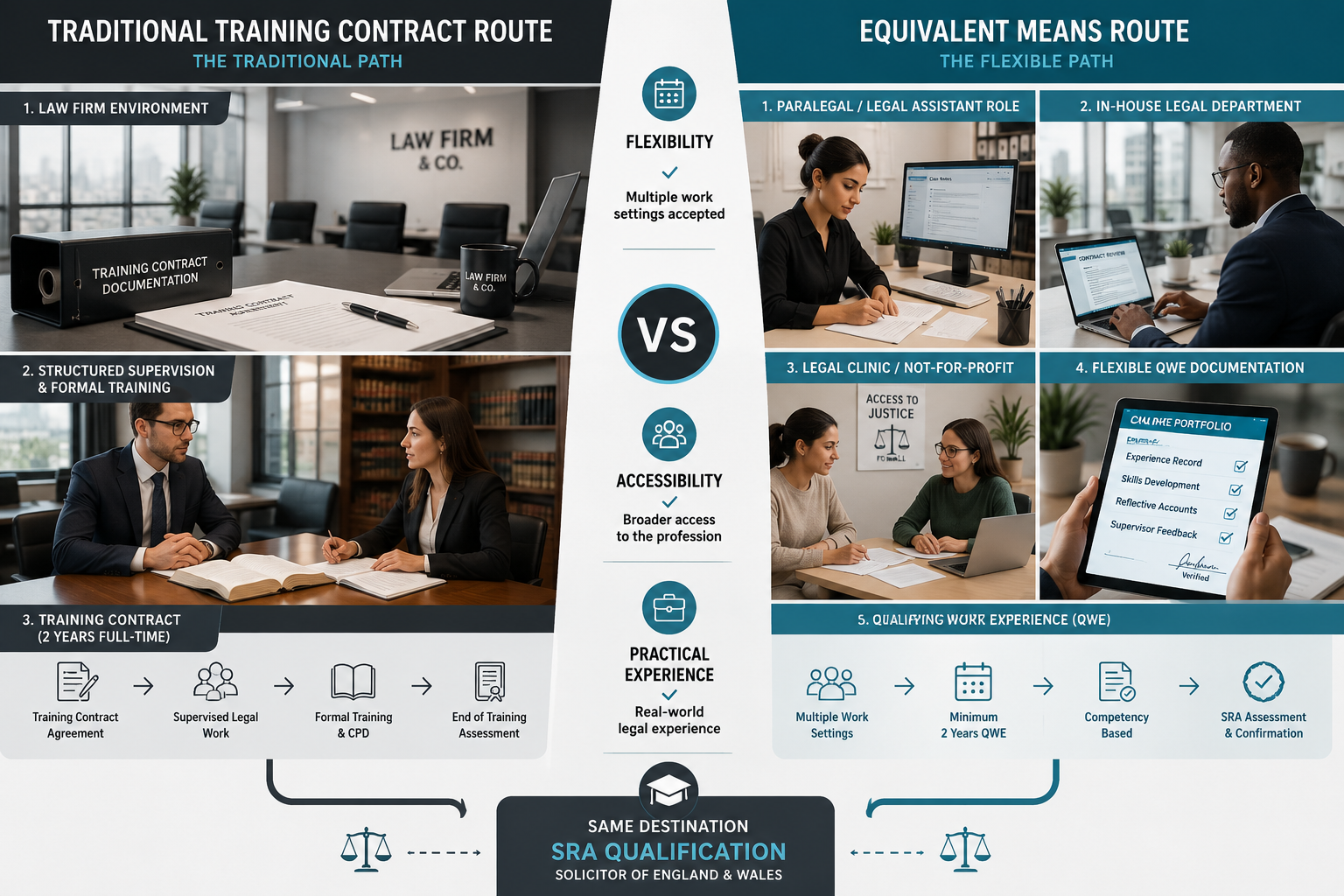
The Equivalent Means route offers significantly more flexibility. You choose when to sit SQE exams, where to gain experience, and how to balance work with preparation. Traditional training contracts impose rigid timelines and seat rotations determined by the firm.
This flexibility particularly benefits paralegals with caring responsibilities, those living outside major legal centres, or candidates who prefer to specialise early rather than rotating through multiple practice areas.
Cost Implications
The financial comparison strongly favours the Equivalent Means route for most paralegals. While training contract candidates often receive salaries of £25,000-£45,000 (London firms pay more), they typically must complete the LPC before securing these positions, incurring £12,000-£18,000 in course fees plus living expenses during study.
Paralegals pursuing Equivalent Means continue earning throughout qualification. Even at modest paralegal salaries of £20,000-£28,000, this represents significant financial advantage over the traditional route’s front-loaded costs.
Career Outcomes
Once qualified, solicitors who used Equivalent Means hold identical professional status to those who completed training contracts. Your practising certificate doesn’t indicate your qualification route. For insights into post-qualification earnings, review how much solicitors earn in the UK.
Some candidates worry that Equivalent Means qualification carries stigma. In 2026, this concern is increasingly outdated. Major firms, including Magic Circle practices, now recruit SQE-qualified solicitors who never held training contracts. The profession recognises that practical paralegal experience often provides better preparation than traditional training contract seat rotations.
Time to Qualification
Traditional training contracts require two years from commencement to qualification, plus pre-contract LPC completion (typically one year full-time). Total timeline: approximately three years from deciding to qualify.
The Equivalent Means route timeline varies based on your existing experience and study approach:
- Paralegal with 2+ years experience: 12-18 months (SQE1 and SQE2 preparation and exams)
- Paralegal with 1 year experience: 24-30 months (additional QWE plus SQE preparation)
- New paralegal: 30-36 months (accumulating QWE while preparing for SQE)
For many paralegals, the Equivalent Means route is actually faster, particularly if you’ve already accumulated qualifying experience before deciding to pursue solicitor status.
Maximising Your Paralegal Experience for QWE
Strategic thinking about your paralegal career can accelerate your qualification journey and strengthen your competency development.
Seeking Diverse Responsibilities
Even within a single practice area, seek opportunities to develop breadth. Volunteer for client meetings, request involvement in advocacy or negotiation, and ask to draft different document types. Each new responsibility potentially demonstrates additional competencies.
If your firm offers secondments, internal transfers, or cross-department projects, pursue them. A three-month secondment to a different team can fill competency gaps without changing employers.
Documenting Your Development
Maintain a detailed log of your paralegal work, noting which competencies each task or project developed. This documentation serves two purposes: it helps your confirming solicitor verify your QWE, and it identifies gaps you need to address.
Effective documentation includes:
- Date and description of the work
- Which competencies it developed (reference the SRA framework specifically)
- Any feedback received from supervising solicitors
- Reflection on what you learned and how it developed your professional judgment
This needn’t be burdensome, a monthly 30-minute review session where you update your log is sufficient. Many paralegals use simple spreadsheets or the SRA’s suggested QWE recording template.
Building Relationships with Confirming Solicitors
Your relationship with potential confirming solicitors matters. These individuals must feel confident verifying your experience. Regular check-ins, seeking feedback, and demonstrating professional development all build this confidence.
If you’re concerned about your current employer’s support, begin building relationships with solicitors outside your firm. Attend local law society events, participate in pro bono projects, or join professional networks. These connections can become alternative confirming solicitors if needed.
Addressing Potential Obstacles
The paralegal to solicitor journey isn’t without challenges. Anticipating and planning for common obstacles increases your likelihood of success.
The Experience Gap Challenge
Some paralegals discover their roles, while legally related, don’t provide sufficient breadth across the competency framework. Administrative-focused paralegal positions might lack client interaction or professional judgment opportunities.
If you identify this gap, consider:
- Requesting expanded responsibilities from your current employer
- Volunteering at legal advice centres or pro bono clinics to gain missing experience
- Seeking a new paralegal role that offers broader exposure
- Taking on freelance legal work that develops specific competencies
The SRA doesn’t require all QWE to come from a single source. Combining a primary paralegal role with supplementary volunteer work is entirely acceptable.
Employer Resistance
Some firms resist supporting paralegal qualification, fearing qualified staff will leave for better opportunities. This short-sighted approach is becoming less common, but it still exists.
If you encounter resistance, consider whether the firm’s culture aligns with your long-term career goals. Firms that don’t support professional development rarely offer fulfilling long-term careers. For perspective on the broader challenges facing legal careers, read about why legal aspirants are rethinking their career plans.
Alternatively, frame your qualification as benefiting the firm. You’ll bring enhanced skills, can take on more complex work, and represent a cost-effective alternative to recruiting externally qualified solicitors.
SQE Exam Pressure
The SQE exams are challenging, and balancing preparation with full-time work creates pressure. Many paralegal candidates experience anxiety about exam performance, particularly if they’ve been out of formal education for several years.
Manage this pressure through:
- Realistic study planning that accounts for work commitments
- Practice questions that familiarise you with exam format and reduce anxiety
- Study groups with other paralegal candidates for mutual support
- Professional support if anxiety becomes overwhelming
Remember that SQE pass rates, while not exceptionally high, reflect that many candidates are adequately prepared. Thorough, consistent preparation over several months yields success for most candidates.
Frequently Asked Questions
Can I start accumulating QWE before passing SQE1?
Yes. You can accumulate QWE before, during, or after your SQE preparation. Many paralegals complete their two years of QWE before even sitting SQE1, then focus entirely on exam preparation. The SRA doesn’t require any specific sequence, you simply need to have completed all requirements (SQE1, SQE2, and QWE) before applying for admission.
Does my paralegal experience need to be in England and Wales?
No. QWE can be gained internationally, provided it meets the SRA competency requirements and can be confirmed by an appropriate person. Many paralegals working for international firms or in overseas offices successfully count this experience. The key is ensuring the work develops competencies relevant to solicitor practice, even if conducted under a different legal system.
How long does QWE confirmation take?
The confirmation process itself is straightforward, your confirming solicitor completes a form verifying your experience, which typically takes 15-30 minutes per QWE period. However, securing their agreement to confirm and providing them with necessary documentation may take several weeks. Start this process early, particularly if you’re requesting confirmation for experience from several years ago.
Can I qualify as a solicitor if I failed SQE1 or SQE2?
Yes. There’s no limit on SQE attempts, though each sitting requires paying exam fees again. Many successful solicitors failed one or both exams on their first attempt. If you don’t pass initially, review your preparation approach, identify weak areas, and consider whether additional study time or different preparation materials might help. The SRA provides detailed feedback after each exam to guide your revision.
What happens if I can’t find a confirming solicitor?
If you genuinely cannot secure a confirming solicitor for legitimate QWE, contact the SRA directly. They can provide guidance on alternative confirmation routes or help you understand whether your experience meets requirements. In rare cases where confirmation is impossible (for example, if your employer has ceased trading and you cannot locate your former supervisor), the SRA may accept alternative evidence of your experience.
Do I need professional indemnity insurance as a paralegal accumulating QWE?
No. Professional indemnity insurance is required once you’re admitted as a solicitor, but not during the QWE accumulation phase. Your employer’s insurance covers your paralegal work. Once qualified, you’ll need to arrange insurance, either through your employer (if you remain employed) or independently (if you practice as a sole practitioner or in certain other arrangements).
Conclusion
The journey from paralegal to solicitor without a training contract is not only possible, it’s increasingly common and, for many candidates, preferable to traditional routes. The Equivalent Means pathway through the SQE recognises that practical legal experience, properly developed and documented, provides excellent preparation for solicitor practice.
As a paralegal, you’ve already begun this journey. Your daily work develops the competencies the SRA requires. Your challenge now is to formalise this development, fill any gaps, and demonstrate your knowledge and skills through the SQE assessments.
Your practical next steps:
- Audit your experience against the SRA competency framework this week
- Register with the SRA through the mySRA portal to begin your official record
- Create a qualification timeline that accounts for your current experience, study capacity, and financial situation
- Begin SQE1 preparation using materials that match your learning style and budget
- Document your ongoing paralegal work systematically to support future QWE confirmation
- Identify your confirming solicitor and discuss your qualification plans with them
The legal profession needs diverse voices and perspectives. Paralegals bring practical experience, client-focused skills, and often a more realistic understanding of legal practice than graduates moving directly from university to training contracts. Your route to qualification may differ from the traditional path, but your destination, admission as a solicitor, is identical.
Thousands of paralegals have already qualified through this route. With clear planning, consistent effort, and confidence in your existing skills, you can join them. Your legal career journey doesn’t require a training contract, it requires commitment, preparation, and trust in the straightforward advice that the SQE route provides a clear pathway to qualification.
For additional guidance on your specific situation, explore our comprehensive resources on pathways to becoming a solicitor and understand your route with trusted guidance designed specifically for aspiring solicitors like you.